Peckshield, a prominent blockchain security firm, has today exposed that there are numerous phishing websites for the Web3 lifestyle app Stepn. Hackers insert a forged MetaMask browser plugin through which they can steal seed phrases from unsuspecting Stepn users, according to Peckshield.
When these cybercriminals obtain the seed phrase, they gain complete control over the Stepn user’s dashboard, where they may connect their stolen wallets to their own or “claim” a giveaway as per Perkshield.
Peckshield has urged Stepn users to contact support as soon as possible if they detect anything suspicious with their accounts. Some customers stated they had encountered issues, reported them to support, and resolved the problem.
I was experiencing Just the same issue but was fixed in minutes soon as I reached out to the support team with the link below, give it a try too mate!https://t.co/l36cJerNm2
However, Stepn has yet to provide any official remarks about it. The phishing notification arrived nearly 20 hours after the Web3 lifestyle app finished its AMA session on Twitter spaces. Peckshield is a popular Twitter account where the cryptocurrency community may learn about hacks or phishing scams.
STEPN is a Solana-based game where gamers buy nonfungible token (NFT) sneakers to begin playing. The app monitors users’ movement through the GPS on their mobile phones and gives them in-game tokens called Green Satoshi Tokens (GSTs). These coins can then be traded for USD Coin (USDC) or Solana (SOL), allowing users to cash out.
Phishing attacks, rug pulls and protocol exploits have become more prevalent in the cryptocurrency industry as decentralized finance (DeFi) and nonfungible tokens (NFTs) have become popular. These types of attacks are not new, but they are continually evolving to take advantage of users in different ways.
Last month, the Ronin bridge on Axie Infinity was attacked and robbed of more than $600 million in Ether (ETH) and USD Coin. As reported by Cointelegraph recently, in a cryptocurrency heist gone wrong, an attacker fumbled their getaway at the finish line, leaving behind over $1 million in stolen crypto. Earlier this year, $80 million in crypto was stolen from Qubit Finance when hackers duped the protocol into thinking they had put down collateral, allowing them to mint a bridged currency asset.
The difference between the LP tokens’ value and the underlying tokens’ theoretical value if they hadn’t been paired leads to IL.
Let’s look at a hypothetical situation to see how impermanent/temporary loss occurs. Suppose a liquidity provider with 10 ETH wants to offer liquidity to a 50/50 ETH/USDT pool. They’ll need to deposit 10 ETH and 10,000 USDT in this scenario (assuming 1ETH = 1,000 USDT).
If the pool they commit to has a total asset value of 100,000 USDT (50 ETH and 50,000 USDT), their share will be equivalent to 20% using this simple equation = (20,000 USDT/ 100,000 USDT)*100 = 20%
The percentage of a liquidity provider’s participation in a pool is also substantial because when a liquidity provider commits or deposits their assets to a pool via a smart contract, they will instantly receive the liquidity pool’s tokens. Liquidity providers can withdraw their portion of the pool (in this case, 20%) at any time using these tokens. So, can you lose money with an impermanent loss?
This is where the idea of IL enters the picture. Liquidity providers are susceptible to another layer of risk known as IL because they are entitled to a share of the pool rather than a definite quantity of tokens. As a result, it occurs when the value of your deposited assets changes from when you deposited them.
Please keep in mind that the larger the change, the more IL to which the liquidity provider will be exposed. The loss here refers to the fact that the dollar value of the withdrawal is lower than the dollar value of the deposit.
This loss is impermanent because no loss happens if the cryptocurrencies can return to the price (i.e., the same price when they were deposited on the AMM). And also, liquidity providers receive 100% of the trading fees that offset the risk exposure to impermanent loss.
How to calculate the impermanent loss?
In the example discussed above, the price of 1 ETH was 1,000 USDT at the time of deposit, but let’s say the price doubles and 1 ETH starts trading at 2,000 USDT. Since an algorithm adjusts the pool, it uses a formula to manage assets.
The most basic and widely used is the constant product formula, which is being popularized by Uniswap. In simple terms, the formula states:
Using figures from our example, based on 50 ETH and 50,000 USDT, we get:
50 * 50,000 = 2,500,000.
Similarly, the price of ETH in the pool can be obtained using the formula:
Token liquidity / ETH liquidity = ETH price,
i.e., 50,000 / 50 = 1,000.
Now the new price of 1 ETH= 2,000 USDT. Therefore,
This can be verified using the same constant product formula:
ETH liquidity * token liquidity = 35.355 * 70, 710.6 = 2,500,000 (same value as before). So, now we have values as follows:
If, at this time, the liquidity provider wishes to withdraw their assets from the pool, they will exchange their liquidity provider tokens for the 20% share they own. Then, taking their share from the updated amounts of each asset in the pool, they will get 7 ETH (i.e., 20% of 35 ETH) and 14,142 USDT (i.e., 20% of 70,710 USDT).
Now, the total value of assets withdrawn equals: (7 ETH * 2,000 USDT) 14,142 USDT = 28,142 USDT. If these assets could have been non-deposited to a liquidity pool, the owner would have earned 30,000 USDT [(10 ETH * 2,000 USDT) 10,000 USD].
This difference that can occur because of the way AMMs manage asset ratios is called an impermanent loss. In our impermanent loss examples:
If you’re into cryptocurrency or blockchain, there’s a good chance I don’t have to spell out the benefits of decentralization. You’re a first-generation user of a technology that will increasingly define the future of the internet, and you have front-row seats to the world premiere of Web3.
The internet’s use and control were always as centralized as we see now. In the early days, under the stewardship of the United States Department of Defense, the network needed not to rely on one core computer. What if a terrorist attack or missile strike took down the principal node? Individual network parts had to communicate without relying on a single computer to reduce vulnerability.
Later, the unincorporated Internet Engineering Task Force, which facilitated the development of all internet protocols, worked ceaselessly to prevent private companies or particular countries from controlling the network.
Today, centralized app nodes are controlled and operated by the planet’s richest organizations, collecting and storing billions of people’s data. Private companies control the user experience on apps and can incentivize and manipulate behavior. From a reliability standpoint, billions lose their primary means of communication when centralized nodes go down — as in recent incidents with Facebook, Instagram, WhatsApp and Messenger in October 2021.
We have also seen how little the tech behemoths think of our privacy when dollar signs appear in their eyes: They harvest and sell our data on an industrial scale. After 10-plus years of using people as advertisers’ products, Mark Zuckerberg has brazenly co-opted the metaverse. Google and Apple, meanwhile, continue their incessant mission to enter every corner of our lives.
We also know what happens when authoritarian governments come knocking on the doors of these centralized mega-warehouses of data, fed by our devices that function as a surveillance army. We’ve seen in Ukraine the awful, large-scale violence that can be excused or hidden when media and military power comes under authoritarian control. In some countries, the state has unprecedented access to every aspect of citizens’ behavior, monitoring everything from internet search history to minor social infractions. Systems that would horrify even George Orwell are only possible because of centralization.
Even in Silicon Valley, ensconced within Western notions of freedom and individuals’ rights, tech empires rarely choose a principled stance over a large, lucrative market. When centralized powers such as Moscow, Beijing or Istanbul ask for censorship and control, they usually get it. Fundamentally, we cannot trust the tech giants with the innermost details of our lives; the centralization of control over the internet is undermining or forestalling democracy everywhere.
Taking our power back
We should not be surprised that tech behemoths have become the natural enemies of decentralization: Centralization is a natural instinct for those in control. Until the advent of the internet and the blockchain, centralization often meant convenience and simplicity. In the Middle Ages, a distributed system of vassal lords meant the monarchy lacked control, and money seeped through the cracks of corruption.
With time and distance no longer problematic in the internet age, Big Tech’s drive toward centralization is less surprising. Can we be astonished by the horrific results of attention-grabbing algorithms, such as attempted genocides or political manipulation based on psychometric analysis of user data? Centralization has consequences.
Distributed ledger technology provides a practical alternative. Social media, messaging, streaming, searching and data-sharing on the blockchain can be fairer, more transparent and accessible, and less centralized. Conversely, this does not mean data has to be less private.
In XX Messenger’s case, which my team and I launched in January, XX Network nodes process anonymous messages worldwide, shredding metadata for recipients and timestamps. With XX, there is privacy and decentralization. Later, this new paradigm of communications and information-sharing makes a significant extension and reinvention of democracy possible.
There are moments in history when two separate events combine to tell a greater truth. In 2008, when Lehman Brothers Holdings Inc. crashed in the wake of the Great Recession, it seemed to be the death knell of centralized financial institutions, despite the economic pain it would herald. Then, little more than a month later, Satoshi Nakamoto published the Bitcoin (BTC) white paper, the revolutionary blueprint for modern peer-to-peer currency. There’s an important connection between these two momentous events, yet the words “Bitcoin,” “blockchain” and “cryptocurrency” draw eye-rolls from those who misunderstand centralization’s issues.
In the autumn of 2008 was the opportunity to begin telling a story: It is up to us — the cryptographers, privacy lovers, traders, developers, activists and converts — to carry the torch of decentralization and democracy. If there was ever a tale that deserved to be told, beginning to end, it is this one.
Join me in telling it.
This article does not contain investment advice or recommendations. Every investment and trading move involves risk, and readers should conduct their own research when making a decision.
The views, thoughts and opinions expressed here are the author’s alone and do not necessarily reflect or represent the views and opinions of Cointelegraph.
David Chaum is one of the earliest blockchain researchers and a world-renowned cryptographer and privacy advocate. Known as “The Godfather of Privacy,” Chaum first proposed a solution for protecting metadata with mix-cascade networks in 1979. In 1982, his dissertation at the University of California, Berkeley became the first known proposal of a blockchain protocol. Chaum developed eCash, the first digital currency, and made numerous contributions to secure voting systems in the 1990s. Today, Chaum is the founder of Elixxir, Praxxis and the XX Network, which combine his decades of research and contributions in cryptography and privacy to deliver state-of-the-art blockchain solutions.
Ethereum is shifting from a proof-of-work (PoW) to a proof-of-stake (PoS) governance mechanism in the foreseeable future, resulting in a faster and more efficient blockchain.
The Ethereum Network has experienced a considerable spike in transactions volume and size since DeFi and NFTs have captured the finance and art worlds. Such traffic has often caused systemic bottlenecks with a significant rise in fees that have made the blockchain unsustainable.
To bring Ethereum into the mainstream and support an increasing number of transactions, the need for a substantial transformation emerged. The upgrade from PoW to PoS will make Ethereum more scalable, efficient and sustainable while securing its fundamental decentralization.
The upgrade will occur only at the backend within a technical framework without affecting how users transact and hold assets across the network. Ethereum’s roadmap envisions the following three phases for the upgrade to complete:
Phase 0, also known as the Beacon Chain
This update is already live, and it brings staking to Ethereum. It lays the groundwork for future upgrades and will coordinate the new system.
The Merge
Mainnet Ethereum, which is the current network, will have to merge with the Beacon Chain at some point, and this is expected to happen in 2022. The merge will enable staking for the entire network and indicate the end of energy-intensive mining.
Shard Chains
Shard chains are expected to be initiated in 2023. However, sharding is a multi-phase upgrade to improve Ethereum’s scalability and capacity. Shard chains enable layer-2 solutions to offer low transaction fees while improving the network’s performance.
Sharding is the process that allows smaller sets of nodes to process transactions in parallel without needing to achieve a consensus across the entire network. Ethereum 2.0 promises to bring transaction speed to as many as 100,000 transactions per second (TPS) through the deployment of shard chains, in contrast with the 30 TPS currently in place.
Ethereum’s transition to PoS has generated a heated debate within the crypto community. While some of the resulting benefits are clear including scalability and sustainability due to a more energy-efficient system, many fear decentralization could be at risk due to its implementation.
The PoS validation process may trip over large holding validators who can have excessive influence on transaction verification, thereby impacting the true nature of decentralization. Detractors of the transition also see sharding as a threat to the network’s security. Because fewer validators will be needed to secure the multiple and small shard chains, there is a higher risk that they could be more exposed to malicious actors.
How will Ethereum 2.0 impact Ether’s intrinsic value?
Many crypto experts believe 2022 will be a make-or-break year for the price of Ether. The digital currency experienced an extraordinary rise since its launch in 2015, going from a mere $0.30 to a high of $4,800 in 2021, including highly volatile motions along the way.
Will Ether keep up with its massive growth through the shift to ETH 2.0? While it’s impossible to predict the price of any asset based on technical or fundamental analysis, crypto investors unanimously believe that ETH 2.0 will impact the intrinsic value of Ether, and a lot will depend on the smooth implementation of the upgrade.
As with any significant transformation, the initial deployment of ETH 2.0 might be a direct cause of volatility. Until the upgrade is thoroughly tested, approved and effective across the network, experts predict months of uncertainty which will inevitably affect the price of ETH.
In the long term, the transition to a more sustainable and efficient PoS will benefit Ethereum’s adoption for users and companies building on the platform. However, the way and timing this will all pan out is a cause of hesitancy among investors showing signs of caution with their allocation until there’s a more accurate outlook.
A lot will depend on the resulting upgrade success in demand and functionality and if the renewed platform will be able to keep its leading position among all other innovative network competitors.
The United Nations Climate Change Conference, known as COP26, in Glasgow, Scotland catalyzed a commitment to carbon neutrality, achieving net-zero carbon emissions, requiring reducing emissions as much as possible, and balancing the remaining emissions with the purchase of carbon credits.
A carbon credit reduces, avoids or removes carbon emissions in one place to compensate for unavoidable emissions somewhere else through certified green-energy projects. Carbon credits represent one ton in carbon emission reduction. They are 1) Avoidance or reduction projects — e.g., renewable energy (wind, solar, hydro, biogas) — and 2) Removal or sequestration — e.g., reforestation and direct carbon capture, which are aimed at the voluntary carbon market (VCM). Carbon credits can be resold multiple times until it has been retired by the end-user who wants to claim the offset’s impact. Carbon credits can also have co-benefits, such as job creation, water conservation, flood prevention and preservation of biodiversity.
Carbon registries store the carbon credits issued by third-party independent and internationally certified auditors or verifiers, in accordance with independent standards. Serial-numbered credits are issued by the verifiers, and the offset reduction claim gets converted to carbon credits that can be traded or retired. Carbon markets turn CO2 emissions into a commodity or tradable environmental asset by giving it a price.
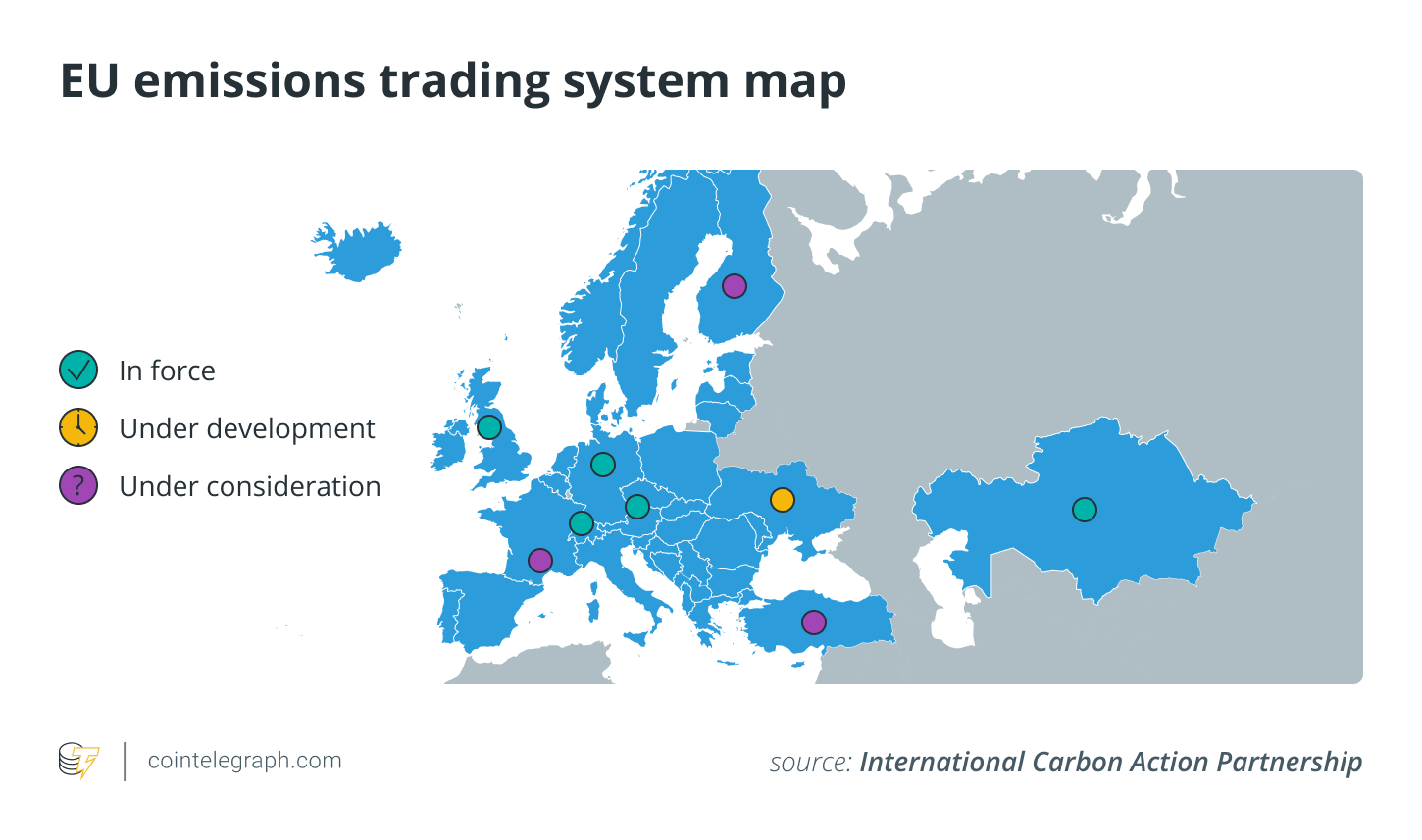
In the compliance market, carbon allowances are traded. There are currently 64 compliance markets in the world, and pricing is determined by the emitters and polluters. The European Union carbon market or Emissions Trading System (ETS), is the largest carbon market, with a 90% share in the global trade. Entry into the EU ETS is restricted to large polluters only and their brokers that are regulated by the operators of the program. The supply of credits is also controlled to manage the pricing. Only the carbon prices traded in the EU ETS reflect the true cost to pollute carbon, but access to the market is not equitable.
Small companies and individuals can only access the voluntary carbon market, where they buy credits at their own discretion to offset emissions from a specific activity. Voluntary credits usually cannot be traded under the compliance market regime. Voluntary carbon markets are expected to grow 15-fold by 2030 to respond to increased private sector demand for climate solutions, according to the “Taskforce for Scaling the Voluntary Carbon Market Final Report January 2021.” A significant problem with VCMs is that carbon credit prices have been low. The low costs of voluntary credits at $2–$3 per credit neither motivate nor incentivize project developers and do little to capture the true cost of climate pollution as compared to the compliance markets.
An excellent article for understanding VCM is “The Good Is Never Perfect: Why the Current Flaws of Voluntary Carbon Markets Are Services, Not Barriers to Successful Climate Change Action.” In this article, Oliver Miltenberger, Christophe Jospe and James Pittman highlight key issues around the design, function and the scale-up of VCMs.
Greenwashing. This happens when companies with false energy efficiencies claim to be more environmentally friendly than they really are, and thus high rates of ineffective credits are used to offset corporate emissions.
Carbon accounting. The number of claims for offsetting emissions is unrealistic, given ecosystem constraints. Net-zero ambitions should have disclosure requirements and be audited. Double-counting can happen intentionally but also occurs due to a lack of complete accounting protocols and a lack of alignment between market jurisdictions or operators.
Market failures and inefficiencies. One major critique emphasizes the risk to unfairly burden product and service markets with compliance costs, and there are few incentives for businesses that voluntarily take action to mitigate an environmental impact.
Monitoring, reporting and verifying. The costs of these activities can constitute the majority of the market value of a carbon credit, reducing the incentive for implementation.
Additionality and baselines. Carbon removal projects utilize inherently subjective baselines.
Permanence. This refers to the assurance that carbon will remain in a stock for an extended period of time, usually 30–100 years. However, there is an opportunity to protect and expand carbon sinks, incentivize low carbon production, and increase the flow of carbon from the atmosphere to short-term and durable stock, even in cases with shorter-term permanence.
Stakeholder inclusion and inequity. Projects can disenfranchise local livelihoods. In some early REDD + projects, the financialized carbon benefits resulted in local communities having restricted access to their traditional land and livelihoods.
These can help with: standardized accounting protocols for interoperability across accounting scales and systems; greater transparency from VCM operators and credit purchasers; standalone certifications on rights and ownership of credits; improved traceability. Traceability, liquidity and smart contracts allow carbon credits to be used in innovative ways, creating additional demand in the overall VCM.
When combined with remotely sensed data via satellite imagery, drones, laser-detecting devices and Internet-of-Things devices with machine learning and artificial intelligence, analytics can decrease development costs and increase rigor in measurement. Southpole pointed out:
“Blockchain technology has enormous potential for climate action. This is only the case, however, when the right safeguards are in place to ensure environmental integrity. Web3 applications can be part of the climate solution, but they have to be designed and applied in the right way.”
While the potential exists, we need action to rectify the problems in VCM, including:
Strengthening the incentives for decarbonization
Pricing carbon is urgently needed with improved price transparency
Reducing the cost of carbon credit creation
Reducing transaction costs and providing additional liquidity
Making the prices in the spot and futures market higher and more reliable
Building carbon credits as a viable asset class by providing predictable returns on investment and including value protection for buyers and sellers
Creating safeguards to protect reputation and legal processes for disputes settlement
Clarity on taxation exemption of carbon credits, moving from “polluter pays” to “polluter invests” and full price discovery goes to the green owners on the ground taking direct climate action on their behalf.
Kishore Butani of the Universal Carbon Registry in India pointed out, “Merely taking carbon credits on-chain does nothing for price discovery. It’s worse when the broker and middleman buy cheap and create tokens as we’re seeing currently, totally cutting off the project owner in the ground. What’s needed is not an NFT [nonfungible token] from the buy-side of the carbon market, but integration directly with carbon repositories that help rural developers and green project owners create the carbon NFTs.” He also added:
“Can we learn from Bitcoin and price all mining years equally and make the entry into the VCM affordable to the rural poor in developing countries and stop diverting carbon finance to projects in Annex 1 countries? These countries are obligated to go green, my India isn’t.”
VCM are an essential means to catalyze action but need major improvements to fulfill that role.
This article does not contain investment advice or recommendations. Every investment and trading move involves risk, and readers should conduct their own research when making a decision.
The views, thoughts and opinions expressed here are the author’s alone and do not necessarily reflect or represent the views and opinions of Cointelegraph.
Jane Thomason is the chairperson of Kasei Holdings, an investment company specializing in the digital asset ecosystem. She holds a Ph.D. from the University of Queensland and has had multiple roles with the British Blockchain & Frontier Technologies Association, the Kerala Blockchain Academy, the Africa Blockchain Center, the UCL Centre for Blockchain Technologies, Frontiers in Blockchain, and Fintech Diversity Radar. She has written multiple books and articles on blockchain technology. She has been featured in Crypto Curry Club’s 101 Women in Blockchain, the Decade of Women Collaboratory’s Top 10 Digital Frontier Women, Lattice80’s Top 100 Fintech for SDG Influencers, and Thinkers360’s Top 50 Global Thought Leaders and Influencers on Blockchain.
The cryptocurrency market is known for its high volatility and the wild-west nature of the space is, in part, due to many of the assets having small market caps and the 24/7 operational hours of centralized and decentralized exchanges (DEXs).
In addition to being high risk, crypto trading can also be a very time-intensive process. It can be an overwhelming task and a barrier to entry for most investors in determining which tokens to invest in.
For these investors, index investing could be a profitable alternative for gaining exposure to some of the hottest sectors of the cryptocurrency market.
Here’s a look at how crypto index products compare to individual tokens and which strategies have produced the biggest return.
Index Cooperative
Index Cooperative (INDEX) is a decentralized autonomous asset manager that allows investors to create a custom index of tokens using smart contracts.
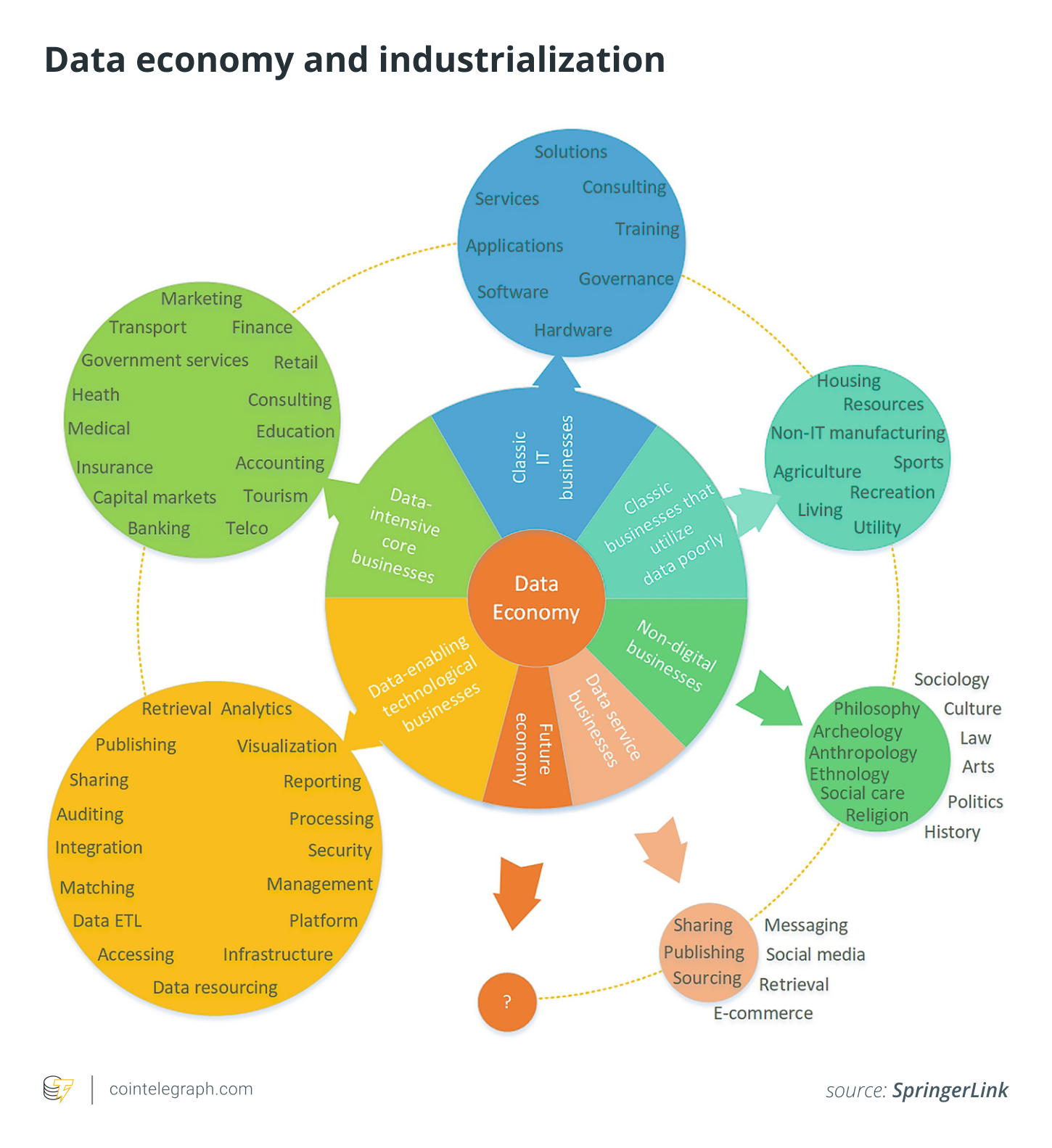
Several of the most actively traded indexes originated from Index Coop, including the DeFi Pulse Index (DPI), Metaverse Index (MVI), Data Economy Index (DATA) and Bankless DeFi Innovation Index (GMI).
Plotting the price of these indexes against the total market capitalization of the cryptocurrency market can help provide insight into how each one performed compared to the market as a whole.
DPI/USDT vs. MVI/ETH vs. Total crypto market capitalization. Source: TradingView
Since May 29, 2021, which is when data first became available for DPI and MVI on TradingView, the weakness of the decentralized finance (DeFi) sector can be seen in the poor performance of DPI, which is currently down more than 50% while the total market cap has risen 19.82%.
During that same period of time, the Metaverse index has increased 103% when compared to the price of Ether (ETH), and the gains are even greater when looking at its value in terms of USD.
MVI/USD 1-day chart. Source: CoinGecko
As seen on the chart above, the price of MVI has increased from $42.02 on May 29 to its current value of $118.06, reflecting a gain of 180% compared to the 20% rise in the total market cap.
Metaverse and nonfungible token (NFT)-related projects have been a bright spot in an otherwise weak market over the past six months and in this instance, it was beneficial to be invested in a basket of metaverse tokens.
Tokens in the Metaverse Index. Source: Index Cooperative
The Data Economy Index and Bankless DeFi Innovation Index have both posted losses since launching. This mirrors the performance of the wider crypto market, which has been in a downtrend since peaking in early November 2022.
NFT Index
NFTs have been one of the hottest sectors of the past year, but finding the next big crowd-pleaser is a monumental challenge because dozens of new NFT projects launch on a daily basis.
An alternative for gaining exposure is the NFT Index (NFTI), a basket that contains 11 different tokens including Polygon (MATIC), ApeCoin (APE), The Sandbox (SAND) and Decentraland (MANA).
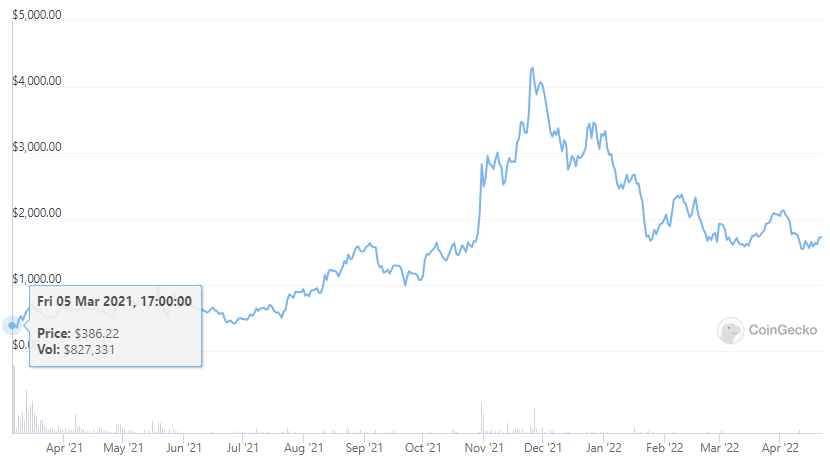
NFTI/USD 1-day chart. Source: CoinGecko
The price of NFTI has increased from $386 on March 5, 2021, to its current price of $1,724, a gain of nearly 350%. During that same period of time, the total crypto market capitalization rose by 30%, providing evidence of the strength the NFT market has seen over the past 13 months.
eToro baskets
For those looking for exposure to crypto baskets in a more regulated environment, eToro, a multi-asset brokerage firm, provides access to several “smart portfolio” options that have performed well over the past year.
Top 2 smart portfolios. Source: eToro
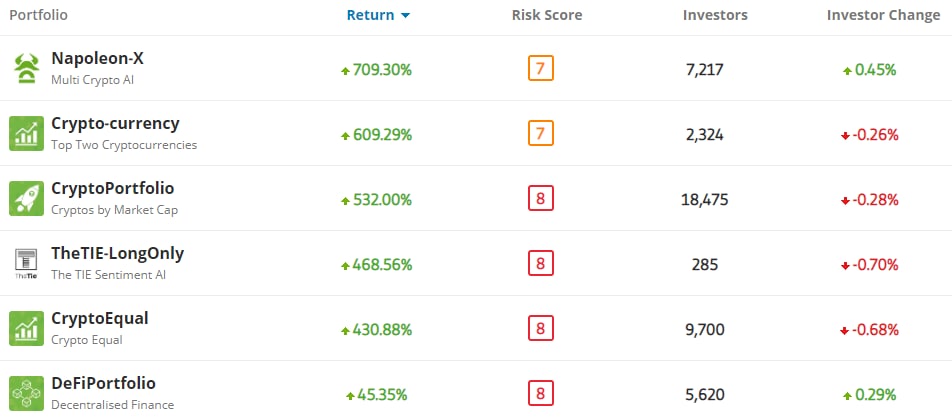
The Napoleon-X smart portfolio is a basket comprising some of the more established projects in the crypto market, including Bitcoin (BTC), Ether, BNB, Litecoin (LTC) and Cardano (ADA). The DeFiPortfolio contains a large allocation of Ether along with smaller allocations to other projects that are involved in the DeFi sector including Polygon and Algorand.
As shown in the graphic above, these portfolios have provided returns of 48.6% and 45.3% over the past year while the total crypto market cap has actually declined 5.71% during the same time period.
On a two-year time scale, several of the eToro portfolios have offered returns in excess of 430% including Napoleon-X, which has experienced an increase of 709.3%. During that same time period, the total crypto market cap has increased 808%, while the price of BTC has increased by 472%.
Top portfolios over the past 2years. Source: eToro.
This suggests that indexes offer the opportunity to capture a large percentage of the overall gains in the market while offering a better return. In many instances, this is a better tactic than trying to pick individual tokens that will see the biggest gains.
The results for DeFiPortfolio also highlight the importance of taking profits when big gains are made because they have a tendency to slip away as traders rotate or whipsaw price movements occur.
Want more information about trading and investing in crypto markets?
The views and opinions expressed here are solely those of the author and do not necessarily reflect the views of Cointelegraph.com. Every investment and trading move involves risk, you should conduct your own research when making a decision.
Blockchain security firm CertiK has raised $60 million in funding from SoftBank Vision Fund II and Tiger Global, further cementing its unicorn status after raising a combined $290 million over nine months.
The raise comes at a time when the blockchain community is leading growth around Web3 application development and creating new use cases for virtual ecosystems, especially in gaming, nonfungible tokens (NFTs) and decentralized finance (DeFi). “When development moves at breakneck speed, mistakes happen,” CertiK’s VP of marketing Monier Jalal explained to Cointelegraph in a written statement. He continued:
“With current Web3 development, security most often is an afterthought — and this is the danger. Early-stage maturity around new infrastructure, e.g., cross-chain bridges or DeFi lending schemes, e.g. flash loans, are targets for hackers.”
Jalal said the “financial nature” of digital assets and DeFi protocols make their rewards much greater than anything we’ve seen in the Web2 era. “The magnitude of impact coupled with increasing trends around Web3 development and resulting hacks is what’s driving the demand for Web3 security,” he said.
Venture funds have placed a strong emphasis on blockchain security services. Earlier this month, CertiK raised $88 million in Series B3 funding, doubling its valuation to $2 billion, in a raise that was led by Insight Partners, Tiger Global and Advent International. In December 2021, the company raised $80 million in a Sequoia-led funding round.
Security vulnerabilities make for routine headlines in the crypto industry. In January, research from bug bounty service ImmuneFi revealed that DeFi hacks drained over $10.2 billion worth of funds in 2021 alone. Earlier this month, Axie Infinity’s Ronin bridge was hacked for over $600 million after the attackers were able to gain access to the private keys of validator nodes.
The largest iGaming token by market cap rolls out XFUN token, XFUN Wallet, and XFUN Casino to bring decentralized, non-custodial gaming to the mainstream.
GIBRALTAR, April 12, 2022 – FUNToken, the largest iGaming token by market cap, has successfully launched its high speed, low latency, and gas-free counterpart on the Polygon network – XFUN.
With XFUN, FUNToken has fulfilled the first quarter of its 2022 roadmap revealed in January. The rollout comprises the token pegged 1:1 with FUN, the non-custodial XFUN Wallet available on both iOS and Android, the embedded FUN/XFUN bridge that enables swapping, and the decentralized XFUN Casino.
In an industry where player funds are traditionally held and managed by the operator on the basis of trust, FUNToken brings autonomy and control to the player experience using decentralization.
Deploying XFUN on the Polygon network helps FUNToken avoid the high gas fees and scalability issues of the Ethereum network it is based on. Furthermore, moving the entire ecosystem on-chain allows users to play straight from the wallet and retain control of their funds.
The FUN/XFUN swapping system introduces new tokenomics – every FUN swapped for XFUN is escrowed from the Ethereum mainnet, effectively taking them out of circulation and creating a dual asset deflationary ecosystem.
XFUN is also available for use at the in-house dPlay Casino and powers the XFUN Casino, a full-fledged decentralized iGaming platform that seeks to disrupt the industry’s status quo.
“I’m pumped to be delivering the XFUN ecosystem as per our roadmap. Providing the ability to dip into disparate operators in the conventional way and in the Metaverse is what our 300k+ and growing community is looking for. Removing gas with the XFUN Wallet is key to this,” said Adriaan Brink, CEO of FUNToken.
“We are thrilled to support FUNToken, the largest iGaming community. By leveraging Polygon technology, they will be able to scale up and deliver a smooth on-chain gaming experience to players now and in the future”, commented Steven Haynes Bryson – VP Head of Business Development at Polygon Studios.
“Bringing their users to Polygon will help to further position Polygon and Polygon Studios as the leading platform for blockchain gaming. We support their vision of a decentralized, player-centric Web3 Gaming category”, concluded Steven Haynes Bryson.
About FUNToken:
With over 300,000 users and counting, FUNToken is the leading iGaming token in the world. Based on the Ethereum blockchain, it was created as a fast, transparent, and truly fair transactional solution for iGaming ecosystems and players alike.
Supported by a robubst development team and helmed by CEO Adriaan Brink, FUNToken’s objective is simple: harnessing the power of blockchain tech to create trustless ecosystems that users can rely on and operators can implement seamlessly.
Polygonis the leading platform for Ethereum scaling and infrastructure development.Its growing suite of products offers developers easy access to all major scaling and infrastructure solutions: L2 solutions (ZK Rollups and Optimistic Rollups), sidechains, hybrid solutions, stand-alone and enterprise chains, data availability solutions, and more. Polygon’s scaling solutions have seen widespread adoption with 7000+ applications hosted, 1B+ total transactions processed, ~100M+ unique user addresses, and $5B+ in assets secured.
If you’re an Ethereum developer, you’re already a Polygon developer! Leverage Polygon’s fast and secure transactions for your dApp, get started here.
Polygon Studios is the Gaming and NFT arm of Polygon focused on growing the global Blockchain Gaming and NFT Industry and bridging the gap between Web 2 and Web 3 gaming through investment, marketing and developer support. The Polygon Studios ecosystem comprises highly loved games and NFT projects like OpenSea, Upshot, Aavegotchi, Zed Run, Skyweaver by Horizon Games, Decentraland, Megacryptopolis, Neon District, Cometh, and Decentral Games. If you’re a game developer, builder or NFT creator looking to join the Polygon Studios ecosystem, get started here.
Bitcoin (BTC) price flashed bullish for a brief moment, possibly tricking some traders into opening longs, before plunging back below $40,000 in evening trading hours. Let’s take a quick look at what traders think about the current price action and whether or not today’s brief break out was nothing more than test of overhead resistance.
BTC/USDT 1-day chart. Source: TradingView
Resistance remains at key moving averages
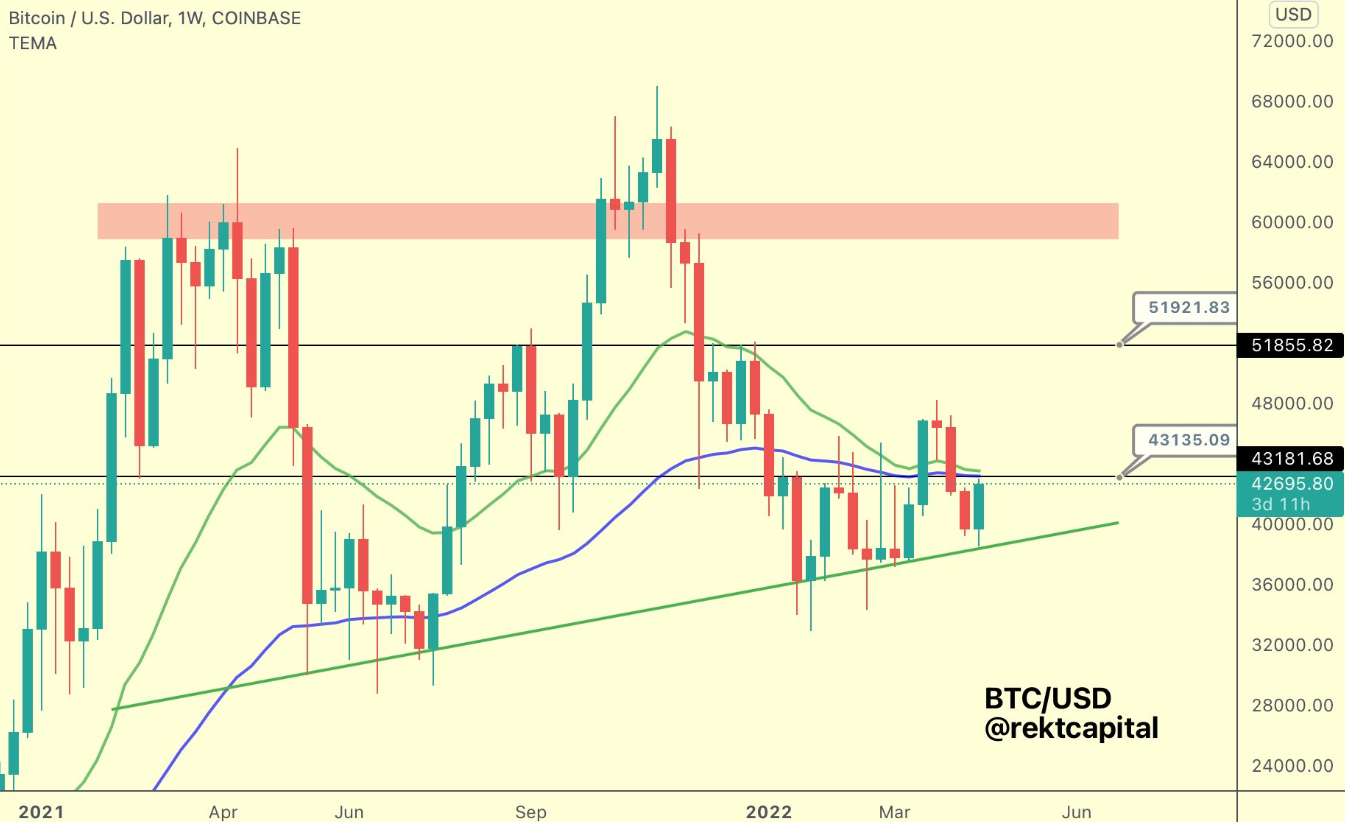
Analysis of Bitcoin’s weekly price action was discussed by crypto trader and pseudonymous Twitter user ‘Rekt Capital’, who posted the following weekly chart noting that “Bitcoin is now hovering below the green 21-week and blue 50-week bull market exponential moving averages (EMA).”
BTC/USD 1-week chart. Source: Twitter
Rekt Capital said,
“Breaks beyond these EMAs have preceded immense upside. Turn these Bull Market EMAs into support and we’ll see Bull Market momentum resume.”
Bitcoin’s correlation to tech stocks provides insight
Despite all the macro factors affecting global financial markets, Bitcoin remains “stuck in the middle of its $35,000 to $45,000 range according to David Lifchitz, managing partner and chief investment officer at ExoAlpha. Lifchitz noted that BTC has behaved more like a risk asset than an inflation hedge.
Evidence for this can be found by looking at the highly correlated price action for BTC and the Nasdaq over the past few months.
BTC/USD vs. Nasdaq futures. Source: Refinitiv
According to Lifchitz, if Bitcoin’s “correlation with speculative tech stocks remains high,” the planned series of interest rate hikes by the U.S. Federal Reserve will at some point “become toxic to risk assets” which could translate into declines in the price of Bitcoin.
Overall, Lifchitz suggests that for investors who are convinced of its long-term potential, “Bitcoin should be actively traded while it bounced up and down in the range.”
According to independent market analyst Michaël van de Poppe, $42,300 is the crucial level that needs to be overcome.
BTC/USD 4-hour chart. Source: Twitter
Van de Poppe said,
“This is also a daily breaker. If it breaks, I’m assuming a new test of $46,000 is around the corner and possibly $50,000.”
Further evidence that suggests BTC could soon trend higher was provided by analyst and pseudonymous Twitter user ‘Plan C’, who posted the following chart looking at the confluence of several analytical measures for Bitcoin price.
Bitcoin confluence floor model. Source: Twitter
Plan C said,
“The last 4 times the blue & purple lines were below the green line for this long the Bitcoin bottom was already in.”
The overall cryptocurrency market cap now stands at $1.881 trillion and Bitcoin’s dominance rate is 41.2%.
The views and opinions expressed here are solely those of the author and do not necessarily reflect the views of Cointelegraph.com. Every investment and trading move involves risk, you should conduct your own research when making a decision.
Alex Zinder, a capital markets veteran who jumped on the blockchain train last year, attended the Paris Blockchain Week Summit, where he sat down with Cointelegraph to discuss blockchain projects, crypto adoption and the traditional financial world’s necessary embrace of digital assets.
After almost two decades in capital markets technology, Alex Zinder joined Ledger Enterprise in March 2021. He previously worked at Nasdaq, where he worked as the global software development director and associate vice president of enterprise architecture.
Zinder now leads Ledger Enterprise Interact, a suite of solutions that allow businesses to manage interactions in smart contract-enabled protocols that support staking, nonfungible tokens (NFTs) and other decentralized finance (DeFi) possibilities.
“Being on the Nasdaq side of things that was very much more involved in the distributed ledger ecosystem of the DLT platforms and looking at that from a more traditional financial services perspective,” Zinder said, adding: “There was a tremendous amount of interest activity experimentation happening in the space, but not a tremendous amount of adoption from real use cases.”
Zinder was asked whether cryptocurrency must develop even further for it to be considered a viable alternative by the traditional sector. According to him, it’s not a “requirement or a prerequisite” since traditional players are ” smart business companies” and they see opportunities. He stated that what he thinks is happening currently, is that “these opportunities are of sufficient scale” for the traditional players to want to participate.
He pointed out that now” it’s no longer can we kind of play around and really understand the space to make sure we don’t miss it, and now it’s more actually have a financial opportunity here that we can monetize and grow and scale our businesses, which is a very different dynamic.”
Zinder also highlighted three primary factors that align well with Ledger Enterprises’ overall strategy. As per him, the scale of value, the scale of complexity, and the complexity of operations are much greater in the enterprise space. He added that:
“The demand is definitely coming, but I think we’re literally just at the preference of what’s coming because the growth is going to continue exponentially for a significant period of time.”
Zinder addressed corporate crypto adoption and custody solutions by explaining that the issues aren’t technological in nature but rather about processes, organizations and business model innovation because traditional firms must adapt to new models.
For years, government regulation has been a major topic in the crypto space. Zinder summarised his thoughts on enterprise blockchain, cryptocurrency adoption and regulation as follows:
“So regulation is a factor, we’ve been having a lot of conversations with regulators. […] We actually have several customers that are fully regulated entities. So several are well-known custodians, custodians are fully regulated in their regions.”