A study claiming that psychopaths and others with ‘Dark Tetrad’ personality traits are drawn to crypto has been criticized as “meaningless” for showing very weak correlativity by a psychology expert from The University of Otago.
Researchers with backgrounds predominately in marketing and advertising from the Queensland University of Technology (QUT) surveyed 566 people on their attitudes toward crypto and correlated the results with four specific personality traits: narcissism, psychopathy, Machiavellianism, and sadism.
The findings were first shared by The U.S. Sun, and were widely syndicated by the mainstream media, with the New York Post headline screaming “Bitcoin fans are psychopaths who don’t care about anyone,” and Salon asserting that “Impulsive psychopaths like crypto”.
But speaking to Cointelegraph, Professor Martin Sellbom from The University of Otago’s Psychology Department — an international expert on personality disorders and personality assessment — criticized the results of the study as essentially meaningless.
“The effects they report, for example, the strength of relationships between these so-called ‘dark tetrad’ traits and attitude and intention to buy cryptocurrency are very weak, pretty much meaningless, in my opinion.”
The widely used Short Dark Triad (SD-3) personality test which rates the traits of psychopathy, Machiavellianism, and narcissism out of a maximum score of 5 was used to assess participants’ personalities.
The results of the study show that participant’s scores for psychopathy and narcissism were below the average levels as determined by psychometric assessment group OpenPsychometrics. The participants scored 2% below the average for psychopathy and 16.7% below average for narcissism, however the scores for Machievellism were 3.6% higher.
But Professor Sellbom said that in any case this line of research is “uninformative about psychopathy and narcissism,” adding:
“The measurement devices used in this literature do not capture the full manifestations of these disorders.”
The authors expanded on their results in an article for The Conversation, stating that narcissists like crypto “because of their great faith in the future”, and because of a “confidence their own lives will improve”.
Psychopaths were drawn to crypto apparently, because they “fear missing out on investing rewards that others are experiencing,”and Machiavellians like crypto because “they distrust politicians and government agencies.”
Other traits, like positivity, and belief in conspiracy theories were also measured as traits that “might connect the dark tetrad judgements about crypto”.
Of those surveyed only 26% owned cryptocurrency, and of those who didn’t nearly 64% said they would be “interested” in investing.
Sellbom said the methodology to link traits such as FOMO to psychopathy was flawed as collecting a sample of both the level of interest in crypto and psychometric results at the same time, from the same person only once, is “pretty much uninformative”, adding the conclusions the researchers reached “cannot be supported in the simple way that they are presenting.”
“Looking at the same results, my interpretation would be the relationship between dark tetrad traits and attitudes towards and buying intention of cryptocurrency is weak, and it is unlikely that these traits will provide much understanding of those who do engage in purchasing cryptocurrency.”
It should be noted the researchers themselves stated in the report that they aren’t out to propose that Bitcoiners are psychopaths, in the way some media outlets were quick to declare.
“We are not suggesting all crypto buyers exhibit Dark Tetrad traits. Instead, we are studying a subset of people interested in crypto who do have these traits.”
Discussing the limitations of their work, the researchers said that whilst they gauged participant interest in investing in stocks, bonds or crypto, the study could have set a control variable by measuring their intention of engaging in those types of investments.
“Many experts on psychopathy and narcissism question this so-called dark personality literature,” said Professor Sellbom, “because the researchers are not really studying these personality disorders, which are far more complex than what the measures used would suggest.”
The authors of the study are Brett Martin, Professor of Marketing QUT; Dr. Di Wang, Senior Lecturer at the QUT School of Advertising and Marketing; Jun Yao, Senior Lecturer in Marketing Macquarie University; Carolyn Strong, Professor of Marketing and Strategy Cardiff University; and Polymeros Chrysochou, Professor of Marketing Aarhus University.
Given the authors’ background in marketing and advertising, it seems possible they would understand how to frame the results of a study in a way to appeal to the mass media.
In the last few months, the standoff between the Central Bank of Russia (CBR) and the country’s Ministry of Finance over crypto regulation has become the key regulatory plot for the Russian crypto community to follow. Simultaneously, however, another important legislative development has been unfolding somewhat under the radar: negotiations around tax code amendments that would make cryptocurrencies a taxable asset class. Here’s how it went down so far.
13% for individuals and 20% for companies
As the head of the State Duma’s (the lower chamber of Russian Parliament) financial markets committee, Anatoly Aksakov told local media on April 7 that the amendments to the federal tax code regarding crypto are expected to pass by the end of the summer parliamentary session.
The government-backed legislation includes a requirement to report digital asset transactions if their total exceeds 600,000 rubles, or around $8,000, per year and fines of up to 40% of the individual tax sum in case of non-reporting. The bill passed the first reading in February 2021, after which it got stuck in limbo for almost a year for reasons unknown.
Aksakov only mentioned the recent delay in the discussion around crypto tax amendments, pointing out Duma’s emergent task of crafting “anti-crisis policy” that has shelved the crypto regulation for a while.
The amendments awaited their fate as the broader discussion on the crypto regulatory framework between the CBR and the Finance Ministry ensued. While the central bank champions the idea of a direct ban on both crypto trading and mining, the ministry has offered its own vision to regulate rather than outlaw the industry. It seems that the CBR still stands by its restrictive position and the tax amendments won’t make an exception. A CBR spokesperson claimed that “digital assets are being used, among other things, to evade tax payments.”
Still, the estimates of potential federal tax revenue from crypto range from 10-15 billion rubles, or around $122-181 million, to 20 billion rubles, or around $244 million. The proposed tax would be imposed only on income — 13% on individuals’ personal income and 20% on legal entities’. Qualified investors would enjoy a tax deduction in the amount of 52,000 rubles or more per annum. The taxes are unlikely to apply to assets accumulated by 2021 but will hit Russian tax residents’ crypto transactions performed in any jurisdiction.
Starting somewhere
“This is an initiative of the Federal Tax Service, with support from the Ministry of Industry and Trade and a number of officials and former officials from the Ministry of Finance,” said Aleksandr Podobnykh, chief information security officer of digital asset firm Security Intelligence Cryptocurrencies Platform (SICP), explained to Cointelegraph.
Alexander Bychkov is the CEO of global crypto debit card provider Embily and pays his taxes in Singapore. Bychkov said that the proposed tax amendments are part of a bigger picture of the regulatory clash between the CBR and the Ministry of Finance. He believes that the amendments will pass, opening “a lot of doors for developing products” in Russia.
The question remains whether Russian citizens holding digital assets — worth about $130 billion by the government’s own estimates — will be willing to get in line and whether the Federal Tax Service (FTS) will have the technical capacity to collect the taxes. Bychkov is not sure about the latter point but doesn’t see any other choice for the authorities but to start somewhere:
“My opinion is that the Russian system cannot be really ready, but it has no option but to build infrastructure step by step. As a Singapore taxpayer and resident, I can say that the tax legalization of crypto helps Singapore to be one of the most developed market economies, with one of the highest GDP per capita in the world.”
In the shadow of a larger fight
Podobnykh said that collecting crypto taxes is not a huge problem currently. He commented:
“Since December 2021, when filing a tax return, you can choose digital assets and indicate the profit from them. Another problem is the exchange of one crypto asset to another and the calculation of profits. Here, the solution is seen in revenue calculation services, possibly integrated with exchanges and auditable for interested parties.”
As both experts agree, the process of institutionalizing crypto taxation through the amendments to the tax code doesn’t bear any specific significance in the context of the standoff between the CBR and the Ministry of Finance over the fundamental approach to digital asset regulation. This is consistent with recent statements made by the finance minister, Anton Siluanov, who has underscored the secondary importance of the tax collection scheme in relation to a more general regulatory framework.
Given the momentum that the Finance Ministry’s approach to bring crypto into the regulatory perimeter has gained recently among many stakeholders within the Russian government, the passage of the tax amendments by the end of the Spring, as Aksakov had promised, looks like a very realistic timeline.
London, April 18, 2022: Cryptobite, a cryptocurrency, and especially bitcoin-based media organization is changing the way people consume news and information about cryptocurrencies.
Cryptobite has successfully established itself among the most innovative media companies by harnessing the latest technologies to create and distribute cryptocurrency and blockchain-based content to its users.
Starting out as a cryptocurrency news site, Cryptobite has since expanded to cover other cryptocurrencies but primarily focuses on price analysis and reviews.
Cryptobite offers a wide range of articles and news regarding Web3, Bitcoin, DESO, NFTs, MetaVerse, and Cryptocurrency in an effort to keep its users up-to-date on all the latest information on the crypto market.
Aside from posting articles, The Cryptobite also publishes PRs and informative articles providing all information and insights on the market cap, as well as an industry-specific blog section.
Additionally, The Cryptobite calculates a Bitcoin news index that forecasts whether bitcoin’s price will increase or decrease; this is one of its users’ favorite features. Furthermore, they let users write articles on their website, where they collect over 6000 crypto articles per month, providing plenty of information about cryptocurrency trends and the crypto market to their users.
Crypto-focused venture firm Framework Ventures has raised $400 million in new funding to invest in early-stage companies across the Web3, blockchain gaming and decentralized finance (DeFi) industries.
The completed raise will go towards “FVIII,” an oversubscribed fund worth $400 million, the company announced Tuesday. Approximately $200 million of that total will be allocated to the emerging blockchain gaming industry.
The venture firm, which had early exposure to DeFi, now has over $1.4 billion in assets under management. Framework Ventures was an early investor in projects such as Chainlink, Aave and The Graph.
Like DeFi in 2020, gaming and Web3 have been identified as the next major growth plays for the blockchain industry. Axie Infinity — a popular play-to-earn game constructed around collecting digital pet avatars called Axies —has provided a solid use case for this emerging paradigm. According to blockchain analytics platform Nansen, there are currently 2.8 million unique addresses holding 11.1 million Axies.
Web3 and NFTs stole the show at SXSW 2022, while BTC and cryptocurrency enjoyed very little focus. https://t.co/e38F0Hifon
As Cointelegraph reported, Web3 is also fostering the continued growth of the nonfungible token market by giving creators the ability to create NFTs with actual use cases inside virtual ecosystems.
Venture funds and other smart money investors have been keen to back Web3 development companies. On Tuesday, Cointelegraph reported that KuCoin ecosystem companies had launched a $100 million Web3 developer fund focusing on NFT projects. Separately, crypto exchange CoinDCX has raised $135 million to support India-based Web3 projects.
Beyond the blockchain industry, it’s believed that the play-to-earn model could have a significant impact on the future of gaming. Myspace co-founder and former CEO Chris DeWolfe told Cointelgraph that the business model of play-to-earn gives players more control over their in-game experiences.
Crypto exchange KuCoin’s venture capital arm and nonfungible token (NFT) marketplace have launched a $100 million “Creators Fund” to help bootstrap early-stage NFT projects at the intersection of art, sports and GameFi.
KuCoin Ventures and the Windvane NFT marketplace have created the fund to help artists and creators showcase their work and scale their business to wider audiences, the companies announced Tuesday. The fund’s mandate is to support promising NFT projects that are contributing to the development of Web3, which refers to the next iteration of the internet powered by blockchain technology.
Windvane is a new NFT marketplace from KuCoin that aims to tap into the crypto exchange’s large user base. At the time of writing, KuCoin was the fifth largest crypto exchange by volume, according to CoinMarketCap.
The rise of Web3 has given creators a new venue to mint NFTs that have real utility inside virtual worlds. Yet Siu, the co-founder and chairman of venture capital firm Animoca Brands, recently told Cointelegraph that Web3 provides an efficient way for creators to work collaboratively for both name recognition and economic benefit.
‘This is the Mona Lisa of the digital world’, This is what Sina Estavi who bought the NFT in March 2021 told then
Jack Dorsey’s first tweet was converted to a NFT last yr & sold for $2.9 million. Now, it may be resold for less than $14,000. pic.twitter.com/fvDU37lgmV
While the nonfungible token market has slowed recently, as evidenced by the plunging resale value of Jack Dorsey’s genesis tweet NFT, the industry’s builders continue to attract significant interest from venture capital. As Cointelegraph reported, NFT avatar startup Genies recently closed a $150 million Series C funding round at a valuation of $1 billion. In January of this year, NFT-focused holding company Metaversal raised $50 million to expand its investment capacity in the digital collectible and metaverse sectors.
Andre Cronje, former Fantom Foundation technical adviser and Yearn.finance founder, resurfaced on Monday via Medium after announcing his departure from the DeFi and crypto space last month. In a post titled “The rise and fall of crypto culture,” Cronje expressed his lamentations of crypto culture as he called for increased regulation and legislation in the industry.
When Cronje and his colleague Anton Nell tweeted about the fate of all the applications and services they had built, they offered no other details as to their personal motivations. They even proceeded to deactivate their Twitter accounts on March 6. Now, readers of Cronje’s words can surmise that these two partners were going through some sort of ethical crisis. The opening and closing refrain, “Crypto is dead. Long live Crypto,” illustrates his ambivalence of emotions when it comes to the future of crypto.
The top highlight in the post is the phrase: “Crypto culture has strangled crypto ethos.” According to Cronje, he has a “disdain” of crypto culture, but a “love” for crypto ethos. He explained that the culture, which prioritizes “wealth, entitlement, enrichment and ego” has suppressed the principles of “self-sovereign rights, self custody and self empowerment.” He also warned that if the culture continues down its current path, it will become the “badlands,” a place where “unknown wallets lurk in the shadows.”
His proposed solution for this “new age” of the blockchain economy is regulation. Using the analogy of a parent trying to protect his or her child, Cronje believes that legislation is the best way to stop the crypto community from sticking its fingers into an electric outlet. “One day they will understand, but not today,” he said.
Cronje concluded his post with a more optimistic tone where he expressed his excitement for a future “driven by trust, not trustlessness” nor greed. He mentioned he has “come full circle,” which likely indicates his return to the space. According to Cronje’s LinkedIn profile, he currently operates SegWit Holdings, an investment banking platform.
Reactions to Cronje on Twitter, however, were not very supportive. Users like “@IAMLLUCIANA” and “0xCana” point out the irony in Cronje’s actions as someone who made his wealth from cryptocurrency and supposedly had turned his back on it.
andre cronje with the gigagrift walking away with over *1 billion dollars* generated from crypto and then exits the space, rails against “get rich quick mentalities” and advocates for strict regulations and then founds an investment banking company
Major developer platform Github has reportedly blocked more than a dozen accounts of Russian developer’s associated with organizations sanctioned by the United States government.
The sanctioned accounts include some of the largest banks in Russia: Sberbank and Alfa-Bank, as well as individual developers with links to the sanctioned firms. However, many individual accounts with no links or ties to sanctioned firms were also blocked in the process, Researcher Sergey Bobrov, who reportedly has no links to any such firm, reported that his account was suspended on April 15 and then immediately restored.
My github account is unlocked, thanks everyone. The ban was related to the sanctions imposed on my previous employer.
Another individual developer, Vadim Yanitskiy, wrote:
“My Github account has been suspended without prior notification. Perhaps because I am ethnically Russian. ‘GitHub’s vision is to be the home for all developers, no matter where they reside,’ they said.”
Github is a popular software development platform used for storing, tracking and collaborating on software projects. It enables developers to upload their own code files and to collaborate with fellow developers on open-source projects. It has become a core part of the crypto ecosystem because of its open-source nature.
As per early reports, most of the firms and developers facing suspension belong to private Russian banks and no crypto firm or developer was impacted. Github didn’t respond to Cointelegraph’s request for comment at publishing time.
After a few Russian developers contacted Github regarding the suspension, they received a response, explaining the reasons behind their suspension with an added link through which they could appeal.
Github Reponse to Developers
The blocking of individual developers’ accounts has raised many questions, especially when the open-source platform has promised “ to ensure free open source services are available to all, including developers in Russia,”
NFT wash trading is a problem for investors, the global community, collectors and traders because these participants use less liquid nonfungible tokens to manipulate the price of an asset.
Due diligence has become more difficult as investors have been forced to rely on measurable statistics, making wrong investment decisions. To encourage NFT investments and prevent NFT scams, discrepancies in the data must be investigated by specialists. Additionally, NFT crimes hit the NFT community the hardest. Regulators and proponents of mainstream financial services can now use wash trading to combat decentralization.
Collectors and traders, likewise, are unable to make an informed judgment. When deceptive facts and history mislead people regarding a piece of art or collectible, it is simple for them to make rash decisions. So, with the NFT markets being impacted by wash trading, is there any way to spot it in the first place?
There is no price or volume history associated with new coins when they are introduced to the market. As a result, developers or other insiders may participate in wash trading to deceive participants about the coin’s true worth. Therefore, avoid investing in those kinds of projects.
Moreover, many NFTs have no trading volume or investor interest. As a result, NFT owners can readily participate in wash trading to entice naïve purchasers to buy the NFT at an exorbitant price. Therefore, avoiding newly-issued small-cap cryptos and NFTs is the most significant way to prevent wash trading.
A trader must choose more established cryptocurrencies with a higher volume to avoid becoming a victim of wash trading. The broader the market, the more money scammers will need to manipulate it. For instance, already established cryptos like Bitcoin (BTC) or Ethereum, which are worth hundreds of billions of dollars, make crimes like wash trading incredibly challenging.
Coming every Saturday, Hodler’s Digest will help you track every single important news story that happened this week. The best (and worst) quotes, adoption and regulation highlights, leading coins, predictions and much more — a week on Cointelegraph in one link.
Multinational payments giant Mastercard filed 15 applications for NFT and metaverse trademarks, joining the ranks of competitors Visa and American Express who have taken similar action recently as well.
Notable applications include those for an online marketplace for digital goods, virtual reality events and communities, and Mastercard payment processing in the Metaverse. Furthermore, the firm is aiming to virtually trademark its “Priceless” slogan via tokenized text, audio and video.
Another filing outlines an intention to get Mastercard’s branding and name on sponsorship deals for metaverse-based sporting events, concerts and festivals.
Epic Games, the creators of the wildly popular Fortnite game, raised $2 billion in funding at a valuation of $31.5 billion. The round was led by Sony and The Lego Group’s holding company, Kirkbi.
The funds will go towards scaling Epic Games’ Metaverse plans, with chief executive officer and founder Tim Sweeney stating that the capital will help create “spaces where players can have fun with friends, brands can build creative and immersive experiences and creators can build a community and thrive.”
While there may not be a crypto or NFT link there specifically, Epic Games is also the developer of Unreal Engine, one of the most prominent game engines. The latest iteration, Unreal Engine 5, is able to facilitate the creation of NFT-based play-to-earn (P2E) games, offering a strong signal that the firm is eyeing the sector.
Ripple Labs scored a “very big win” in its long-running dispute with U.S. Securities and Exchange Commission (SEC) this week, according to Ripple community lawyer James K. Filan. While both parties have traded many blows during the legal battle, Ripple appears to be growing confident that its arguments against XRP being a security will hold up in court.
Presiding Judge Sarah Netburn denied the SEC’s request to reconsider shielding important documents under privilege relating to a June 2018 speech made by the SEC’s former Director of the Division of Corporate Finance William Hinman, who stated that Bitcoin and Ether were not securities.
“The SEC seeks to have it both ways, but the Speech was either intended to reflect agency policy or it was not. Having insisted that it reflected Hinman’s personal views, the SEC cannot now reject its own position,” said Judge Netburn.
The Federal Senate of Brazil has announced the drafting of a bill that will enable the regulation of the local cryptocurrency market. The long-debated issue is set to come to an end soon, with the bill due to be sent off for a full senate vote soon.
Two legislators, Senator Irajá Abreu and Federal Deputy Áureo Ribeiro, both rapporteurs of the aforementioned proposals in their respective legislative chambers, are drafting the bill.
“By joining the projects together, we accelerated the approval of this cryptocurrency milestone,” said Senator Abreu. “There is a market demand for a safer business environment and the need for criminal classification to avoid fraud, in addition to adjusting Brazil to international agreements.”
Coinbase reportedly suspended crypto payment services via its Unified Payments Interface (UPI) for Indian users earlier this week. It wasn’t an ideal move for the cryptocurrency exchange, given that it had just launched its services in the nation, but it was said that local regulators were the main reason behind the decision.
The exact reason for the suspension is unclear, though UPI is a payment portal governed by the National Payments Corporation of India (NPCI). On Thursday, the NPCI released a statement saying that it did not recognize the legal standing of any crypto exchanges using UPI. According to local crypto influencer Aditya Singh, Indian exchanges have been facing similar payment service problems since at least 2018.
According to reports from Indian financial publication Business Standard, Coinbase stated that it is “committed to working with NPCI and other relevant authorities to ensure that we are aligned with local expectations and industry norms.”
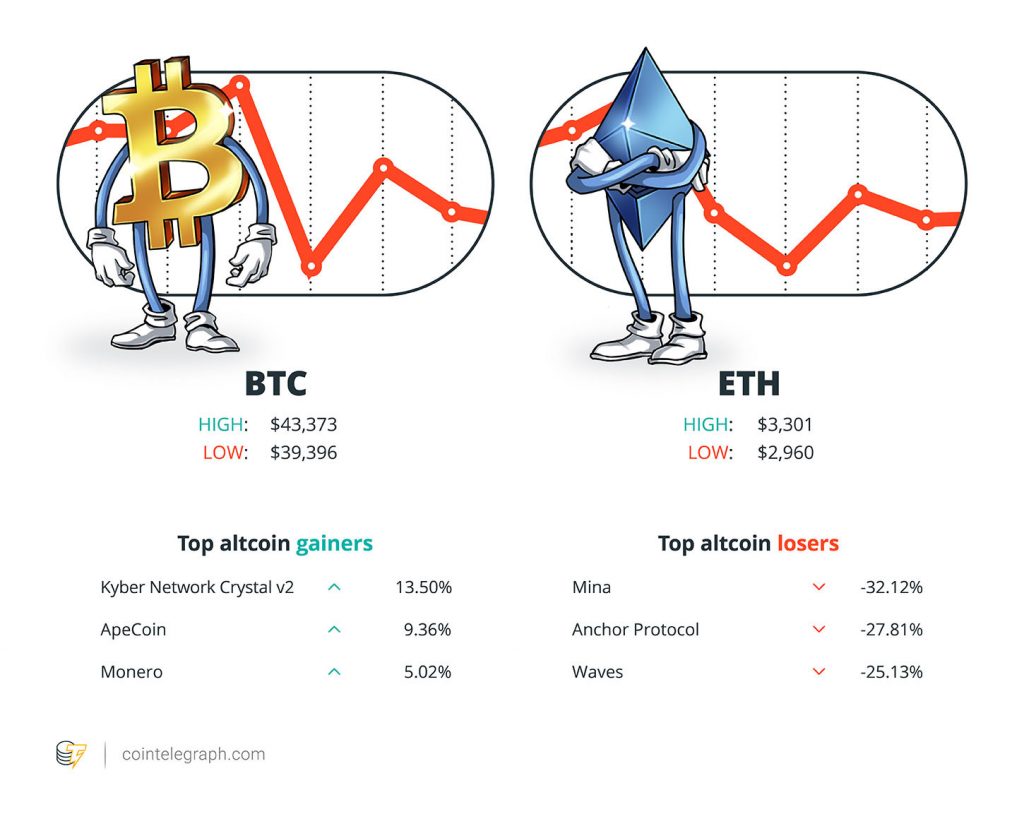
At the end of the week, Bitcoin (BTC) is at $40,453, Ether (ETH) at $3,032 and XRP at $0.77. The total market cap is at $1.88 trillion, according to CoinMarketCap.
Among the biggest 100 cryptocurrencies, the top three altcoin gainers of the week are Kyber Network Crystal v2 (KNC) at 13.50%, ApeCoin (APE) at 9.36% and Monero (XMR) at 5.02%.
The top three altcoin losers of the week are Mina (MINA) at -32.12%, Anchor Protocol (ANC) at -27.81% and Waves (WAVES) at -25.13%.
“Stablecoins are the perfect Trojan horse for Bitcoin.”
Paolo Ardoino, chief technology officer for Bitfinex and Tether
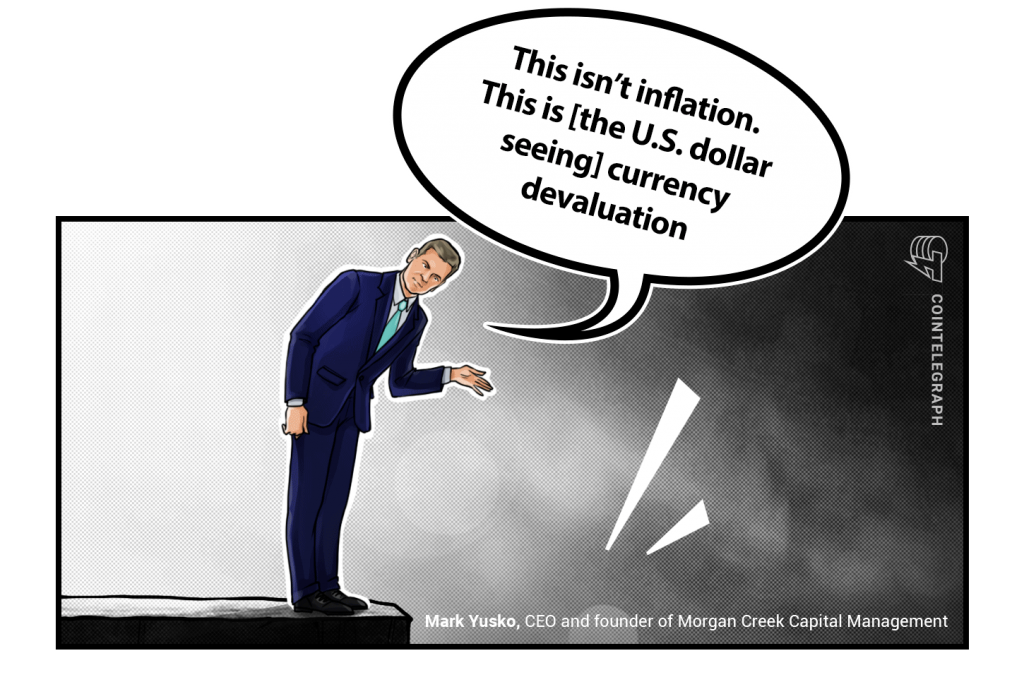
“This isn’t inflation. This is [the U.S. dollar seeing] currency devaluation.”
Mark Yusko, CEO and founder of Morgan Creek Capital Management
“It won’t be June, but likely in the few months after. No firm date yet [for the Ethereum mainnet/Beacon Chain merge], but we’re definitely in the final chapter of PoW on Ethereum.”
“While the idea of using such a functionality as a means to achieve a negative interest rate is sometimes discussed in academia, the Bank will not introduce CBDC on this ground.”
“If I pay with 100 euros in cash in a supermarket, I don’t have to show my ID card or identify myself. I simply pay with cash, and that’s it. And why should that be different in the crypto sector? I don’t understand that. We in Germany love cash, and we still accept an EU-wide cash payment cap of 10,000 euros. Why don’t we make the same rules of the game for crypto if we already have these rules of the game? Normal world, crypto world. Yes, we need regulations, but you still have to leave room to breathe.”
This week, Bitcoin’s price traded downward and somewhat sideways for the most part, breaching below the $40,000 mark on multiple occasions, according to Cointelegraph’s BTC price index. BTC traded above $43,000 and below $39,500 inside the week.
Arthur Hayes, BitMEX’s former CEO, expects lower prices for Bitcoin in the weeks ahead. His reasoning: central banks have recently made it their mission to combat inflation — or at least make it seem like they’re fighting inflation. Whether they’re serious or not in combating inflation, they still need to raise interest rates and reduce the magnitude of their quantitative easing programs. These actions will have a negative impact on the “debt-based global economy” of which crypto and Bitcoin are a part, according to Hayes.
“By the end of the second quarter in June of this year, I believe Bitcoin and Ether will have tested these levels: Bitcoin: $30,000; Ether: $2,500,” Hayes wrote in the blog post.
Facebook whistleblower Frances Haugen has slammed Meta in a new interview, warning that the firm could once again repeat the data- and power-hungry tactics that made the social media platform so successful.
Haugen highlighted that the Metaverse will give Meta even more opportunity to spy on its users than before and that the world will simply have to trust that the company does the “right thing” with all of its users’ data.
“They’ve made very grandiose promises about how there’s safety-by-design in the Metaverse,” she said. “But if they don’t commit to transparency and access and other accountability measures, I can imagine just seeing a repeat of all the harms you currently see on Facebook.”
The Wikimedia Foundation community has voted in favor of a proposal to stop accepting crypto donations, citing the reputational risk of accepting digital assets along with the environmental impacts of Bitcoin’s mining practices. Wikimedia is the non-profit organization that hosts the popular Wikipedia website.
The anti-crypto vote was in the strong majority, with around 71% of the 326 votes from Wikimedia contributors requesting that the Wikimedia Foundation stop accepting crypto donations.
“Bitcoin and Ethereum are the two most highly-used cryptocurrencies, and are both proof-of-work, using an enormous amount of energy. […] The current models continue to be extremely damaging to the environment. While there are eco-friendlier cryptocurrencies, they are less widely used,” the proposal read.
Texas and Alabama state securities regulators have filed a cease and desist order against the Cyprus-registered virtual Sand Vegas Casino Club in order to “stop a fraudulent investment scheme tied to metaverses.”
The firm has been accused of illegally offering NFT sales to fund the development of virtual casinos in metaverses, with a collection of 11,111 NFTs, in particular, offering the hodlers a supposed share of future profits from the casinos.
“The Respondents are also devising a scheme to obstruct any attempt to regulate the Gambler NFTs and Golden Gambler NFTs. […] They are misleading purchasers by claiming they can simply avoid securities regulation by implementing illusory features or using different terminology,” according to a Texas State Securities Board news release describing the order.
“If you are running a multi-million-dollar protocol, it’s not wise to remain anonymous. You need to be visible to ensure that you won’t suddenly rug-pull and get away with it.”
The feeling in the crypto and decentralized finance space has been shifting and evolving. The industry is also becoming more scrutinized and, inevitably, more organized. Some weeks ago, United States President Joe Biden signed an Executive Order to expedite and focus regulatory oversight of the $3-trillion industry.
The order will spur the government to examine the risks and benefits of cryptocurrencies, with a particular focus on consumer protection, financial stability, illicit activity, U.S. competitiveness, financial inclusion and responsible innovation. While the results of this order have yet to unfold, this moment helps to set the table for more clarity, predictability, security and stability for decentralized finance (DeFi).
Like with any industry, clarity on how DeFi and crypto should operate is important. Regulatory oversight by the U.S. government will be ultimately helpful and should be welcomed by participants and organizations in the DeFi community.
Meanwhile, there are plenty of signs that the DeFi and crypto ecosystem is teeming with talent, creativity, energy — and capital hungry to participate. Denver recently hosted one of the largest Ethereum conferences and hackathons of the pandemic era. Over nine days in February, ETHDenver welcomed more than 12,000 people to the in-person event to share ideas, build and reveal new protocols, curate investments and socialize.
Word got around town during the conference that a group of brilliant youngsters in their late teens and early 20s had set up a hacker house in Denver. Some of the most talented, smartest and youngest hackers in the world were there welcoming venture capitalists to visit. The price of admission for a chat on the ground was $3,000 a pop. Events like ETHDenver and impending regulatory involvement and oversight reveal a path for an energetic, meaningful and proactive year ahead in the crypto industry.
Talent meets creativity meets money
Denver included an interesting and eclectic ecosystem of players, investors and builders. The culture and industry are strengthening and deepening. When thirsty venture capitalists (VC) are paying $3,000 just to talk to the smartest 19-year-olds in the country, it’s a bold sign of life in the industry. Denver showed us that the space is much less fringe than it used to be.
These young people, in some cases, are leaving top schools to join DeFi teams or to develop protocols and products, and there is plenty of investment capital to provide a runway for big ideas, tools and decentralized applications.
Meanwhile, members of the first wave of crypto have evolved into a so-called old guard, providing stability, cautiousness and experience to help usher in projects, decentralized autonomous organizations and protocols. The VCs, gigabrains and old guard continue to be supported and energized by the legions of crypto troops whose enthusiasm for investing, discussion and participating in the space continues to provide the lifeblood for DeFi.
There is a mixing going on that’s creating a healthier ecosystem with bright ideas, expertise, money and enthusiasm that will provide longevity for the industry as Web3 matures and evolves.
The battle for talent escalates
One common discussion point in Denver was that everyone is hiring and struggling to maintain a pipeline of talented, experienced and engaged developers, engineers and technical experts. We can expect that trend to continue as the mainstream world becomes increasingly interested in crypto and DeFi.
It’s likely that Web2 talent from the likes of Facebook, Apple, Amazon, Netflix and Google will increasingly be pulled into Web3 — and that’s a good thing.
There is plenty of experience and know-how in traditional technology companies that can and should help build DeFi protocols, services and systems, thereby decentralizing finance. Not everyone will be open to the risk or uncertainty of the crypto space, but that sense of risk is reducing as Web3 organizations continue to receive large investments that provide plenty of runway and breathing room to generate stability and comfort.
Web3 is starting to show its relevance, and it looks like we are turning a corner toward more stable talent recruitment and retention.
Anyone who has been paying attention to the TradFi and DeFi markets in recent weeks and months recognizes there has been whipsaw volatility in prices and tokens. Entire markets have been up and down for plenty of reasons and could stay that way for the next year or more. This scenario is likely one of the many reasons why the U.S. government is keen to assess (and regulate) the industry.
But true builders in crypto don’t retreat in bear markets — they thrive. A bear crypto market can be more productive, especially for teams focused on good ideas and creativity. Bull markets tend to be more consumer- or trader-centric, and the noise can often drown out or blunt meaningful progress.
Good ideas within the developer community tend to rise to the surface during bear markets, earning more air time, visibility, reflection and development. The DeFi space is growing more academic both in team construction and recruitment, and that brainpower will be critical as it focuses on new ideas and solutions to existing problems.
This article does not contain investment advice or recommendations. Every investment and trading move involves risk, and readers should conduct their own research when making a decision.
The views, thoughts and opinions expressed here are the author’s alone and do not necessarily reflect or represent the views and opinions of Cointelegraph.
Hart Lambur is a co-founder of UMA and Across. UMA is a decentralized financial contracts platform where Hart leads a team of financial contract and oracle design researchers. He is also a co-founder and the CEO of Risk Labs, the entity behind the UMA protocol. Prior to this, Hart served as the CEO of Openfolio, a personal finance tracking platform he co-founded in 2013. He also worked for Goldman Sachs, where he provided liquidity in U.S. Treasuries for a diverse range of clients, including central banks, money managers and hedge funds.








 At the end of the week, Bitcoin (
 Facebook whistleblower warns Metaverse will repeat ‘all the harms’