Zero-knowledge applications platform Aleo has raised $200 million in a solid investment round, pushing the company forward and supporting its goals to develop products and services that encourage and assist developers in building applications on top of its decentralized network.
The Series B investment round was led by Kora Management LP and SoftBank Vision Fund 2, which invest in fintech projects within emerging digital economies. Samsung Next also participated in the raise along with Tiger Global, Sea Capital, Slow Ventures and Andreessen Horowitz (a16z).
Aleo is building a network that integrates zero-knowledge proofs, a cryptography technique that lets the platform become scalable, private and interoperable.
Aaron Wong, an investor at SoftBank Investment Advisers says that Aleo is creating a foundation that ensures that Web3 is scalable, safe and secure. Wong added that this will enhance financial transactions and gaming applications as well.
“As the blockchain industry continues to evolve, it is proving its potential to support a digital ecosystem defined by accessibility, efficiency, and interoperability.
Daniel Jacobs, Founder at Kora Management LP says that the biggest challenges in the industry are privacy and scalability. According to Jacobs, Aleo “will have profound impacts on a large and growing number of applications in the blockchain space and beyond.”
Jacobs explained that the project could protect user and application identity without giving up on performance that’s required to support many users. He also further noted that Aleo will become a catalyst that spurs the next generation of gaming, decentralized finance, and other use cases within the blockchain industry.
As Cointelegraph reported in April, Aleo secured $28 million in a private investment round to bring its platform for zero-knowledge applications to a wider audience. Venture capital firm a16z led the effort followed by investments from Coinbase Ventures, Galaxy Digital, and others.
A Phoenix couple tied the knot with their digital identities this weekend in the first marriage to take place in the Metaverse.
The wedding ceremony took place in Decentraland, complete with witnesses, Supreme Court Justice officiant Clint Bolick, and a virtual crowd of 2,000 guests on Feb. 5.
The bride and groom, Ryan and Candice Hurley hired Rose Law Group to legally formalize the marriage. The group’s Founder and President Jordan Rose claims it was the first-ever wedding hosted on any blockchain-based Metaverse.
“Because the metaverse is still in its infancy, we have developed the legal paradigm for a legally recognized marriage,” she told Cointelegraph.
The wedding ceremony was held on Rose Law Group’s estate on Decentraland. The law group developed a “meta-marriage framework,” by incorporating a “Virtual Premarital Agreement,” which identified the couple’s virtual identities and digital assets as recorded on the blockchain.
Meanwhile, a “Meta-Marriage License” identified, recorded, and tokenized the couple’s virtual identities and place of marriage on the blockchain as an NFT. Rose explained:
“There currently is no legal framework for marriage in the Metaverse, so whether or not it will be legally binding is more a question of contract.”
“Unlike the real world, the metaverse isn’t limited by physical constraints that restrict your perfect wedding. Only in the Metaverse can your wildest, most imaginative dream wedding be a reality,” stated the event description on Decentraland. Rose added:
“We see the future of the metaverse as being truly decentralized and existing almost completely on the blockchain, so the future of marriage in the metaverse will not need to have a record of their marriage in the real world.”
Although the couple seemingly envisioned a wedding of the future, they were met with some rather archaic technical issues. Decentraland struggled to handle the number of guests in attendance, and the NFT gifts for attendees were quickly claimed only about twenty minutes into the event.
Even more, Ryan’s avatar was left at the aisle as Candice’s failed to make a digital appearance — but only for some guests. Depending on which server attendees had been split into, the bride was wearing a dress, a hoodie, or wasn’t there at all.
After struggling to make the ceremony work on Decentraland, one attendee instructed the guests to head to Rose Law Group’s Instagram, where the real-world couple was sealing their vows via a livestream.
Despite Rose’s assurances about the legality of the wedding, it appears that many legal experts remain unconvinced. According to the American Marriage Ministries, people must appear as their real-life selves during a legal wedding ceremony, not as their digital counterparts.
Furthermore, most states in the U.S. don’t even allow a couple to be wed by an officiant remotely via a video conference, or if the couple is in separate locations at the time of the ceremony.
The Hurleys married in the “real world” 14 years ago after meeting on the dating portal Match.com.
Although the wedding is a first of its kind in many ways, it’s certainly not the only instance of a couple wanting to immortalize their marriage on the blockchain.
Data from Cointelegraph Markets Pro and TradingView followed a mercifully non-volatile weekend for BTC/USD, which continued to test $42,000 resistance while retaining $40,000 as support.
Friday’s unexpected gap upward initially resulted in misgivings over a price “fakeout,” but at the time of writing, no significant retracement had entered.
“I do not believe this Bitcoin impulse is done,” popular trader and analyst TechDev announced.
Other comments focused on what could be a more sustainable price transformation, William Clemente eyeing $41,000 as a support-resistance flip to secure an attack on levels closer to $50,000 next.
“Pretty straightforward price action-wise for BTC,” he tweeted in fresh analysis on the day.
“Bidding green box(es); would like to see a higher low set for continuation. Flip the 40-41k area as support and can start eyeing 47K which is PoB in confluence with yearly open and STH realized price. Final major area is 58k.”
BTC/USD annotated chart. Source: William Clemente/ Twitter
“Constructive” market needed for altcoin gains
Fellow trader Pentoshi meanwhile said that the time could soon be right to take a position in altcoins.
These suffered heavily in recent months and are now primed for a turnaround should Bitcoin’s own strength persist.
A few requirements
Must have Bullish MS on both USD/BTC pairs or no interest
Must be above 1hr + 4hr ema’s
— Pentoshi Forbes worst trader 40 years running (@Pentosh1) February 5, 2022
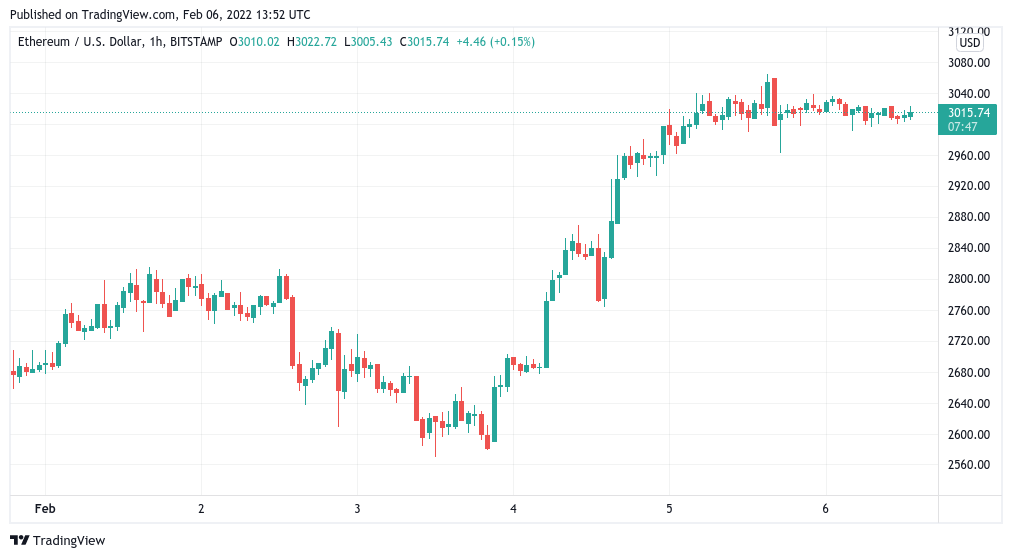
While flat on the day, many of the top ten cryptocurrencies by market cap produced significant gains through the week, among them Ether (ETH), up nearly 16% and above $3,000 for the first time since Jan. 20.
On Jan. 26, the United States Securities and Exchange Commission proposed amendments to Rule 3b-16 under the Exchange Act that lacks any mention of digital assets or decentralized finance, which could adversely affect platforms that facilitate crypto transactions. Some cryptocurrency advocates — including SEC Commissioner Hester Peirce — believe that the commission’s extended definition of an exchange could thrust an entire class of crypto entities under the regulator’s jurisdiction, subjecting them to additional registration and reporting burdens. How real is the threat?
The proposed change
The amendments proposed by the regulator dramatically expand the definition of what an exchange is while eliminating the exemption for systems that merely bring together buyers and sellers of securities while not providing facilities for order execution, which are currently not obliged to register as an Alternative Trading System — a class of trading platform within the SEC’s purview. Furthermore, the proposed rule includes “communication protocol systems” within the scope of the term “exchange.”
What it means in practice is that the SEC is claiming regulatory turf over a broad range of platforms that were previously operating outside of its jurisdiction. A particularly worrying point is that decentralized finance protocols could well fit into the definition of communication protocol systems that bring together “buyers and sellers of securities using trading interest.” The commission, as is well known by now, is keen on characterizing most digital assets as securities.
In a statement that followed the publication of the proposed amendments, SEC chairman Gary Gensler specifically emphasized his support for “the element of this proposal that modernizes the rules related to the definition of an exchange to cover platforms for all kinds of asset classes that bring together buyers and sellers.”
The agency’s rationale for introducing the amendments is that the definition of “exchange” must be updated in light of recent technological developments, most notably digitization of securities marketplaces. The proposal states that the new definition is supposed to be “flexible enough to accommodate the evolving technology.”
The SEC also wants to ensure that new digital players remaining unregulated do not enjoy an unfair competitive advantage over established exchanges that carry the compliance burden.
What does it mean for crypto?
Pro-crypto SEC Commissioner Hester Peirce was among the first opinion leaders to ring the alarm over the proposal. She offered a dissenting statement in which she called the document “too wide-ranging.” In follow-up remarks, she expressed her concern that, given the securities regulator’s recent eagerness to regulate all things crypto, the amendments could potentially reach DeFi protocols.
If the new rules are adopted and DeFi systems end up being treated as exchanges, a host of hard questions would arise, including whether it is even possible for decentralized protocols to comply.
Patrick Daugherty, partner at law firm Foley and Lardner and the leader of its blockchain taskforce, calls the SEC’s initiative a “stealth rulemaking proposal,” agreeing with Commissioner Peirce on its potential to be used in targeting crypto industry players. Daugherty commented to Cointelegraph:
It’s a ‘stealth’ proposal because the words ‘crypto’ and ‘digital’ do not appear in the SEC’s 654-page release, but the SEC is plainly aiming at systems (both centralized and decentralized) whose protocols aggregate indications of interest for buying and selling crypto assets, which its chair and its Division of Enforcement (not necessarily federal judges or juries) are eager to classify as ‘securities’ exchanges.
Daugherty further added that, as an alternative to registering as an exchange, a communication protocol system could theoretically register as a “slightly-less-regulated” Alternative Trading System and also register as a broker-dealer. Recalling his own experience of facilitating such a registration for a digital asset platform, Daugherty said that it is “less arduous than full ‘exchange’ registration, but it is labor-intensive nonetheless and entails on-going compliance burdens and expense.”
As a silver lining, what the proposed regulations do not cover are mere speech or mere securities issuance. Entities that only issue securities or act as information conduits, such as software developers that enable price displays, will not fall under the extended definition of an exchange.
Short comment period: Targeting crypto specifically?
The rule change, at least formally, is not a matter of course: The released document calls for public comment on the proposed amendments. However, what makes most crypto advocates uneasy is the egregiously short comment period, which Daugherty called “undue haste.” Thirty days is simply not enough time to formulate a thoughtful response to a wide-ranging, 654-page proposal. Some observers were quick to ascribe the procedural rush to the SEC’s drive to bend the digital asset space within its purview as soon as possible.
While it might be a cold comfort for the crypto folk, the commission’s strategy of cutting the public comment period down is not exclusive to rule changes related to digital assets. A recent study by libertarian think tank Cato Institute found that Gensler’s SEC consistently designates comment periods shorter than the standard 60 days. Furthermore, these periods overlapped with major public holidays on most occasions. This trend stands in stark contrast with the agency’s modus operandi under the previous chairman, Jay Clayton.
Regardless of whether the regulator is intentionally seeking to limit the industry’s capacity to weigh in on the matter, it is certain that the controversial proposal will receive significant pushback from crypto stakeholders and advocates.
Scalability is one of the main hindrances within decentralized finance (DeFi) applications and has created huge barriers to entry. Closely linked to this has been the issue of high gas fees, which continues to be a major pain point for newcomers to the Web3 space. When Web3 goes mainstream, these gas costs will become minimal. For the user, the experience will become completely gas-less like how it is on Web 2.0 applications.
As a result of the lack of scalability and network congestion, gas fees have skyrocketed, further preventing users from performing various transactions on the blockchain. According to YCharts report, the average gas price on Ethereum is at a level of around 146 Gwei at the time of writing. The high cost of gas fees has become a financial nightmare for regular users in the Web3 space. This has led to the search for a solution that improves the decentralized finance ecosystem and makes it more usable and accessible.
Solving the scalability problem
So, the question becomes what steps can we take to minimize gas fees? While there are a number of strategies that can be taken to lower and mitigate gas expenses, most of them can be boiled down to either building a different layer 1 blockchain or making Ethereum better. Another area that has been heralded as a way to tackle this problem would be layer-2 scaling solutions.
Layer-2 refers to a network or technology that operates on top of an underlying blockchain protocol to improve its scalability and efficiency. These layer-2’s use math and cryptography to validate transactions securely without sending as much information to the blockchain. It’s like batching together a thousand transactions for the cost of one, without giving up (too much) security. There is a range of layer-2 protocols that enable Ethereum users to cut their fees down to a bare minimum. Some examples include zero-knowledge Rollups, Optimistic Rollups and Plasma, among others. Each of them comes with different tradeoffs. Some are faster than others, some are more ironclad secure than others.
Gas fees will become thing of the past
Once the scalability issues are solved, gas fees become much more negligible. You can see that the gas fees on L2s are considerably cheaper in the figures below.
The next question becomes, why make the user pay for gas at every step? This is where gasless meta-transactions come into play. Meta transactions take things a step forward by allowing different users to transact on the public blockchain with zero transaction fees. The decentralized application (DApp) developer sponsors the negligible gas on the user’s behalf. This builds a more seamless UX since users don’t need to understand the inner workings of various blockchain platforms and gas fee dynamics.
Meta transactions use cryptography where users have to sign the transaction and authenticate it. The major difference here is that a third party relayer removes the complexities by managing the transaction, paying the gas and, finally, completing the transaction by sending it to a receiving address.
Revolutionizing the Web3 space: Solutions to gas problems
There are a number of strategies besides the aforementioned solutions that can be utilized in order to mitigate or at the very least lower gas expenses:
Scheduling transaction times: Ethereum gas prices are known to fluctuate within the day as different on-chain events take place and as different parts of the world wake up. As a result, there are certain times during the day when gas prices are likely to be considerably lower. One way of lowering gas fees would be to take stock of these times and target them when making transactions. Research from Paxful has pinpointed the busiest and most expensive times to be between 8 AM to 1 PM (EST), with most of Europe and the United States being awake and at work during that time frame. Comparatively, midnight to 4 AM (EST) has been found to be a lot less busy and ultimately less expensive.
Using stable off-chain payment networks: Xpal off-chain payment channel is working to develop a payment solution that allows for instant transaction approvals in seconds by lowest fee through its share gas system. This is done by charging a nominal fee proportional to the payment amount.
Relayer infrastructure: The future of Web3 is multichain and gasless. The various chains, layers-twos and scaling solutions will all seamlessly combine to ensure scalability and speed. In an ideal world, the everyday user would be removed from blockchain headaches. They would not need to sort through all the different chains and layers-twos in order to use a DApp. It would simply happen in the background.
A multichain relayer network is the best solution to enable this vision. As explained in the diagram above, the user forwards their request to a relayer node (executor) who then manages the transaction on the user’s behalf. The DApp can then refund this relayer node with the gas fee for the transaction so the user does not have to either pay the gas fee or manage other transaction parameters to make it successful.
With such an infrastructure, users can connect their wallet to any DApp, instantly access their funds on any chain or L2/rollup and then enjoy a gasless experience everywhere.
Conclusion: The future of Web3
Web3 will only succeed in faster adoption or even replacing Web 2.0 completely if users are able to interact freely without the burden of paying high gas fees.
Everything we have seen in DeFi so far has literally just scratched the surface. We’ve caught a glimpse of what the future will hold for us. UX will play a paramount role, allowing us to scale and onboard new people.
We predict a future where transactions simply become free, instantaneous and safe. Take, for example, when you watch a movie on Netflix, you simply pay the subscription fee without having to deal with operation costs or hosting fees. By simplifying the Web3 user experience, the barrier to entry is lowered, ultimately becoming more open to a wider user base.
This article does not contain investment advice or recommendations. Every investment and trading move involves risk, and readers should conduct their own research when making a decision.
The views, thoughts and opinions expressed here are the author’s alone and do not necessarily reflect or represent the views and opinions of Cointelegraph.
Ahmed Al-Balaghi is the CEO and co-founder of Biconomy. Before that, Ahmed worked for Jabbar Internet Group, a Dubai-based venture capital firm. He also founded Encrypted, the largest podcast in MENA dedicated to fintech, blockchain and crypto assets. Prior to that, Ahmed spent time as a blockchain researcher in Shanghai, China. He has also worked for institutions such as Citibank, Dow Jones and Ofgem.
Last year was impressive for blockchain startups, as research from CB Insights found that venture capital funding reached new heights during every quarter of 2021. According to CB Insights’ “State Of Blockchain 2021” report, $25.2 billion worth of venture capital funding went to global blockchain startups last year, demonstrating a 713% increase from $3.1 billion in 2020.
The report also found that the United States led the greatest amount of funding deals in Q4 of last year, generating $6.26 billion for 157 deals. The document notes that global growth was driven by increasing consumer and institutional demand for crypto-related products and services.
VC funding focused on crypto adoption
Chris Bendtsen, a senior analyst at CB Insights, told Cointelegraph that CB Insights’ report contains data aggregated from private marketing funding from over 3,000 blockchain and crypto companies that the firm regularly tracks. Bendtsen further explained that while the title of the report references blockchain, this serves as an overarching category that includes cryptocurrency, nonfungible tokens (NFT), enterprise blockchain and decentralized finance (DeFi). Bendtsen pointed out that the majority of VC funding mentioned throughout the report was allocated to crypto-focused startups. The report states:
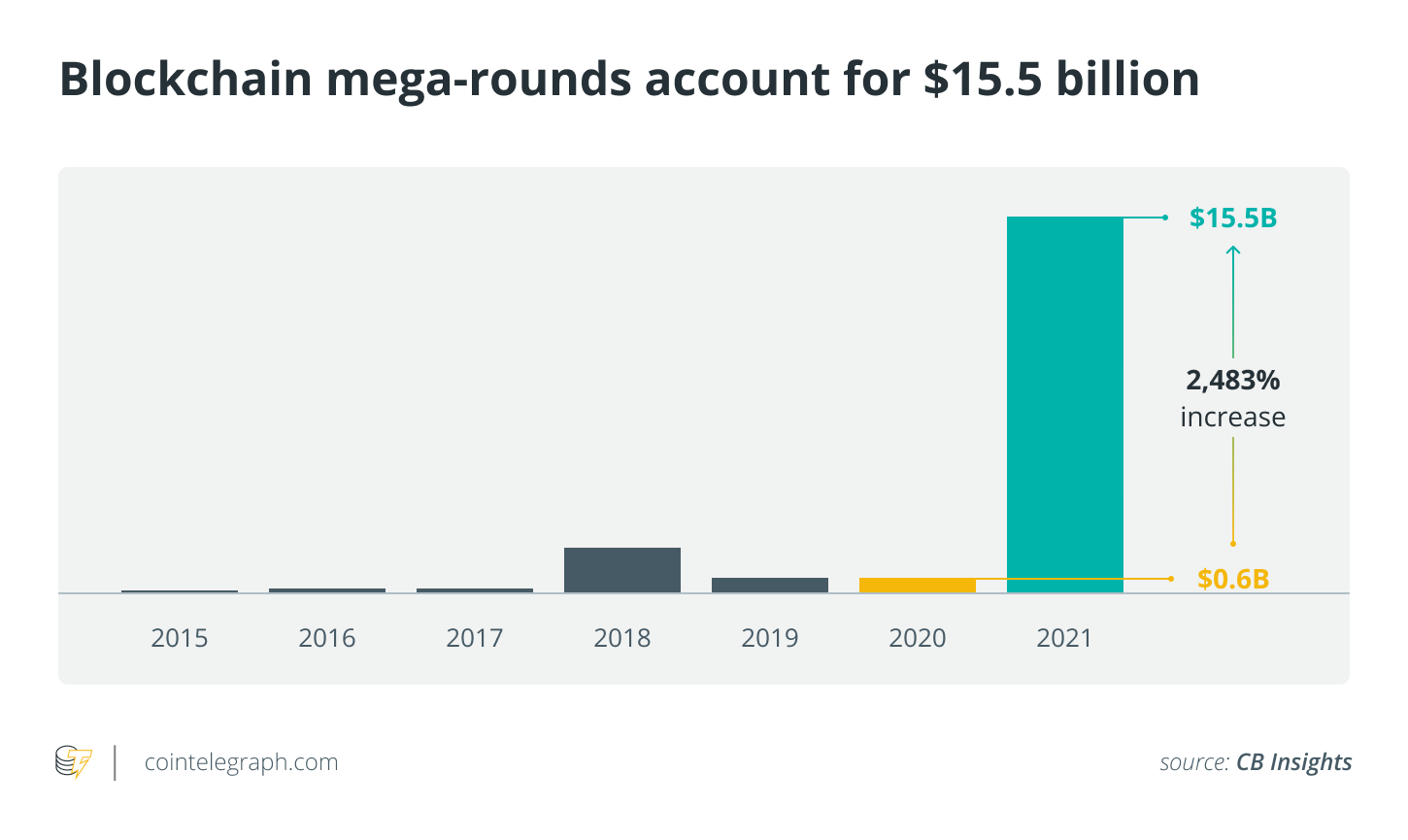
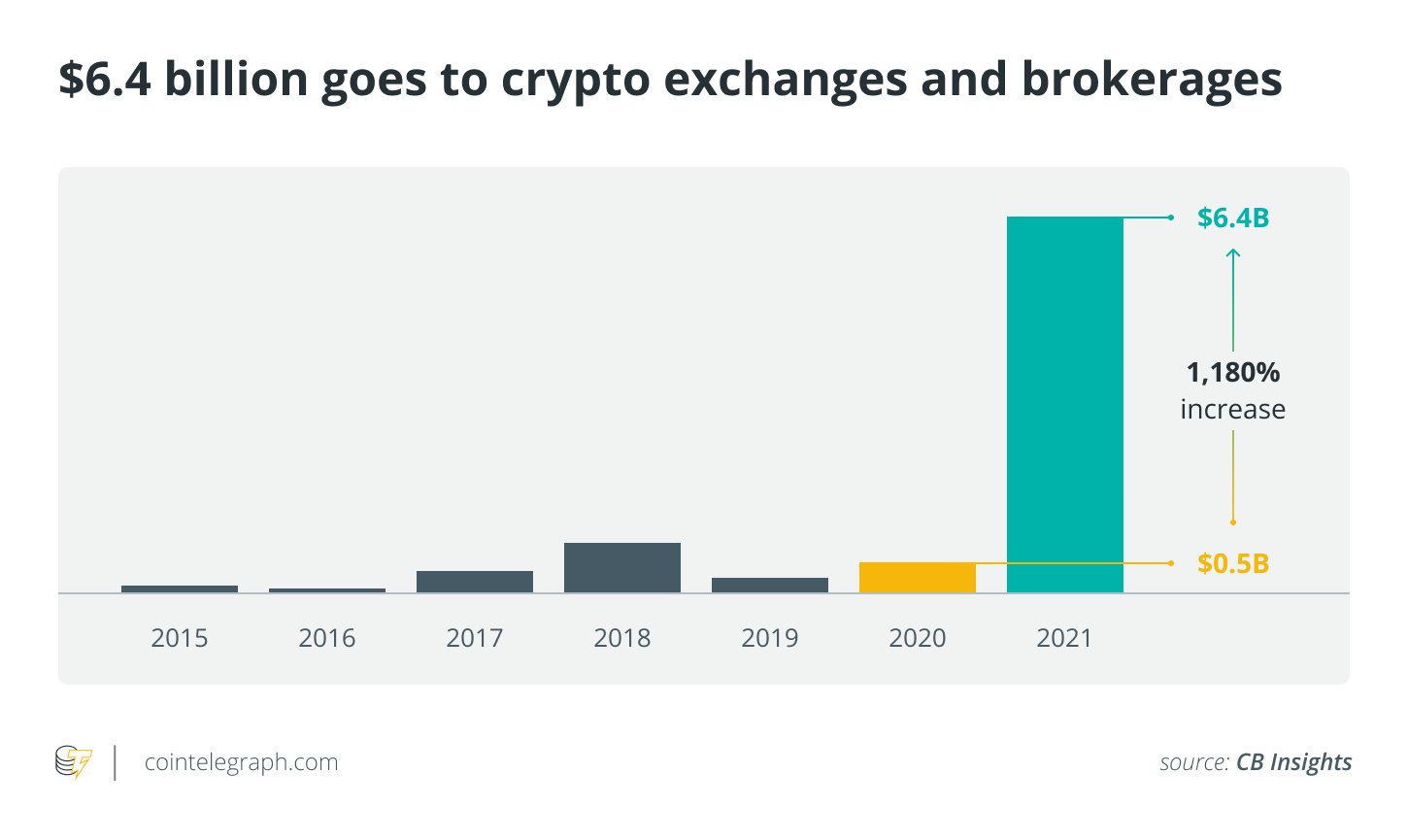
“Over $100M mega-rounds (worth $100m+) were the driving force behind blockchain’s record funding year. The 59 mega-rounds in 2021 accounted for just 5% of total deals but 60% of total funding. The biggest mega-round deals went to crypto exchanges, brokerages, NFTs, gaming, and payments.”
According to the report, $1 out of every $4 worth of funding went to crypto exchanges and brokerages, which also equates to a quarter of all global blockchain funding in 2021. Bendtsen remarked that while the biggest deals went to major crypto exchanges such as FTX — which ranked as the second-largest equity deal for brokerages and exchanges in Q4 of 2021 — funding for country-specific exchanges has also been on the rise.
For instance, CoinSwitch Kuber, one of the largest crypto trading platforms in India, ranked No. 4 for top equality deals for brokerages and exchanges in Q4 of 2021, generating over $260 million in its recent Series C funding round. “Based on these findings, it’s become evident that we are seeing the globalization of crypto, as more country-specific exchanges are raising impressive rounds,” said Bendtsen.
Bendtsen further pointed out that global VC funding for crypto custody and wallet providers reached $6.3 billion last year. “Toward the beginning of 2021, a lot of funding was going to consumer-driven exchanges, but there was a shift later in the year that saw major funding rounds go to crypto custody providers and custodians,” he remarked.
For example, the New York Digital Investment Group (NYDIG) ranked as the top equity deal in Q4 of 2021 under the category of custody and wallet providers. In December 2021, the institution specializing in Bitcoin (BTC) financial services secured a $1-billion equity investment led by WestCap Group. Fireblocks, the digital asset custody platform, ranked directly under NYDIG with its $550-million raise from Sequoia Capital.
Michael Shaulov, CEO of Fireblocks, told Cointelegraph that he believes investors are paying more attention to custody and wallet providers because this has been the biggest barrier to entry for institutional participation. “Having a direct custody solution and technologies that can plug and play into the crypto capital markets is a game-changer for businesses and individuals alike,” he said.
“Our investors see us as the picks and shovels of the crypto industry. This includes everything from direct custody wallets and settlement networks to compliance integrations with Chainalysis and Elliptic, along with access to staking providers.”
In regard to the company’s latest funding round, Shaulov said that Fireblocks plans to expand its offerings to include securing high-value transactions around DeFi and NFTs. This is important, especially now as the number of scams and fraudulent activities within the DeFi and NFT sectors has increased.
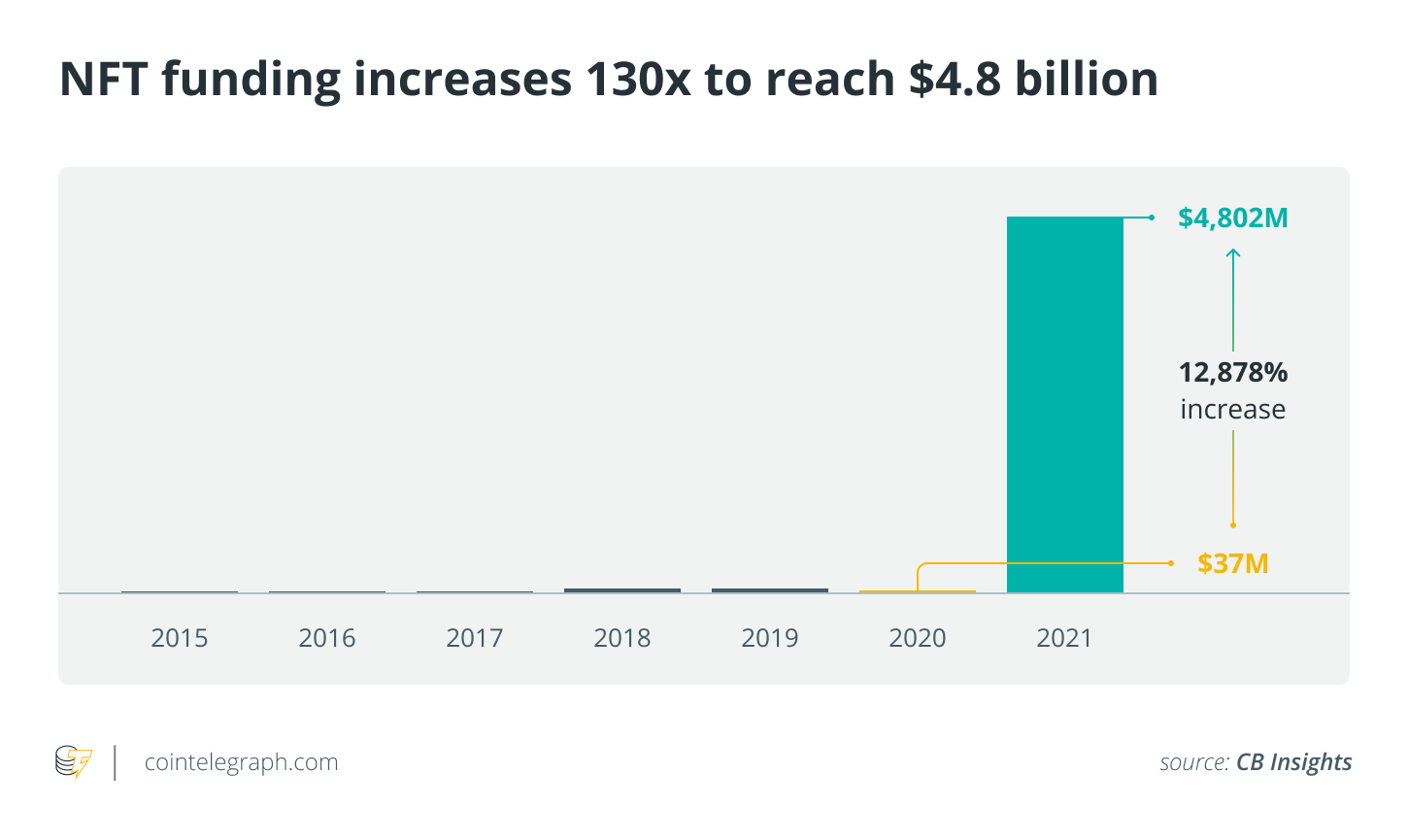
Although criminal activity within the NFT space has started to quickly unfold, the CB Insights report found that funding allocated to NFT startups grew by a margin of 130 times. In 2020, NFT startups generated $37 million in VC funding, which reached $4.8 billion in 2021. “Gaming, marketplaces, and infrastructure are the top 3 NFT categories driving the funding craze,” the report highlighted.
Animoca Brands, which ranked as the No. 1 investor by company count in Q4 of 2021 according to CB Insights, made at least 49 investments in blockchain projects last year. Yat Siu, co-founder and executive chairman of Animoca Brands, told Cointelegraph that NFT and blockchain gaming overall were major drivers of the growth in funding last year:
“We have always believed that NFTs, and in particular gaming, are key to the mass adoption of blockchain, and I think what happened in 2021 strongly suggests that this thesis will be realized in 2022. It’s interesting to note that in 2021, many new blockchain users entered the world of crypto not because of cryptocurrencies but because they were seeking to acquire NFTs.”
Traditional VCs take an interest
In addition to where funds are going, Bendtsen noted that the CB Insights report found that more traditional investors started taking interest in blockchain startups last year:
“Over the course of 2021, Andreessen Horowitz jumped out as a smart-money investor. They are one of the biggest VC firms in the world and announced a huge crypto-focused fund in June of last year.”
As Cointelegraph previously reported in June 2021, the Silicon Valley venture firm launched “Crypto Fund III,” a $2.2-billion venture fund co-led by Andreessen Horowitz general partners Chris Dixon and Katie Haun. According to the CB Insights report, Andreessen Horowitz was ranked as the No. 3 blockchain investor in 2021, falling under Coinbase Ventures and China’s AU21. “Our numbers show that Andreessen Horowitz invested in 46 blockchain startups last year, the third-most of any investor out there, including the crypto-focused funds. This shows that we are seeing more traditional firms coming into the crypto space,” remarked Bendtsen.
While this may be, Siu noted that Andreessen Horowitz has had a much longer history with blockchain investments. For instance, the venture firm invested in blockchain-company Dfinity in 2018. As such, Siu remarked that while Andreessen Horowitz isn’t new to the space, the company did ramp up its investments in Web3 startups throughout 2021.
“It is very clear that A16z and other major investors like Sequoia China understand the enormous potential of Web3 and of the value that the application of blockchain can deliver, and they are investing accordingly,” he said. Given this, Siu believes that more well-known venture capitalists and firms will continue to invest in blockchain startups, particularly those innovating with NFTs.
Will crypto price volatility impact funding?
While recent growth for blockchain startups has been impressive, crypto price volatility and unclear regulations may create challenges for companies looking to raise funds in the future. For instance,rising inflation in the United States may further impact the price of Bitcoin. Also, unclear regulations around NFTs could be detrimental for new companies entering the space.
Although these challenges should be carefully considered, Bendtsen explained that none of the data recently generated from CB Insights indicates any type of slowing down for funding. “The fact is that these investors view crypto as a long-term play. I, therefore, don’t think the lower crypto prices today will affect startup funding in the future.” Shaulov added that he believes there will be growing agreement around cryptocurrency regulation around the world, which will ultimately fuel retail and institutional adoption.
Meta Platforms, the parent company of Facebook, saw the largest single-day slide in market value for a U.S. company ever with a 26% fall in share prices on Thursday after the tech giant revealed disappointing earnings and a decline in daily active users.
Meta famously changed its name from Facebook in late 2021, to signal its plans to focus on the Metaverse, and its struggles have coincided with double-digit percentage gains for its decentralized competitors The Sandbox and Decentraland.
Meta reported $33.67 billion worth of total revenue for Q4 2021, compared to $28 billion the year prior. However, its net income decreased to $10.28 billion, down from $11.2 billion 12 months ago.
For the first time, Meta broke out a segment in its earnings report for its virtual and augmented reality research and development business, Reality Labs. It saw losses which topped over US$10 billion, up from US$6.6 billion in 2020. However it’s only in the early stages of laying the groundwork for Metaverse technology, including developing a haptic glove, allowing users to “touch” objects in the metaverse.
Speaking with Cointelegraph, Animoca Brands chairman and co-founder Yat Siu, suggested that the sharp drop of Meta’s share price may represent a broader trend in which users are beginning to question the centralized Web2 model:
“It’s a system that does not share any meaningful part of the ownership or value of the network, which will eventually lead to a decline as users look for better options.”
“As people are still likely to spend even more time online, the question is where and how? This is an early indicator that they are moving away from Web 2.0 and the logical conclusion on where to go for a growing number is Web 3,” he added.
Siu argued that Web2 companies like Meta and Apple are also “losing their best people” to Web3 companies and projects:
“Web 3 and the open Metaverse is more than just another product cycle, it’s a movement, and it’s hard to fight something like that as a single corporation.”
Crypto-backed metaverses
Decentraland, a Metaverse platform built on Ethereum, has seen the price of its token MANA increase by over 20% the past seven days, surging from a seven-day low of US$2.19 to recent support levels around the US$2.60 mark.
Likewise, SAND tokens for The Sandbox, one of Decentraland’s main Metaverse competitors, has seen a seven-day gain of 17.5%, entering the weekend at a low of US$3.31 before surging to a high of over US$4, now seeing support levels around US$3.60.
Apart from Meta, other factors are affecting prices for MANA and SAND this week. Decentraland released it’s 2022 Manifesto, announcing a prototype mobile app, improvements to its play experience, greater utility of NFTs, and protocol enhancements.
The Sandbox team announced a partnership with UniX Gaming, a decentralised autonomous organisation (DAO), and a release of more “land” in its metaverse slated for February 10th.
Animoca Brands owns The Sandbox, and there were unconfirmed rumors earlier this week that Meta would be acquiring the Metaverse platform. However Siu promptly shut those rumors down on Feb. 3.
There is an unconfirmed rumor that Facebook is about to acquire @TheSandboxGame. It looks like regulation is coming sooner than later to this space… https://t.co/XiAelDoBac
Outside of Meta, other big tech companies including Apple and Microsoft are getting into the space. Entertainment giant Disney also seems to be gearing up for a move into the Metaverse with a recent job advertisement for a Business Development Manger seeks looking for someone to “help lead Disney’s efforts in the NFT space”.
It’s not immediately clear if Disney’s efforts could relate to it’s planned headset-free augmented reality Metaverse project uncovered by patent filings.
A new report indicates that the blockchain industry is set for astronomical growth in the next decade, with the North American market leading the way.
The report by Fortune Business Insights, titled “Blockchain Market Analysis Research Report, 2021-2028,” mentions that the global blockchain market size is expected to reach a whopping $104.19 billion by 2028, exhibiting at a CAGR of 55.8% across the forecast period.
The presence of major industry players such as IBM, Microsoft, Oracle, AWS, Digital Asset Holdings and others in the North American market is expected to have a significant impact during the forecast period. For comparison, the regional market was valued at $1.44 billion in 2020.
According to the research, the pandemic has expedited demand for cloud-based services and software, resulting in a market ripe for blockchain innovation. The demand for secure and transparent data management is greater than ever, with more and more organizations seeking to establish virtual work platforms.
The report highlights that blockchain’s increasing popularity is due to enterprises’ need for software as a service in order to maintain business continuity. According to the study, small business enterprises (SMEs) utilize Blockchain-as-a-Service solutions to protect their digital assets and validate human identities, implying that demand for BaaS services will continue to rise.
The growing concern over data security is expected to drive demand for blockchain technology in the future. The technological demands, including cross-border transactions, clearing and settlements, trade finance platforms, digital identity verification, and credit reporting, are expected to fuel future growth in the blockchain sector.
Big tech companies are increasingly shifting focus to the blockchain space to capitalize on the increasing demand for distributed ledger technology. As Cointelegraph reported, Google’s parent company, Alphabet, is looking into using the innovative technology in its core products and services, such as YouTube and Google Maps.
Her Majesty’s Revenue and Customs (HMRC), the U.K.’s tax agency, on Wednesday, has released a controversial set of guidance that could affect innovation in Decentralized Finance (DeFi).
The updated regulation focuses on the treatment of digital assets specifically for DeFi lending and staking in the UK, and whether returns or rewards from these services are deemed as capital or revenue for taxation purposes. Owing to the cutting edge nature of DeFi these services had fallen into a grey area with tax professionals unsure of how the existing rules apply.
“The lending/staking of tokens through decentralized finance (DeFi) is a constantly evolving area, so it is not possible to set out all the circumstances in which a lender/liquidity provider earns a return from their activities and the nature of that return. Instead, some guiding principles are set out,” the HMRC update stated.
HMRC has updated its guidance on the treatment of crypto and digital assets, specifically for decentralised finance (DeFi) lending and staking in the UK, significantly altering their classification and treatment. Full report and our response here – https://t.co/8XXD0bm34Opic.twitter.com/Q3N7La5FVX
The guidance outlined that returns via staking and lending of DeFi assets will not be treated as “interest” as digital assets in the UK aren’t considered currencies, but rather property for tax purposes.
However, this approach could create tax problems for stakers with the guidance suggesting that in many cases it would indicate that “beneficial ownership of those tokens” had been passed to the platform. This would mean they were disposed of for tax purposes and incur Capital Gains Tax.
Ian Taylor, executive director of CryptoUK asserted the new regulations would create an “unnecessary burden” for crypto investors that stock market investors do not face when lending shares:
“HMRC treats crypto assets as property for tax purposes. However, this is inconsistent with the approach currently being adopted by Government and other regulatory bodies in the UK, including the Treasury and the FCA”
Right,so if i have to pay taxes on staking, isn’t that double taxing….Let’s say i stake 200 000 pounds worth of crypto on 10% APY, that will be worth 20 000,so i will have to tax as i earn it and after that tax it again once i exchange it for fiat/different asset?
Taylor added that the new rules add “undue reporting requirements for the consumer, and create tax compliance confusion” as investors will have to report on hundreds or even thousands of transactions.
“This is out of step with the Government’s stated aim for the UK to be open and attractive as a destination for investment and innovation post Brexit,” he said.
Last week, former Secretary of State for Health and Social Care current U.K. Member of Parliament (MP) Matt Hancock urged the House of Commons to introduce progressive crypto policy to make England the “home” of crypto.
In November last year HMRC laid out regulations concerning the introduction of digital services tax levied on crypto exchanges operating in the UK
Major crypto exchanges originating from Asia as well as from the West have shown an increasing interest in the Asia-Pacific region.
Coinbase launched in Japan last year, joining the selected group of exchanges to offer crypto trading services to native customers. Binance, the world’s leading crypto exchange by trading volume, has forged a series of new partnerships in Singapore, Indonesia and Thailand.
The growing interest in global crypto exchanges in Asia could be attributed to the crypto craze in the region, despite regulatory uncertainty in several countries. The Asia-Pacific region is currently the hub for the majority of crypto growth. Countries such as Singapore and Thailand have seen a great boom in crypto adoption both as a retail payment as well as a form of investment.
Mastercard Asia-Pacific executive vice president Rama Sridhar said in an interview with TechAsia that compared to the global market, “adoption rates for emerging payment options have always been better within the Asian region.” A survey conducted by Mastercard across 18 markets in 2020 suggested 94% of consumers in the Asia-Pacific region are considering using emerging payments methods.
Jackson Mueller, director of policy and government relations at Securrency — a financial markets infrastructure company — sees the prominence of digital payment and peer-to-peer market growth as one of the key reasons behind Asia’s growing influence as a crypto hub. He told Cointelegraph:
“Southeast Asia has been a hotbed for payments activity for some time now. It comes as no surprise to see significant growth in the number of crypto firms, exchanges and volume of peer-to-peer activity in the region.”
“It’s also important to note that we’re just beginning to see the emergence of crypto assets frameworks in the region, alongside ongoing efforts to improve current domestic payments systems, interlink these systems with neighboring countries, and promote capital markets development,” he added.
According to a Chainalysis report, Asian markets accounted for 43% of global cryptocurrency activity or $296 billion in transactions between June 2020 and June 2021. The report further highlighted that the Central and Southern Asia and Oceania crypto market is the fourth-largest in the world, and transaction activity there increased 706% in the same time frame.
Here we’ll take look at some of the top global crypto exchanges and service providers with a growing presence in Asia.
Binance’s rapid expansion in Asia
The leading global exchange by trading volume had a roller coaster of a ride in terms of regulations in 2021. After seeing a series of compliance warnings from nearly a dozen countries, Binance mended its way toward the end of the year. The exchange forged several new partnerships, but its growth in the Asia region was something that got everyone’s attention.
Binance acquired an 18% stake in Singapore’s securities exchange Hg Exchange. However, the exchange withdrew its crypto license, which many claimed was due to non-compliance with the Anti-Money Laundering guidelines. Binance CEO Changpeng Zhao called the reports as fear, uncertainty and doubt, or FUD, and maintained that Singapore remains one of the top priorities for the exchange.
The exchange is now looking to reestablish its presence in Thailand after an early warning in 2021. The crypto exchange partnered with Gulf Energy Development PCL, a Thai holding company run by billionaire Sarath Ratanavadi.
Binance is looking to open a crypto exchange in a joint venture with a consortium led by MDI Ventures, an investment arm of Telkom Indonesia.
Binance chief regulatory liaison officer Mark McGinness told Cointelegraph:
“We are keeping all of our options open, and we are currently considering a number of cities that meet user needs, our needs as a company, and of course, regulatory requirements. The crypto regulatory framework of the jurisdiction is a key consideration. Naturally, we would like to operate where the regulations are clear, workable and ‘pro-crypto.’”
Coinbase’s growing focus in South Asia
The first United States crypto exchange to go public in 2021 is looking to expand to a global market. The exchange has been rapidly ramping up its presence in South East Asia and building new crypto infrastructure. In terms of regulatory headway, the crypto platform acquired an operating license in Japan last year. Coinbase officially launched in Japan in August 2021 after it had partnered with banking giant Mitsubishi UFJ Financial Group. Japan is one of the first countries to adopt crypto and one of the biggest crypto markets by trading volume.
Singapore was one of the first destinations for Coinbase outside the U.S., with the firm starting its services in the country in 2015. At the time, the exchange had not revealed any expansion plans to other Asian countries.
Despite the regulatory uncertainty in India, crypto giants and venture capital firms have been eyeing the Indian market for quite some time. In July 2021, Coinbase made its intentions of expansion in India clear and said it is setting up a new office there and hiring hundreds of new employees.
Kraken is available in over 45 Asian nations
Kraken, a global crypto exchange originating from the U.S., has had quite a success in the Asian markets. The exchange’s services are available in over 45 Asian nations, and it has grown to become one of the leading western exchanges to gain a footing in the Asian market.
Kraken also relaunched in Japan in 2020 after closing its services in 2018, citing rising operating costs and the need to concentrate its efforts on “other geographical areas.” The exchange became a licensed “Crypto Asset Exchange Service Provider” in the country in line with domestic regulatory requirements.
Crypto.com’s Asia-first Policy
Crypto.com, a global crypto trading service provider with its headquarters in Singapore, is primarily known for its $500-million venture arm fund to support early-stage crypto startups. However, the exchange has a strong footing in the Asian market despite its primary sponsorship partnerships in the United States.
The platform launched its flagship crypto Visa card that allows people to spend their crypto at Visa merchants in Asia first, followed by the rest of the global market, which indicates the popularity of the crypto ecosystem in Asia.
What makes Asia crypto-friendly?
Messari’s report on the Asian crypto landscape revealed that leading crypto nations in the region such as Japan, South Korea and Singapore have deep liquidity pools. The region is also a top crypto spot market and accounts for more than 90% of Bitcoin (BTC) and Ether (ETH) futures trading volume. The nature of traditional finance has also played a key role in becoming a crypto hub, where capital controls in China and South Korea pushed people toward crypto, while low yields in Japan played a catalyst in fast crypto adoption.
Apart from major crypto exchanges that avail their services in Asia and looking to expand further, many mainstream global payments processing giants such as Visa and Mastercard also see great potential in the Asian market. In November 2021, Mastercard partnered with three leading crypto service providers in the Asia Pacific to launch crypto-funded Mastercard payment cards.
Countries such as India and Pakistan, where there is still no clarity over crypto regulations, are not lagging behind either. The Indian crypto market grew 641% from July 2020 to June 2021 and attracted $638 million in crypto funding, while Pakistan has seen a similar rise in crypto adoption. According to an FPCCI report, Pakistanis held $20 billion in crypto in 2020–2021. Jawad Nayyar, co-founder of Pakistani fintech firm PropTech, told Cointelegraph:
“Over the last five years, cryptocurrencies have gone from a Ponzi scheme to a gambling tool and a highly volatile asset to now finally being recognized as a legitimate virtual asset of value in the region. In times of monetary expansion, high inflation and a huge currency devaluation, the private sector now considers cryptos as a hedge against such economic adversaries.”