The new book written by Steven Sidley and Simon Dingle explains why Defi Is the future and banks are the past, covering the entire landscape of people, projects and future portents
February 22nd, 2022 – A new book written by Steven Sidley and Simon Dingle has made a strong case as to why the death of the legacy banking system is inevitable as Decentralized Finance (DeFi) applications offer less expensive and more robust competitive solutions to retail, corporate and international finance. The authors draw on their insights as fintech professionals and technology and crypto entrepreneurs to outline their points. Both also have strong credentials as established authors.
The title of the book is Beyond Bitcoin: Decentralised Finance and the End of Banks, which is clear in terms of what the book is about and all of the chapters to follow are geared towards explaining why legacy finance is being rendered obsolete.
While written in a way that non-technical people will understand, it covers all of the main points of the DeFi industry including the birth of the industry, smart contracts, the removal of middlemen, lending and borrowing, automatics market makers, decentralized exchanges, ICOs, legacy financial models, yield farming, NFTs, stablecoins, mining, regulations, and more. It also outlines some of the major events in the past 15 years and introduces the reader to key individuals who have helped to bring about the world of DeFi.
The book aims to bring about what is truly missing in the DeFi space – a clear and articulate description of the entire landscape, including how each of the major Defi innovations works under the hood comprehension. Too many of the criticisms of distributed ledgers and blockchains are fueled by a superficial understanding of how the underlying technologies and services work, and how it compares with competitive traditional financial products. This book, written with wit and insight, cuts through the jargon and makes the subject both accessible and compelling.
The host ofJist (a UK-based blockchain-orientated YouTube channel), stated, “It wasn’t until I got the chance to read Beyond Bitcoin: Decentralised Finance and the End of Banks by Steven Boykey Sidley and Simon Dingle that I really understood the full scope of how this space threatens the world of finance, what exactly DeFi is, and how NFTs are going to be so much bigger than just some neat pictures.”
Further praise includes:
“A rich, clear, and articulate explanation of a transformative technology,” David Spence, former Director and Chairman of PayPal Australia.
“Looking backward to move forward, this book is a masterclass on the evolution and expansion of the crypto world and its possible futures. Essential for those wanting to move beyond the headlines,” Herman Singh, Associate Professor, University of Cape Town Graduate School.
“The gripping story of the great financial disruption and its portents, told with wit and insight,” Ray Hartley, Research Director, The Brenthurst Foundation.
“Everyone who cares about money is trying to get their heads around DeFi, and what it may mean for financial institutions. This book explains it all, with sparkle, depth, and clarity,” Michael Jordaan, ex-CEO of First National Bank and co-founder of Bank Zero.
Beyond Bitcoin: Decentralised Finance and the End of Banks is 240 pages long and is written for the intellectually curious layperson as well as those already established in the industry and released in stores across the US on Feb 22nd. The book is also currently available on Amazon as a paperback, audiobook, or Kindle ebook.
About Steven Boykey Sidley
Steven Boykey Sidley has worked extensively in technology and finance and is an award-winning novelist, playwright, and columnist. An American citizen, he currently
lives in Johannesburg with his wife and their two children. Steven possesses an MSc in Computer Science from UCLA and is currently a partner with Bridge Capital.
About Simon Dingle
Simon has been working with cryptocurrency since 2011 and has founded multiple fintech firms. His career spans broadcasting, journalism, design, product management, and investing all with a focus on information science, finance, and open source technologies. He is currently the chief of Venox Digital Assets which operates exclusively within the Defi space. Simon has been on the founding teams of several fintech firms, founded cryptocurrency exchange Luno, and opened banking provider Curve.
The blockchain and cryptocurrency rave is not ending anytime soon. And as more people are being introduced to revolutionary technologies in the digital space, new improvements upon these technologies are also being introduced. In the last couple of years, the DeFi and NFT industries have experienced immense levels of growth and, currently, metaverses and Web3 are the technologies making the digital space light up.
It is not yet clear where these disruptive technologies will lead us, but we are sure that there will be much value up for grabs. At the convergence of Web3 and NFTs lie many platforms looking to leverage technology and infrastructure to make the NFT ecosystem more decentralized, structured and community-driven.
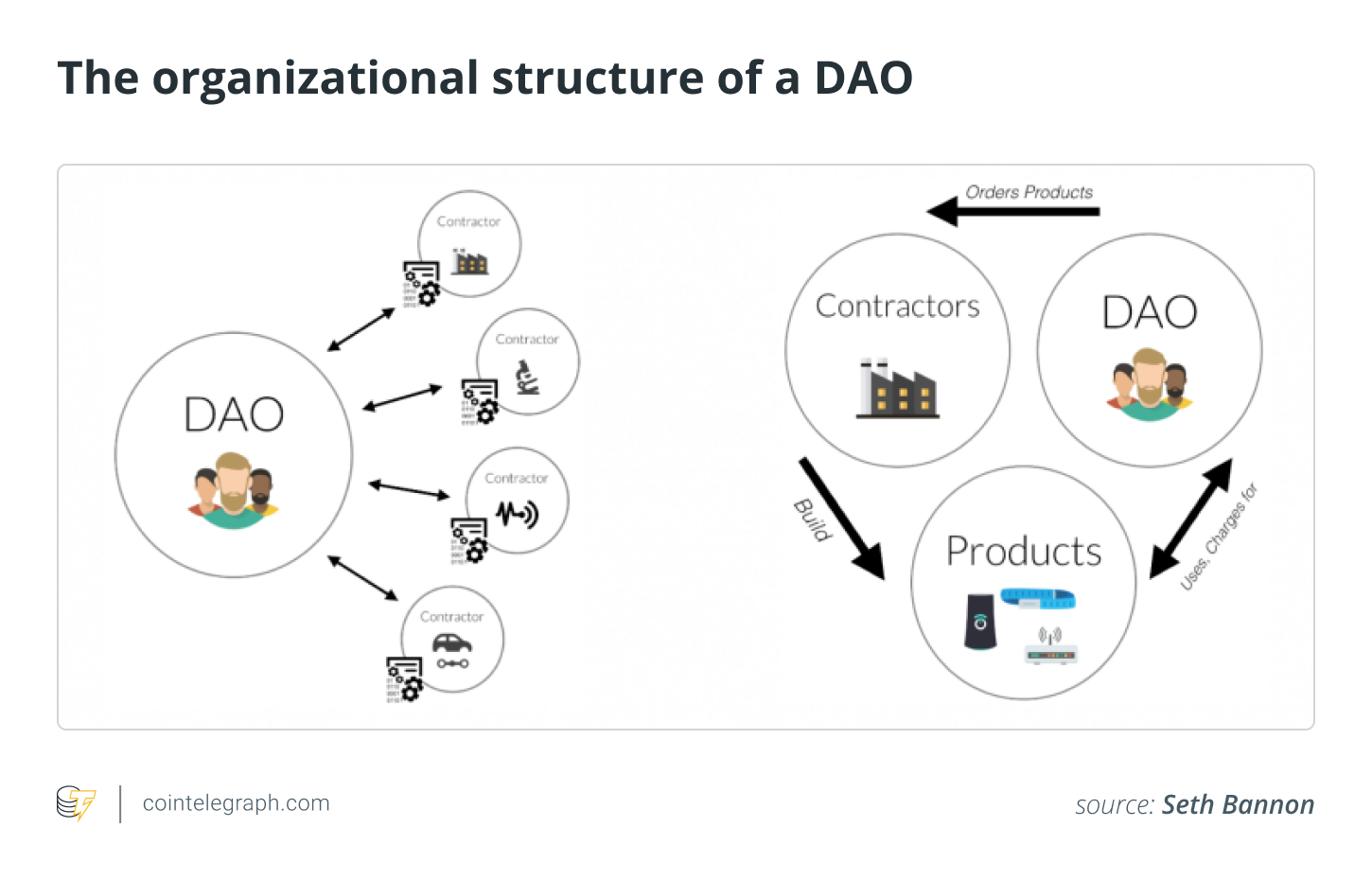
Using both social building and governance, the decentralized autonomous organization disruption is a notch higher. The DAO is one major invention that is challenging current systems of governance. Utilizing NFTs, DAOs are changing our perspective of how organizations and systems should be run, and they put further credence to the idea that the optimal form of governance does not have to do with hierarchical structures.
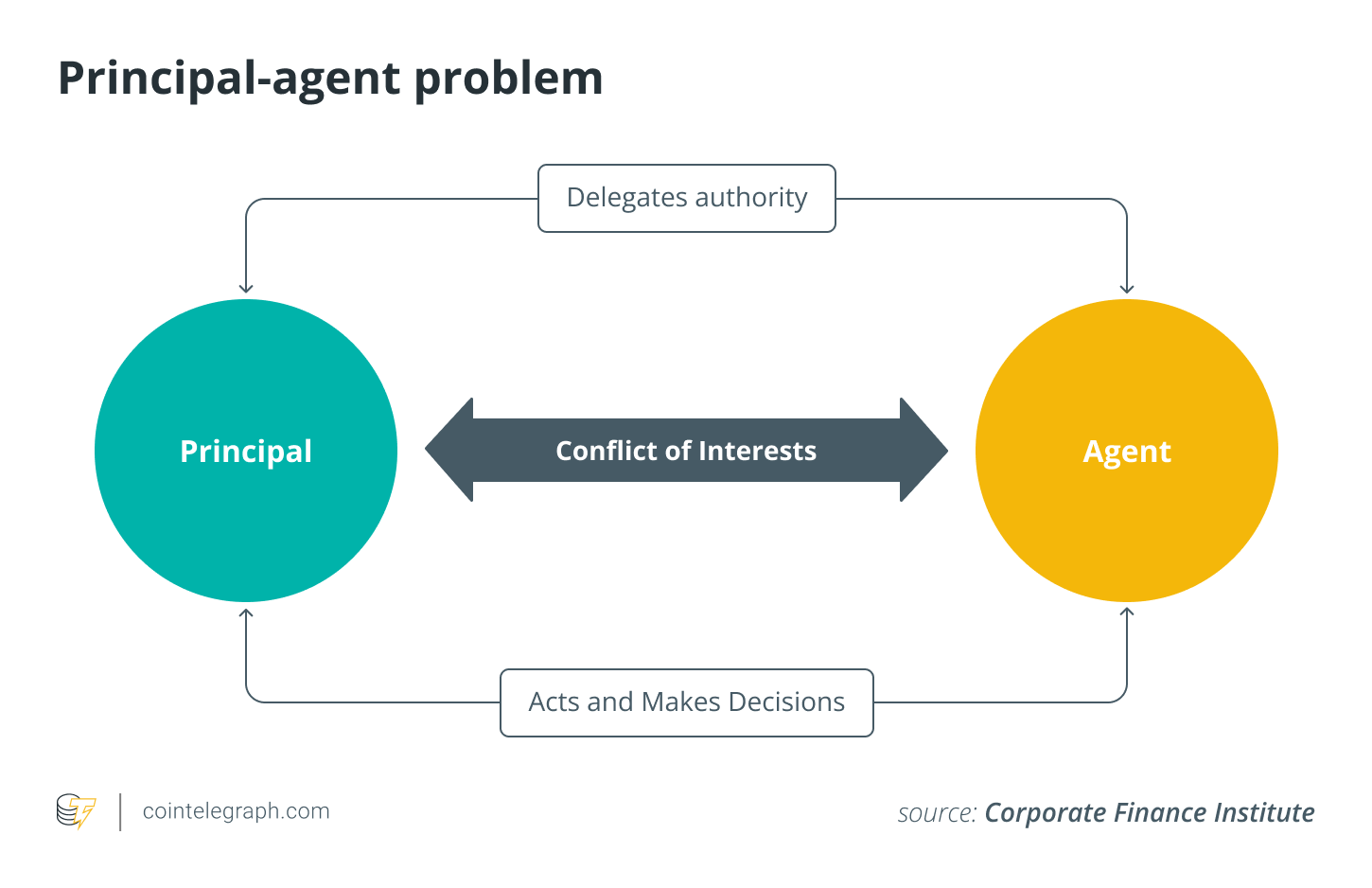
With the principal-agent problem limiting the growth of organizations and preventing agents from feeling like part of a team, you can see why the need for decentralized organizations fostering community-inclusion is paramount.
Is there something you would change about your current organization if given the chance? Leadership? Structure? Payment system? What if your current organization could help you feel like a more valid part of the team by reducing the disparity between the principals and staff? Or, better put: What if you get to be a part of your organization’s governance? Sound interesting? This is what we’ll be discussing here.
Understanding DAOs
From its name alone, you can probably get an idea of what a decentralized autonomous organization is. A DAO is an organization that is focused on a specific mission, and its members work in coordination according to a shared set of rules encoded on a blockchain. The major purpose of the decentralized autonomous organization is to help eradicate a significant problem in many conventional organizations — the principal-agent problem.
As the popular English phrase goes, two’s company; three’s a crowd. Organizations need a more hands on deck. But with each new person joining the team, there is bound to be some divergence of interest, priorities and goals. This often results in parties making some selfish choices. DAOs avoid this problem by existing as a trustless system, removing the need for centralized leadership.
There are a few criteria that a company must meet before it can be considered a decentralized autonomous organization. The governing rules and policies need to be set up as a smart contract on a blockchain — this helps to remove the need for a central authority, and it also prevents any party from making decisions that are different from the organization’s initial goal. The treasury of the organization must be accessible only with the consent of the whole group, or at least a predefined percentage.
A brief history of DAOs
The earliest application of DAOs did not go well simply because stakeholders did not put a standard precautionary measure in place. Created in early 2016, the first DAO was called, simply, The DAO. It was an open-source framework focused on venture capitalism. It became an instant success, raking in over $250 million worth of Ether (ETH) — note that ETH was priced at around $20 at this time.
This huge success did not last long, as a bug exploitation attack left The DAO reeling from a loss of roughly 3.6 million ETH in mid-2016. It didn’t recover. Since then, several attempts have been made to run a successful DAO, and many more are being created at this very moment. (The Faith Tribe, discussed later in this article, is one of the closest to full decentralization.) The success of a DAO lies in the strength of its smart contract. And, as an investor, you should spend time looking through the smart contract’s open-source code to check for any red flags or abnormalities.
A token that can be spent within the system for rewards.
The smart contract holds the rules and nitty-gritty of the DAO, ranging from a roster of its members, the amount invested, who the majority stakeholders are, the workflow, and the reward mechanism. The other two aspects depend on this important facet, as a faulty smart contract puts the project at risk. Any upgrade would also need votes from all its members, so it is important to get it right from the start.
Encoded in the smart contract is a token. The token is useful in allocating rights and incentives to the organization members. The DAO involves everyone in its mission, but members have different levels of benefits based on different input values.
Notable advantages of using a DAO:
The autonomous structure of DAOs makes them open to transparency. The concept of decentralization has fostered the idea of trust and, with DAOs, you don’t need to be worried about the people behind the organization and whether or not there’s an ulterior motive. The template everyone is judged by is the smart contract, and every transaction is immutably recorded on the blockchain.
There is no long, arduous process required to accept innovations with no central authority. With DAOs, innovations do not need to pass through different hierarchies before they get to those with the authority to make decisions. Anyone can make a suggestion, and the fact that these suggestions come at a fee encourages more well-researched and thought-out ideas, not just random, vague ones.
DAOs solve the principal-agent problem. There is no power play as members see themselves as equally responsible for the organization’s progress. Everyone is responsible for the organization’s direction, and if there is to be a change in the trajectory, it has to come with the consent of everyone on board.
Disadvantages of using a DAO:
The major disadvantage of the DAO is that it needs everyone to be involved. (Wait! I know you’re thinking: “Isn’t that supposed to be an advantage?”) Yes, there are times when the codes written for the smart contracts are buggy and have loopholes, and getting the whole organization to agree on how to rectify those issues becomes a time-consuming process. Knowing that hackers can operate more effectively given ample time, this can cause huge problems.
The legal terrain for DAOs is still subject to the regulatory frameworks of different nations. Since the DAO itself is not bound by borders, it comes with a high possibility of facing multiple lawsuits from different cities/countries. This is a hurdle that has not yet been surmounted.
Examples of and use cases of DAOs
Faith Tribe
Faith Tribe is an open-source design platform specially made to give fashion creatives a say both in the metaverse and physical world. It is the first fully decentralized platform for fashion creatives, and it is community-owned.
The general idea of NFTs relates to arts, so Faith Tribe is looking to change the fashion design narrative by contributing to the growth of Web3 while also building an economically viable ecosystem.
The global market for fashion apparel is roughly $3 trillion, and 15% of this is unbranded. With Millenials and Gen Z showing unflinching interest in fashion, Faith Tribe is looking to leverage their engagement with the metaverse in bringing more brands into the limelight without the help of an intermediary.
Gains Associates
Another great example of a DAO use case is Gains Associates. Gains Associates is a decentralized investment fund that utilizes a DAO in order to make investment in cryptocurrencies and projects in the blockchain space accessible to anyone — and in a transparent way. The organization does this by sharing news, insights and opinions with a like-minded community whose main goal is to develop a solid aptitude and knowledge with regard to investing in the industry.
Paragen
A fantastic example of a DAO being used as a project launchpads is Paragen. This is an organization that focuses on helping projects through the preparatory stages before they launch. From marketing to strategy, to in-depth technical development, Paragen offers comprehensive advisory support throughout a project’s cycle.
Paragen also incubates projects by searching for talent. Upon the discovery of this talent, Paragen then works with the talent in an advisory capacity as an incubator. Finally, Paragen helps with the launching of projects. Through the DAO’s rigorous screening process and sophisticated research papers, the community members have a portal to where they can access safe and secure projects in a single hub.
Tangible
Tangible is an interesting example of the types of problems that can be solved using the DAO model. Tangible custodies real world assets like fine wine, gold and real estate and mints NFTs that represent the physical asset. These NFTs will be tradable on their marketplace, which is set to launch in the near future. This enables deep instant liquidity for assets that have traditionally been cumbersome to trade.
Gaming and DAOs
In 2021, blockchain gaming took the world by surprise with a high rate of adoption and acceptance. It’s great just being able to play a game and earn value from it on the blockchain, but playing a game that utilizes the benefits of a DAO for its community is even better.
One such platform to offer these games is Nest Arcade. Nest Arcade is a play-to-earn arcade application on the blockchain. The project’s goal is to massively accelerate the adoption of blockchain technology through the help of a simple application that offers a variety of games its community members can select from and play. Think of this as a Netflix application, but for mini-to-medium scale games.
Using Nest Arcade, players will be able to own their in-game characters through the use of NFTs and playing with them in a variety of play-to-earn games. Players will earn rewards from playing on the Nest Arcade platform via Nest’s own SPL token ($NEST), which is the project’s currency, as well as via Solana (the blockchain it is built on).
Even though the growth of DAOs has been overshadowed by NFTs and various play-to-earn models, they have been growing significantly in relative silence, and many of them have seen sizable venture capitalist involvement. Gaming DAOs are a major part of the DAO ecosystem that have received heavy investment from VC funds.
Despite their substantial funding, it is difficult to see how they will fare against less decentralized virtual world games, such as Roblox.
Why DAOs are the future
The stereotypical traditional organization has seen more flaws than imagined, and the COVID-19 pandemic has left us with many workers who are not willing to return to their former jobs because they feel used and without a say. It’s unclear if the traditional systems will change or how soon they will, but DAOs have shown a clear path to better working conditions and staff management.
The two unique models for DAOs are the token-based membership and the share-based membership, and both of them have team-centric motives — not a sign of superiority complex.
Because of these reasons and many more, the concept of bringing decentralization into private and public governance has been birthed.
The decentralized autonomous organizations have been used in projects like Dash, Digix, and even BitShares. We have even seen torrents operate similar models and look to integrate blockchain inclusiveness into their future upgrades.
As Vitalik Buterin, co-founder of Ethereum, cited, most companies are likely to buy into the DAO system as it helps to reduce operational costs and improve the bottom line of these companies’ finances.
This article does not contain investment advice or recommendations. Every investment and trading move involves risk, and readers should conduct their own research when making a decision.
The views, thoughts and opinions expressed here are the author’s alone and do not necessarily reflect or represent the views and opinions of Cointelegraph.
Evan Luthra is a tech entrepreneur and blockchain expert holding an honorary Ph.D. in decentralized and distributed systems. Evan has been featured in Influencive’s “The Top 30 Entrepreneurs Under 30 Creating Life On Their Own Terms.” His companies, StartupStudio and Iyoko, invest in and help build the companies of tomorrow. Evan is a featured speaker at various universities and conferences around the globe.
As public understanding of how digital assets work becomes more nuanced along with the mainstreaming of crypto, the language of Bitcoin’s (BTC) “anonymity” gradually becomes a thing of the past. High-profile law enforcement operations such as the one that recently led to the U.S. government seizing some $3.6 billion worth of crypto are particularly instrumental in driving home the idea that assets whose transaction history is recorded on an open, distributed ledger are better described as “pseudonymous,” and that such a design is not particularly favorable for those wishing to get away with stolen funds.
No matter how hard criminals try to obscure the movement of ill-gotten digital money, at some point in the transaction chain they are likely to invoke addresses to which personal details have been tied. Here is how it went down in the Bitfinex case, according to the documents made public by the U.S. government.
Too comfortable too early
A fascinating statement by a special agent assigned to the Internal Revenue Service, Criminal Investigation (IRS-CI) details a process whereby the U.S. federal government’s operatives got a whiff of the couple suspected of laundering the money stolen in the 2016 Bitfinex hack.
The document describes a large-scale operation to conceal the traces of stolen Bitcoin that involved thousands of transactions passing through multiple transit hubs such as darknet marketplaces, self-hosted wallets and centralized cryptocurrency exchanges.
In the first step, the suspects ran the crypto earmarked as being looted in the Bitfinex heist through darknet market AlphaBay. From there, a portion of funds traveled to six accounts on various crypto exchanges that were, as investigators later found, all registered using email accounts hosted by the same provider in India. The emails shared similar naming styles, while the accounts exhibited similar patterns of trading behavior.
The chain wore on, and the BTC that law enforcement followed was further funneled to a slew of self-hosted wallets and other exchange accounts, a few of them registered in the real name of one of the suspects. Following along the investigators’ narrative, a reader eventually gets an impression that, at one point, Ilya Lichtenstein and Heather Morgan felt that they had done enough to cover up their tracks and that they could spend some of the money on themselves.
That was it: Gold bars and a Walmart gift card, purchased using the funds traceable back to the Bitfinex hack and delivered to Lichtenstein and Morgan’s home address. Everything was right there on the ledger. The resulting report reads as a compelling description of a crime that has been reverse-engineered using an immutable record of transactions.
Following the money
The scale of the investigation was perhaps even more formidable than that of the laundering operation. Despite the suspects’ years-long efforts to obscure the movement of the funds, government agents were able to gradually unravel the paths by which the majority of stolen BTC traveled, and ultimately seize it. This goes to show that the U.S. government’s capacity to follow the money on the blockchain is at least on par with the tactics that the people behind some of the major crypto heists are using to escape the law.
Speaking of the investigation, Marina Khaustova, chief executive officer at Crystal Blockchain Analytics, noted that the Bitfinex case is an especially hard one to crack due to the sheer amount of stolen funds and the perpetrators’ extensive efforts to conceal their operations. She commented to Cointelegraph:
“Any case of this size, which has been running for years, it will no doubt take a long time for financial investigators to examine and understand the data they have before using it as evidence.”
The U.S. government agents were well-resourced and had access to state-of-the-art blockchain analytics software as they tackled the case. It is no secret that some of the leading players of the blockchain intelligence industry supply law enforcement in multiple countries, the United States included, with software solutions for digital asset tracing.
One possible explanation of why Lichtenstein and Morgan ultimately got busted is the seeming nonchalance with which they abandoned caution and began spending the allegedly laundered funds in their own name. Were they simply not smart enough, or is it because law enforcement has gone unprecedentedly deep into the transaction chain, deeper than the suspects could reasonably expect?
Khaustova thinks that there was “a bit of carelessness to the methods employed” as the suspects let investigators obtain one of the key documents – which allowed them to link email addresses to exchanges, KYC records and personal accounts – from cloud storage.
Yet, it is also true that there is a point where any crypto launderer has to step out of the shadows and turn the stolen funds into goods and services they can use, at which point, they become vulnerable to deanonymization. The Bitfinex investigation showed that, if law enforcement is bent on tracing the suspects to that point of “cashing out,” there is little that criminals can do to avoid getting caught.
A case to be made
The big-picture takeaway here is that governments — the U.S. government in particular, but many others are not too far behind when it comes to bolstering their blockchain-tracing capacities — are already up to speed with the tactics and techniques that crypto launderers are using. The blockchain’s perfect traceability could have been a theoretical argument some years ago, but now it is an empirically proven reality, as evidenced by enforcement practice.
There are two big reasons why this notion is good for the crypto industry. One is that there could be some degree of recourse for the victims of major crypto heists. Granted, not every instance of crypto theft will attract the scarce attention of federal investigators, but the most high-profile and egregious ones certainly will.
Another powerful consequence of law enforcement’s newfound prowess with blockchain tracing is that it renders some regulators’ tired argument of “crypto as a perfect tool for money laundering” obsolete. As real-life cases demonstrate, digital assets are, in fact, opposite to that. Hammering this point into policymakers’ minds will eventually moot one of the fundamental anti-crypto narratives.
Ether (ETH) reached a $3,280 local high on Feb. 10, marking a 51.5% recovery from the $2,160 cycle low on Jan. 24. That price was the lowest in six months, and it partially explains why derivatives traders’ main sentiment gauge plummeted to bearish levels.
Ether’s futures contract annualized premium, or basis, reached 2.5% on Feb. 25, reflecting bearishness despite the 11% rally to $2,700. The worsening conditions depict investors’ doubts regarding the Ethereum network’s shift to a proof-of-stake (PoS) mechanism.
Analyzing Ether’s performance from a longer-term perspective provides a more appealing sentiment, as the cryptocurrency is currently 45% below its $4,870 all-time high.
Furthermore, the Ethereum network’s adjusted total value locked (TVL) has held a reasonable 42.8 million ETH despite the price correction.
Ethereum network total value locked, in ETH. Source: DefiLlama
As shown above, the network’s TVL increased by 16.5% in three months, reflecting growth from decentralized finance (DeFi) and nonfungible token (NFT) marketplaces.
However, due to network upgrade delays and worsening global macro conditions, professional traders are becoming frustrated and anxious, a sentiment that is depicted in multiple derivatives metrics.
Ether futures hit their most bearish level in seven months
Retail traders usually avoid quarterly futures due to their fixed settlement date and price difference from spot markets. However, the contracts’ biggest advantage is the lack of a fluctuating funding rate, hence the prevalence of arbitrage desks and professional traders.
These fixed-month contracts usually trade at a slight premium to spot markets because sellers are requesting more money to withhold settlement longer. This situation is known technically as “contango” and is not exclusive to crypto markets.
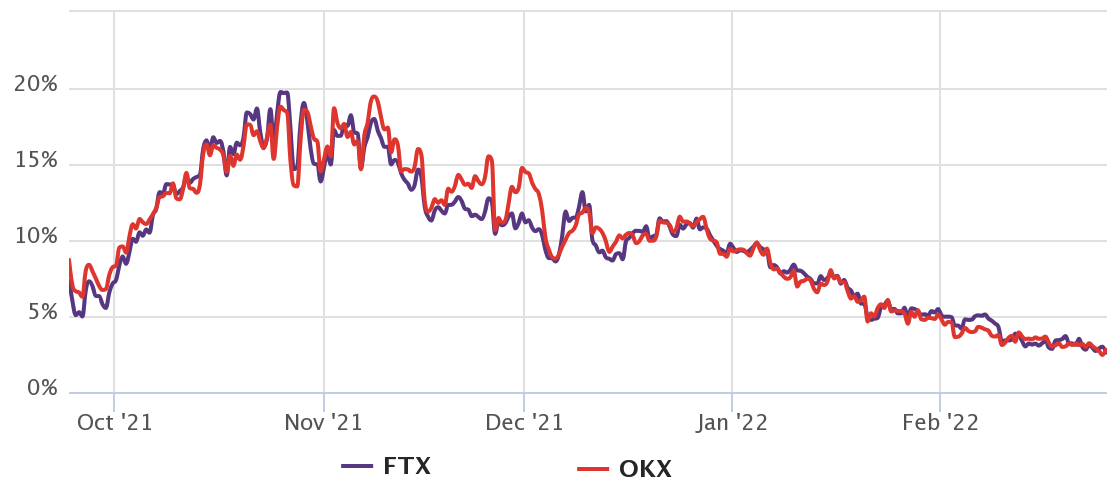
Futures should trade at a 5%–15% annualized premium in healthy markets. Yet, as displayed above, Ether’s annualized premium has decreased from 20% on Oct. 21 to a meager 2.5%.
Although the basis indicator remains positive, it has reached the lowest level in seven months. The crash to $2,300 on Feb. 24 caused bearish sentiment to prevail, and not even Feb. 25’s 10% recovery was enough to flip the tables.
Currently, data shows few signs that bulls are ready to regain control. If this were the case, the Ether futures premium would have turned positive after such a rally.
The views and opinions expressed here are solely those of the author and do not necessarily reflect the views of Cointelegraph. Every investment and trading move involves risk. You should conduct your own research when making a decision.
The world’s most popular sport suffered an own goal as European clubs canceled their partnerships with Bitci, a Turkish crypto exchange. However, plenty of substitute crypto companies are on the bench, ready to bring crypto to the mainstream through soccer.
Portugal’s Sporting CP, the green-and-white-striped footballers famed for being the club where Cristiano Ronaldo cut his teeth, whereas Italian club Spezia, play in Italy’s Serie A, have also canceled their partnership with Bitci. The F1 powerhouse Mclaren Racing terminated their sponsorship deal with Bitci earlier in February.
Barcelona also recently announced that they would favor a partnership deal with Binance over Spotify, despite the launch of their fan token in April 2021.
While it would appear that crypto and soccer partnerships are down to 10 men; deals, enthusiasm, and sponsorships for crypto among football clubs are an open goal.
Seventeen of England’s 20 football clubs have at least one deal with a cryptocurrency firm. For Watford soccer club, not only does Dogecoin (DOGE) appear on the shirtsleeve, but Stake.com sponsors the main body of the shirt.
Dogecoin and Stake.com on Watford FC football shirt. Source: DW
Eighty miles Southeast of Watford, in Southampton “the Saints,” as they are known locally, launched a Bitcoin (BTC) hunt on Feb. 23. In partnerships with crypto betting site Sportsbet.io, the online quiz winner takes home a whole Bitcoin.
Still in England, Bitcoin podcaster Peter McCormack sparked the beginnings of an English underdog story as he bought his local club Bedford FC. He’s keen to take on the Premiere League with the help of Bitcoin and its community.
Elsewhere, fan tokens are also growing in popularity among European football fans. As Cointelegraph reported, blockchain sports firm Chiliz has caught the eye of major football clubs, as Socios, its platform, announced a deal with UEFA.
The Inter Milan fan token appearing on the shirt. Source: Inter.it
While a crypto sponsor for a European national team may have to wait till next season, the Argentine team was the first national soccer club worldwide to take on a crypto sponsor. Binance recently partnered with the white and sky blues.
Finally, as European soccer waits for a national team to be sponsored by crypto, in rugby football, BitPanda crypto exchange now sponsors the Azurri. The exchange made the announcement ahead of Italy’s clash with the six nations rugby teams in January.
Ciao ragazzi!
We are proud to announce that we will be the main sponsor of @Federugby, the Italian Rugby Federation.
So, @SixNationsRugby fans, get ready to spot our logo whenever gli Azzurri are playing!
Crypto markets are taking a beating but there are still a few standout performers even during this week’s volatility.
One sector that has managed to rise above the noise are NFT-related altcoins and GameFi tokens.
Top gainers in the collectible and NFT sector. Source: CoinMarketCap
Data from Cointelegraph Markets Pro and CoinMarket Cap shows that three notable gainers over the past 48-hours were Voxies (VOXEL), Smooth Love Potion (SLP) and MyNeighborAlice (ALICE).
Voxie Tactics launches its marketplace
VOXEL is the native utility currency of Voxie Tactics, a free-to-play, 3-dimensional, role-playing game that combines the classic look of the popular tactical games of the 1990s and 2000s with modern game mechanics.
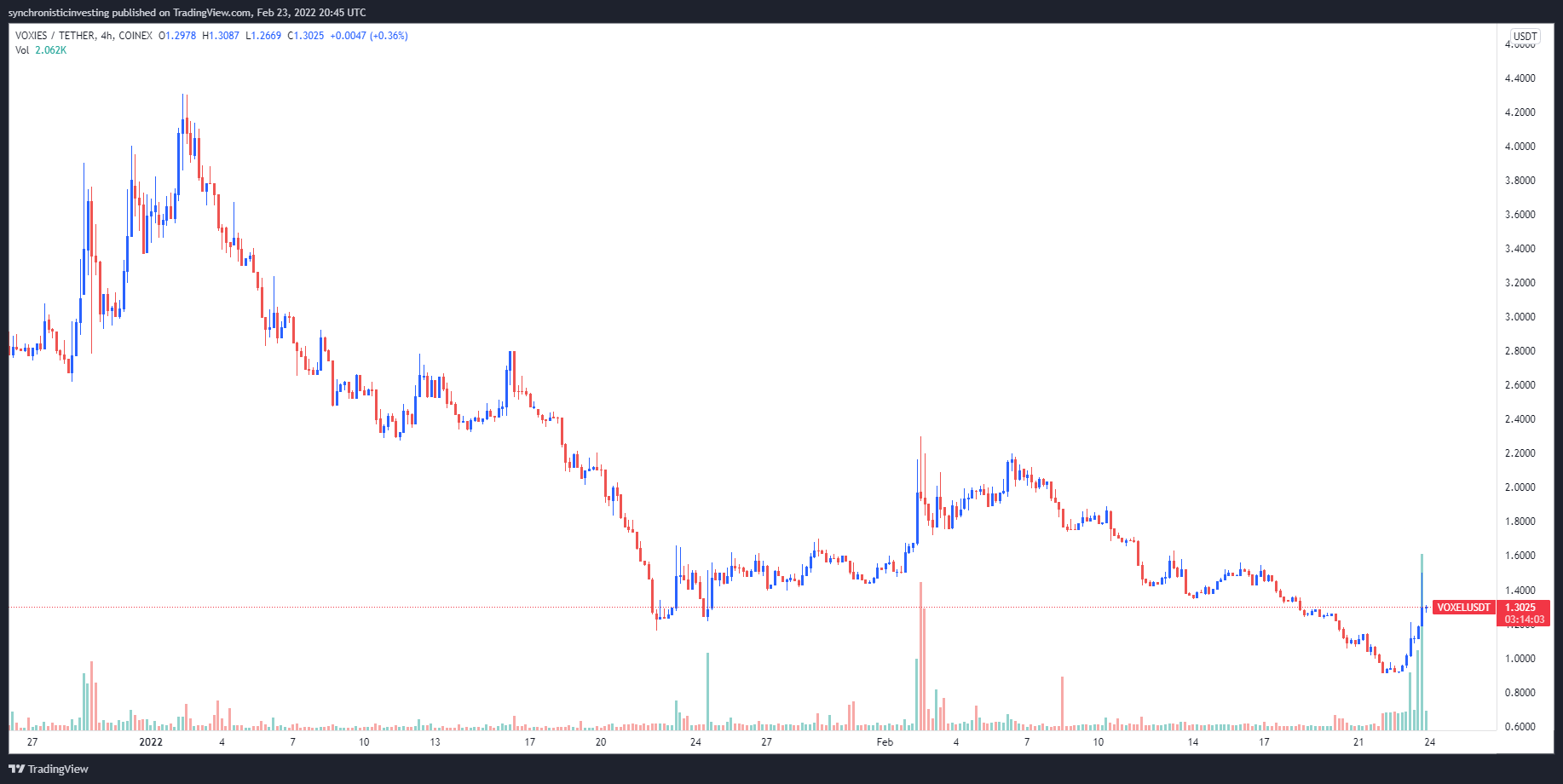
Data from TradingView shows that after hitting a low of $0.90 on Feb. 22, VOXEL price spiked 65.6% to a daily high of $1.50 on Feb. 23 amid a 688% increase in its 24-hour trading volume.
VOXEL/USDT 4-hour chart. Source: TradingView
The turn of fortune for VOXEL comes as the protocol announced the Feb. 26 launch of the Voxie Tactics marketplace which will allow users participating in the game’s beta launch to buy or sell items for gameplay.
Smooth Love Potion becomes more scarce
Smooth Love Potion is the in-game currency players earn while playing Axie Infinity that can be used to breed new Axies.
VORTECS™ data from Cointelegraph Markets Pro began to detect a bullish outlook for SLP on Feb. 22, prior to the recent price rise.
The VORTECS™ Score, exclusive to Cointelegraph, is an algorithmic comparison of historical and current market conditions derived from a combination of data points including market sentiment, trading volume, recent price movements and Twitter activity.
As seen in the chart above, the VORTECS™ Score for SLP climbed into the green on Feb. 20 and reached a high of 81 around 23 hours before the price increased 38% over the next day.
The price turnaround for SLP comes amid a revamp of the tokenomics for the Axie Infinity ecosystem that includes a decrease in the rate of emission of SLP which will reduce the number of SLP minted daily by 175 million SLP.
MyNeighborAlice is a farming-themed play-to-earn builder game with integrated decentralized finance features that operates on the Chromia network.
Data from Cointelegraph Markets Pro and TradingView shows that the price of ALICE rallied 35% from a low of $6.11 on Feb. 22 to a daily high at $8.25 on Feb. 23.
ALICE/USDT 4-hour chart. Source: TradingView
The sudden spike in price and trading volume for ALICE followed an announcement from top-ranked U.S.-based cryptocurrency exchange Coinbase that it would be adding trading support for ALICE beginning Feb. 24.
The overall cryptocurrency market cap now stands at $1.713 trillion and Bitcoin’s dominance rate is 41.7%.
The views and opinions expressed here are solely those of the author and do not necessarily reflect the views of Cointelegraph.com. Every investment and trading move involves risk, you should conduct your own research when making a decision.
Findings from an online survey of 1,500 United States-based consumers reveal people’s deep concerns over privacy and tech platforms’ outsize power while suggesting that Web3 is yet to become a household term.
The study was fielded by global insights and strategy firm National Research Group (NRG) in January 2022. 54% of respondents said they were worried about their rights and freedoms are being threatened by technology, with 44% citing online privacy concerns, 38% being unhappy about online ads, and 35% reporting feeling a lack of control over their data. Almost half believe that tech companies have accrued too much power and have to be broken up.
Still, only 13% reported knowing what Web3 means, while 54% haven’t heard the term at all. Of those who have, 83% reported believing that the new version of the internet will improve their lives. Speaking of the potential downsides of the new Web, 33% cited concerns of cybercrime and scams ramping up when the decentralized internet comes to fruition.
Notably, U.S. consumers do not think that the burden of ensuring positive social impact of the future internet rests primarily with regulators: only 32% ascribe the leading role on this matter to politicians and regulatory agencies. More than half (51%) believe that it is mainly tech companies’ responsibility, and 50% said that is developers’ and engineers’ job.
On the crypto adoption note, 57% of respondents reported having bought crypto or considered doing so. 39% percent believe that cryptocurrencies are most similar to stocks and shares rather than fiat currencies (18%) and commodities like gold (15%).
Marlon Cumberbatch, senior vice president and global head of insights at NRG, commented to Cointelegraph:
“To me, the most unexpected finding from this research was just how many consumers felt a strong sense of a lack of agency in online spaces. It’s rare, in this increasingly polarized world, to find anything that unites all of us. But it seems that Americans, regardless of income, politics or race, feel strongly that they don’t have enough control over how they engage with content online and how corporations use their personal data.”
Cumberbatch added that the findings point to “a real desire among consumers for a new era of the internet,” the kind that would give them a greater sense of agency and control over their online experiences. The primary roadblock at this point seems to be the lack of information and the still-insufficient public understanding of Web3-related concepts.
Respondents were selected to participate in the study based on quotas calibrated to U.S. census data for age (within the 18 to 64 range), gender, race, region, income and education level. While this method does not yield a sample representative of the general population in the strict sense, it does allow to draw robust generalizations about how opinions are distributed.
There has been a lot of focus on the performance of the stock and cryptocurrency markets over the past year or two as the trillions of dollars that have been printed into existence since the start of the COVID pandemic have driven new all-time highs, but analysts are now increasingly sounding the alarm over warning signs coming from the debt market.
Despite holding interest rates at record low levels, the cracks in the system have become more prominent as yields for U.S. Treasury Bonds “have been rising dramatically” according to markets analyst Dylan LeClair, who posted the following chart showing the rise.
U.S. Treasury bond yields across duration. Source: Twitter
LeClair said,
“Since November yields have been rising dramatically — bond investors begun to realize that w/ inflation at 40-year highs, they are sitting in contracts programmed to decline in purchasing power.”
This development marks a first for the U.S. debt markets as noted in the February letter to investors released by Pantera Capital, which stated “there has never been a time in history with year-over-year inflation at 7.5% and Fed funds at ZERO.”
Matters get even worse when looking at real rates, or the interest rate one gest after inflation, which Panteral Capital indicated is “at negative 5.52%, a 50-year low.”
Pantera Capital said,
“The Fed’s manipulation of the U.S. Treasury and mortgage bond market is so extreme that is it now $15 TRILLION overvalued (relative to the 50-year average real rate).”
Treasure and mortgage bonds overvaluation. Source: Pantera Capital
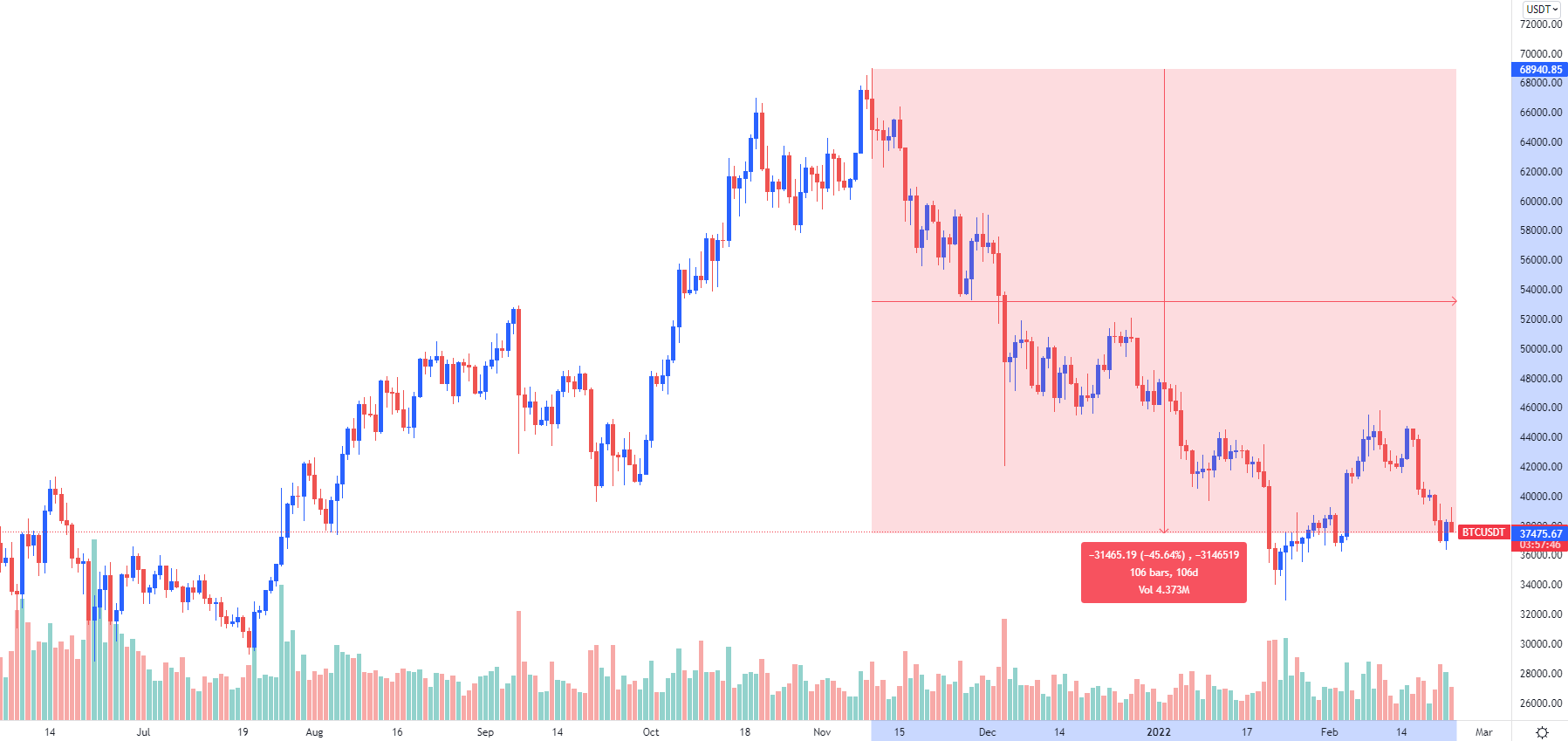
At the same time as treasury bond yields have been rising, Bitcoin (BTC) and altcoin prices have steadily fallen, with BTC now down more than 45% since Nov. 10.
BTC/USDT 1-day chart. Source: TradingView
The declines in the crypto market have thus far been highly correlated with the traditional markets as noted by Pantera Capital, but that could soon change as “crypto tends to be correlated with them for a period of roughly 70 days, so a bit over two months, and then it begins to break its correlation.”
According to Pantera’s report,
“And so we think over the next number of weeks, crypto is basically going to decouple from traditional markets and begin to trade on its own again.”
Despite the weakness seen in BTC since the talk of rising interest rates began, the situation could soon improve according to Pantera Capital, which warned that “10-year interest rates are going to triple — from 1.34% to something like 4%–5%.”
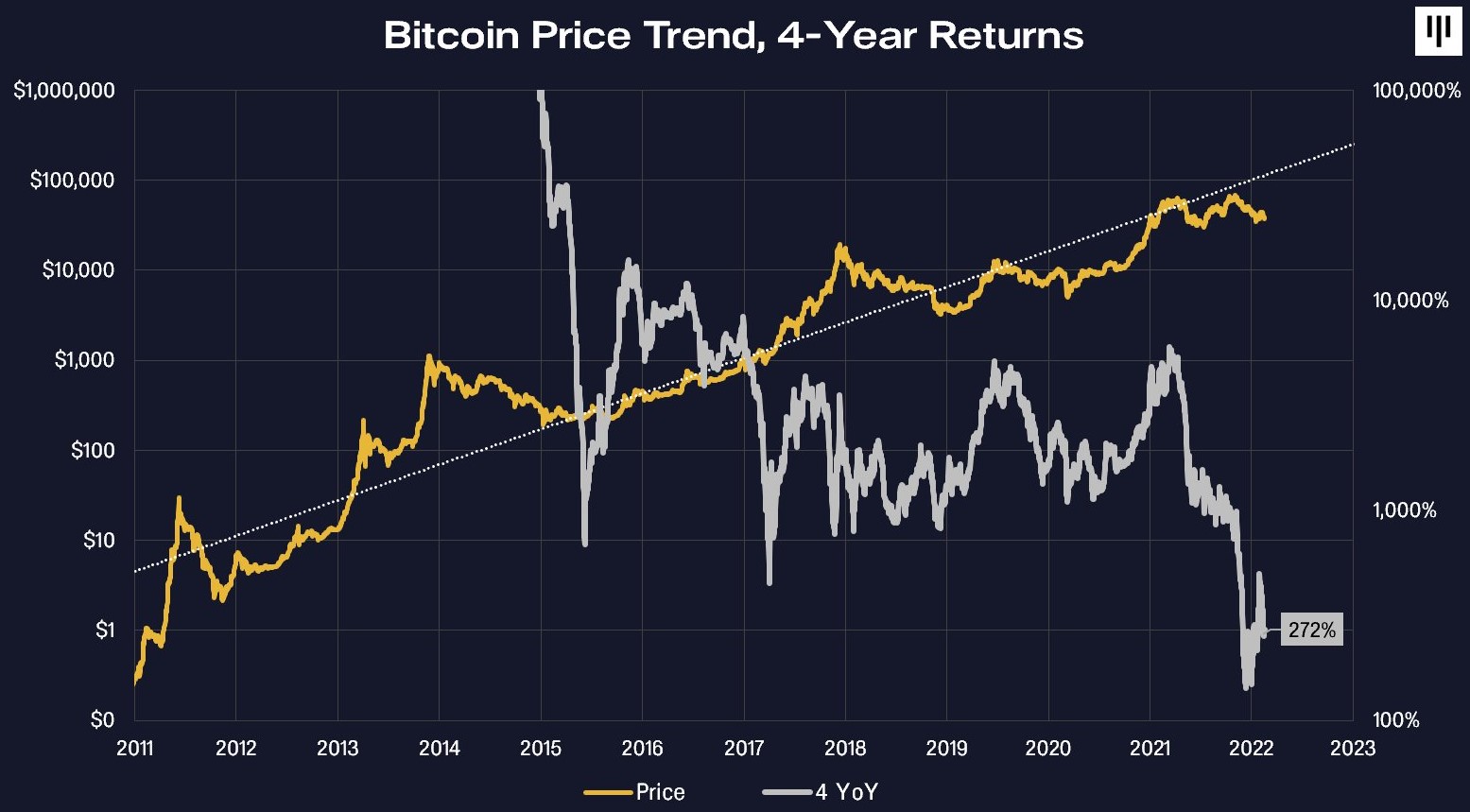
Based on the well known saying to “be fearful when others are greedy, and greedy when others are fearful,” this might be the opportune time to accumulate BTC because its “four-year-on-year return is at the lowest end of its historical range” according to Dan Morehead, CEO of Pantera Capital, who posted the following chart suggesting that Bitcoin “seems cheap” and “doesn’t look overvalued.”
Bitcoin price trend vs. 4-year returns.
Morehead said,
“Once people do have a little bit of time to think this through, they’re going to realize that if you look at all the different asset classes, blockchain is the best relative asset class in a rising rate environment.”
When it comes to a timeline to recovery, Morehead suggested that the turnaround could come sooner than many expect and only be a matter of “weeks or a couple of months until we’re rallying very strongly.”
Morehead said,
“We are quite bullish on the market, and we think prices are at a relatively inexpensive place.”
The overall cryptocurrency market cap now stands at $1.722 trillion and Bitcoin’s dominance rate is 41.6%.
The views and opinions expressed here are solely those of the author and do not necessarily reflect the views of Cointelegraph.com. Every investment and trading move involves risk, you should conduct your own research when making a decision.
zkSync, a provider of zero-knowledge blockchain solutions, has announced the successful deployment of its Rollup protocol on the Ethereum (ETH) testnet. The deployment is seen as a positive development by proponents of Ethereum, as it removes the need for human operators to validate transactions.
Last year, the creators of zkSync described their vision for a permissionless, Turing-complete rollout that allows decentralized applications (DApps) to be deployed in a low-cost and scalable layer-2 environment.
Users will supposedly have “a better” experience on this network, according to the official announcement by Matter Labs. One of the major issues when utilizing the Ethereum blockchain is its prohibitively high gas fees. As a result, many users and developers have migrated to lower-cost blockchains that do not require costly gas fees.
With the release of a completely EVM compatible scalability ZK Rollup, such as zkSync 2.0, it might be the long-awaited answer to this problem and crack open the door for a new era for Ethereum. The announcement was greeted with enthusiasm by the crypto community, with many fans joining Twitter to express their sentiments on the matter.
The latest deployment suggests that lower transaction fees are on their way. Hundreds of developers are anticipating launching projects zkSync 2.0. Developers were quick to express their desire to launch on zkSync 2.0:
This is huge, can’t wait to deploy my first solidity contract on this new unexplored land. Kudos to the team https://t.co/sAeyuwxdsc
Another user highlighted that the rollout would open up new possibilities:
testnet with evm compatibility and zkporter is here. people underestimate how many usecases it opens!!!@zksync is *the* Layer 2 we need. https://t.co/ER3jPQIp64
The platform’s plan for scaling up is built around a framework that allows for rapid growth without sacrificing security and privacy. This scalability solution will allow various ecosystem upgrades and act as a significant step forward in user experience. It will also decentralize application development on the network.
Congratulations to @zksync on the launch of their public testnet!
We look forward to helping connect zkSync to the entire EVM ecosystem https://t.co/bM3fkB0xIG
As reported by Cointelegraph, Morgan Stanley’s global investment office in the wealth management firm believes that if significant market competition emerges, Ethereum’s popularity might decline. The firm stated that Ethereum may lose its smart contract advantage to lower-cost and faster blockchain networks. The new rollout might be just what Ethereum needs to stay relevant in this competition.
The cryptocurrency market has had a less than stellar start to the year and it appears that the downtrend that began after the November 2021 market peak has been extended thanks to a multitude of negative developments, including the expectation of rising interest rates and the threat of a war between Russia and Ukraine.
While many traders have little appetite to risk capital during bearish conditions, contrarian investors looking to buy while “there is blood on the streets” have several viable options with data from Cointelegraph Markets Pro indicating that Bluzelle, a decentralized storage network for the creator economy, is one token with an increasingly positive outlook.
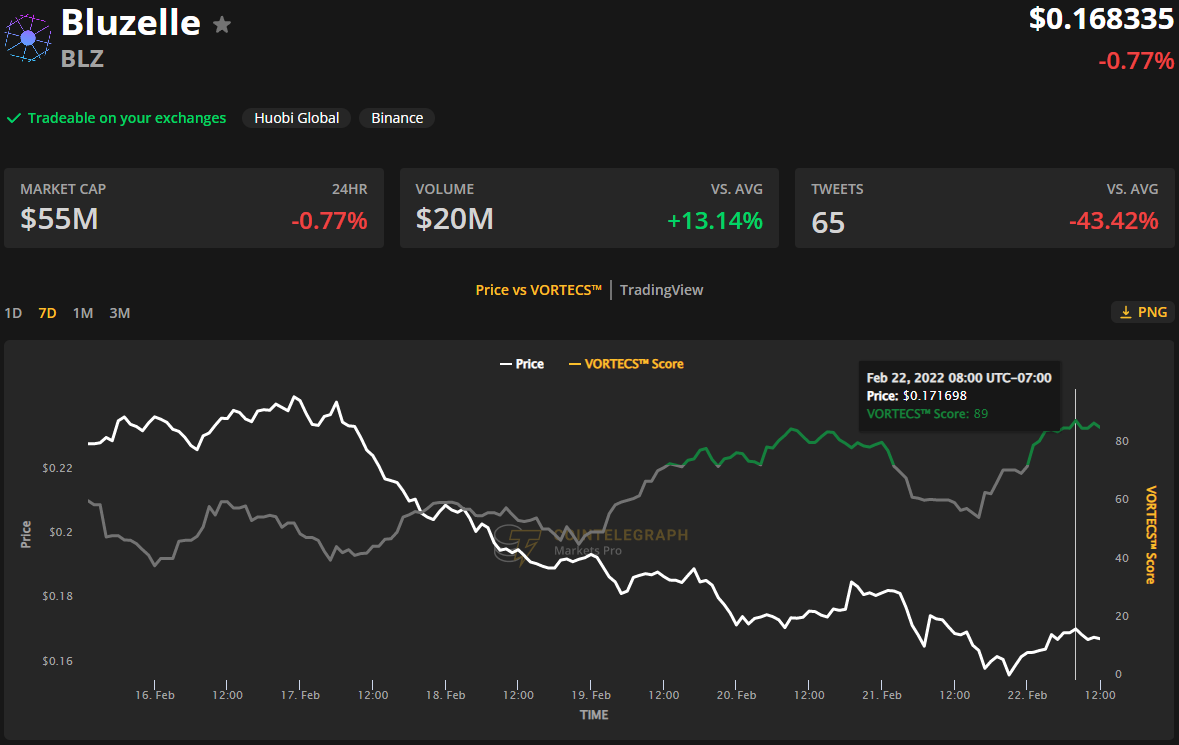
According to data from Cointelegraph Markets Pro, market conditions for BLZ have been favorable for some time.
The VORTECS™ Score, exclusive to Cointelegraph, is an algorithmic comparison of historical and current market conditions derived from a combination of data points including market sentiment, trading volume, recent price movements and Twitter activity.
As seen in the chart above, the VORTECS™ Score for BLZ began has been on the rise since Feb. 19 and reached a high of 89 on Feb. 22 as its price hovered just below a major support and resistance zone at $0.17
Here’s a look at three factors backing the building momentum for BLZ.
The launch of Denomination
One of the main developments helping drive interest in BLZ has been the launch of Denomination, the first play-2-earn (P2E) game on the Bluzelle network.
With the #Denomination launch upnext, we’ll be releasing exciting updates from the Denomination Whitepaper every week to help you with:
Core Game Progression Combat system Breeding System Tokenomics
Denomination is a real-time card battle game where gamers can fight against each other in player versus player (PvP) mode or against the environment in player versus environment (PvE) mode to receive tokenized rewards that can be used for governance or to purchase non-fungible tokens (NFTs)
The game was developed in collaboration with Starloop Studios, a professional game studio that has worked with some of the biggest game publishers in the world. It also includes a social system comprised of factions, a game shop, NFT marketplace, loot boxes and a treasury.
Collaboration with Cosmos
Another development helping build momentum for BLZ is the project’s ongoing collaboration with Cosmos to help build out GameFi on the Cosmos Network.
With our continued development with @cosmos, we will also discover new ways to build out game finance in the Cosmos ecosystem
We’ll explore methods to work with other chains as we go through production.
Cosmos has been one of the hottest networks over the past couple of months despite the overall weakness in the cryptocurrency market thanks to its rapidly expanding ecosystem of interconnected projects and newly launched protocols that have rewarded early adopters with airdrops.
The GameFi capabilities of Bluzelle could help the Cosmos ecosystem make its mark on the blockchain gaming sector.
Developers behind Bluzelle have also expressed interest in integrating with other networks that could benefit from the addition of GameFi capabilities.
A third factor making the case for BLZ is the overall popularity of blockchain-based gaming and the P2E model.
Gaming has long been one of the most popular and widespread segments of the traditional economy and the success of Axie Infinity shows that blockchain gaming could vastly outperform traditional gaming.
Soon the same endless hours you spent playing video games growing up will be spent on blockchain games.
A focus on helping to build out GameFi on multiple networks and the ability to process 10,000 transactions per second are helping to establish the bullish case for BLZ moving forward.
The views and opinions expressed here are solely those of the author and do not necessarily reflect the views of Cointelegraph.com. Every investment and trading move involves risk, you should conduct your own research when making a decision.