Some in the NFT community fear the market top may be in after Tai Lopez, the controversial entrepreneur and social media star, famous for his oddball marketing tactics, launched his own NFT project.
Tai lopez has to be the top. this madness cant continue.
— fxnction aka i gotabigdick.eth (@0x_fxnction) March 5, 2022
The NFT project is dubbed the “OG (original garage) Social Club” and pays homage to his highly memed-on ad from 2015 in which Lopez flaunted his Ferrari and the 2000 new books in his garage to promote his business courses of allegedly dubious value.
The NFTs come in three levels of rarity, including the silver “Mentorship” cards, gold “Mastermind” cards, and black “1 on 1 Mentorship” cards which all provide access to an online social club and varying levels of access to Lopez himself.
For example, in the Silver tier there is an NFT, reportedly priced at 18.4 Ether ($50,000), that grants the owner a chance to win $10,000 via one on one basketball game with Lopez. While an NFT from the gold tier enables the hodler to watch a two-hour movie with Lopez, once per year for a maximum of three years.
Alibaba’s NFT marketplace bans massage guns
Alibaba has reportedly suspended more than 680 users from its NFT marketplace Jingtan for using massage guns and computer software to spam the purchase process to buy nonfungibles on the platform.
According to an Alibaba representative who spoke to Forkast News on March 9, the firm’s technical department believes that some users were using the massage guns to perform rapid mouse clicks on buy buttons.
The accounts accused of spam buying have received one-year suspensions, with Jingtan labeling the activity “cheating” and in violation of its user policy.
English Premier League eyes NFTs
The English Premier League (EPL) is reportedly aiming to launch officially licensed NFTs later this year.
The EPL is the most famous pro-football league in the world and wants to replicate the success of tokenized sports collectibles from other projects such as Dapper Labs’ NBA Top Shot.
According to a March 8 report from UK newspaper The Telegraph, all 20 clubs discussed the sale of NFT rights at a shareholders meeting on Tuesday, and the League is carefully considering which blockchain and firm to partner with as the deal could be worth hundreds of millions of pounds. Further details are sparse at this stage.
The volume for the highly popular and recently charitable Bored Ape Yacht Club (BAYC) NFT project has dropped 65% over the past 30 days. But that may just because they’ve got way too expensive.
According to DappRadar data, the BAYC generated $92.14 million worth of secondary sales over the past month from a total of 526 traders (which is down 58.22% also).
While the NFT market appears to be going through a strong downturn across the board, a contributing factor to the BAYC’s decreased volume may also be its booming floor price.
DappRadar’s data shows the floor price is up 22.16% over the past 30 days to sit at around a whopping $197,800.
BAYC Volume over 30 days: DappRadar
Other Nifty News
The Crypto.com exchange announced the airdrop of its “The Moment of Truth” nonfungible token (NFT) collection on Wednesday featuring Los Angeles Lakers forward LeBron James to 5,550 randomly selected viewers of its Super Bowl commercial.
The Sandbox metaverse announced its partnership with NFT community World of Women, or WoW, to launch the WoW Foundation. A $25 million grant from The Sandbox will help fund the foundation over the next five years.
The pair had shrugged off the latest round of macro tensions to add over 11% in 24 hours, among the best movers in the broader crypto market.
Despite mixed feelings over the real significance of the move among traders and analysts, fresh information about U.S. President Joe Biden’s executive order on cryptoassets appeared to allay some of the market’s fears.
An accompanying fact sheet seemed to point to the order being more investigative than draconian, making the White House’s latest efforts decidedly unlike last year’s Infrastructure Bill.
“The Administration will continue work across agencies and with Congress to establish policies that guard against risks and guide responsible innovation, with our allies and partners to develop aligned international capabilities that respond to national security risks, and with the private sector to study and support technological advances in digital assets,” it concluded.
Reacting, Bill Barhydt, founder and CEO of payment gateway Abra, called the order a “nothing burger with a side of psychobabble” and said that Bitcoin was rallying as a result.
The fact sheet, itself, did not mention “Bitcoin” at all, referring only to “digital assets” and “cryptocurrencies.”
“Today, POTUS signed an Executive Order on crypto-assets. I look forward to collaborating with colleagues across the government to achieve important public policy goals: protecting investors & consumers, guarding against illicit activity and helping ensure financial stability,” Gary Gensler, chair of the Securities and Exchange Commission (SEC), wrote on Twitter.
Among the order’s plans was a pledge to further research into a central bank digital currency, or CBDC, on the part of the U.S. government.
Range resistance not tipped to be broken
Buoyed by the events, BTC price action thus allowed market players to push higher in their short-term forecasting.
A pair of siblings is now in very hot water with the U.S. government with criminal charges filed against them for allegedly committing fraud in the Ormeus Coin scheme.
On Mar. 8, the Securities and Exchange Commission (SEC) charged siblings John Albert Loar Barksdale and sister JonAtina (Tina) Barksdale with violating federal securities laws and allegedly defrauding at least 12,000 “retail investors out of more than $124 million.” The Department of Justice (DOJ) arrested John abroad and charged him with wire fraud, securities fraud, and conspiracy.
Both of the Barksdale siblings are U.S. citizens. John, 41, was living in Thailand while JonAtina, 45, was in Honk Kong according to Reuters.
There were two Ormeus Coin (ORME) initial coin offerings (ICOs) starting in 2017. The SEC complaint specifically states that the Barksdales lied about “the size, value, and purported profitability of Ormeus Coin’s cryptocurrency mining assets.”
ORME is an ERC-20 token and a BEP-20 token found on Ethereum (ETH) and BNB Chain (BNB).
While both siblings created social media posts and videos marketing the project, only John attended traveling roadshows and conferences to promote it. Associate Director in the SEC’s Division of Enforcement Melissa Hodgman likened John to a “snake-oil salesman.” She also said both siblings used “social media, promotional websites, and in-person roadshows to mislead retail investors for their own personal benefit.”
Hodgman also reaffirmed the SEC’s position on fraudsters in the crypto industry in stating:
“We will continue to vigorously pursue persons who sell securities in schemes to defraud the investing public no matter what label the promoters apply to their products.”
Both the SEC and DOJ are basing fraud charges on alleged misrepresentations the Barksdales told investors about the state of the Ormeus mining operation. The Oremus Coin website states that mining operations for the coin started in Nov. 2017 with physical Bitcoin (BTC), Litecoin (LTC), and Dash (DASH) mining devices. The Barksdales claimed that the project had invested $250 million into the mining operation backing ORME, and that it was generating $5 million in monthly revenue.
The project allegedly misled investors by showing its vault wallet was worth more than $190 million as of last Nov. However, the display was allegedly set up through a separate website that showed the value of an unrelated wallet. The SEC claims that the project’s real wallets “were worth less than $500,000.”
The DOJ also stated that the mining operation “never approached a value close to $250 million and never produced revenues exceeding one million dollars in any month.”
John, who wrote a blog post on February 26, 2018 about “Why Taking Calculated Risks In Life Is Important” is still listed on the Ormeus Coin and Ormeus Cash websites as an advisor. A court date will be set while the Barksdales are held in custody.
A recent decision by the 11th Circuit Court of Appeals could give the SEC more leverage in this case as it allows prosecutors to use a broader range of evidence. The court reversed a decision by an inferior court which prevented prosecutors from including videos from being used in the securities fraud case against the BitConnect founders on Feb. 18.
The SEC has been hawkish on common advertising methods in the crypto industry and whether it constitutes securities fraud. Reports emerged on Mar. 3 that the Commission currently has its sights set on nonfungible tokens (NFT) used for fundraising purposes “like traditional securities.”
The Sandbox (SAND) metaverse announced its partnership with nonfungible token (NFT) community World of Women, or WoW, to launch the WoW Foundation. A $25 million grant fromThe Sandbox will help fund the foundation over the next five years. The mission of the WoW foundation is to amplify female representation in the NFT and metaverse spaces.
As a collection of “diverse and powerful” women sold on the Ethereum blockchain, World of Women shared with Cointelegraph that they aim to lower the barrier to entry for women in Web3.
“Our mission is to highlight and lift up as many female and underserved creators as possible, making the metaverse not just a landscape designed by men but rather one enriched with as much diversity of thought as possible.”
This mission has four main pillars: uplift the ecosystem by supporting artists and funding projects; educate newcomers; give more visibility to women-centric causes and give back to charities. Via The Sandbox’s grant, it also plans to support creators’ journeys in Web3, from mentoring and funding their first mint to their first sale.
World of Women and The Sandbox intend to work together to create a series of interactive experiences via the WoW Foundation within the metaverse. Among these projects are theWoW Museum on a 2×2 Sandbox LAND, the WoW University, which provides free online lessons on how to get started with Web3, and The WoW Academy, which will serve as a mentoring and funding incubator.
Recently, The Sandbox acquired the most expensive WoW NFT at the time of purchase for 200 ETH, named Aurora, and made her the new “goddess” of The Sandbox. Yam Karkai, co-founder and artist of World of Women, revealed that WoW will be voxelizing all 10,000 NFTs “so that our entire community can join us” in the metaverse. These interoperable avatars will be accessible within The Sandbox’s “Alpha, Season 2.
Additionally, WoW may be gearing up for film, TV and music opportunities thanks to tech investor Guy Oseary who recently added World of Women to his NFT portfolio. WoW NFT holders have complete ownership and intellectual property rights over their assets, similar to the Bored Ape Yacht Club model.
Both The Sandbox and World of Women currently rank within the top 20 collections of all time in terms of trading volume on OpenSea. At the time of publication, WoW had traded 55,300 ETH, or $142.7 million, while The SandBox traded a volume of 156,200 ETH, or $403.2 million.
Bitcoin inflows across all exchanges have been net negative since last July, but four major exchanges have been running contrary to this trend with nearly an equal amount of net positive inflows.
There have been total net outflows of 46,000 BTC (worth around $1.8 billion at current prices) from all crypto exchanges since last July.
Only Binance, Bittrex, Bitfinex, and FTX have seen net positive inflows of 207,000 Bitcoin (BTC), according to data from blockchain analytics firm Glassnode’s March 7 newsletter. Over the same time period, net outflows have totaled 253,000 BTC from all other exchanges tracked.
FTX, Binance, Bittrex, and Bitfinex have seen net positive inflows of BTC since July, 2021 – Glassnode
FTX and Huobi have experienced the most dramatic shift in their BTC holdings since last July. Whereas FTX has more than tripled the amount of BTC it holds to 103,200 today, Huobi’s holdings have dwindled to just 12,300 BTC, or around 6% of what it held, from over 400,000 BTC in March 2020.
Most exchanges have seen net negative inflows of BTC since July, 2021 – Glassnode
However, Glassnode attributes the current relatively low inflows to “the scale of market uncertainty at present,” and suggests that the crypto trading market, in general, has shifted to derivatives trading over spot sells in order to hedge risk.
Exchange inflows are measured to help give a better understanding of whether investors are preparing to liquidate or hodl their coins. Net inflows s incoming selling pressure whereas net outflows suggests more hodling.
The coins that remain on-chain maintain a realized price of $24,100 per BTC, suggesting most hodlers enjoy a profit margin of 63%. Realized price is the average price of all coins when they were moved on-chain.
The realized price contrasts with an implied price of $39,200. The implied price is an estimated fair value price per coin and is currently just below break-even as BTC was trading at $38,346 at the time of writing according to CoinGecko.
Right now, short-term holders are underwater by about 15% as the average price of coins that have moved on-chain in the last 155 days is $46,400 according to Glassnode.
In addition to the low volume of inflows and outflows is the profit and loss (PnL) ratio of sellers which has been demonstrably flattening since the beginning of 2021. Glassnode suggests that long-term holders (LTH) are growing tired of selling even though “we are yet to see a major LTH capitulation event as was seen at previous cyclical bottoms.” It added:
“The historically low magnitude of both STH and LTH losses may be signaling increasing probabilities of aggregate seller exhaustion.”
The newsletter warns that there still remains the risk of a “final and complete capitulation of both STH and LTH” which has happened at the bottom of previous cycle bottoms.
Bitcoin (BTC) plunged below $40,000 on March 4 and has been trading below the level throughout the weekend.
Although the crypto price action has been volatile in the past few days, Glassnode data shows that institutional investors have been gradually accumulating Bitcoin through the Grayscale Bitcoin Trust (GBTC) shares since December 2021.
Another positive sign has been that fund managers have not panicked and dumped their holdings in GBTC. This suggests that managers possibly are bullish in the long term, hence they are riding out the short term pain.
Bloomberg Intelligence said in their crypto market outlook report on March 4 that Bitcoin may remain under pressure if the U.S. stock markets keep falling, but eventually, they expect crypto to come out ahead. On the other hand, if the stock market recovers, then Bitcoin could “rise at a greater velocity” if past patterns repeat.
Although crypto markets are facing strong headwinds, select altcoins are showing signs of life. Let’s study the charts of the top-5 cryptocurrencies that could benefit from a rebound in Bitcoin.
BTC/USDT
Bitcoin broke below the moving averages on March 4, suggesting that bears are attempting to gain the upper hand. The bulls tried to trap the aggressive bears by pushing the price back above the moving averages on March 5 and March 6 but they failed.
BTC/USDT daily chart. Source: TradingView
If the price sustains below the moving averages, the bears will try to pull the BTC/USDT pair to the support line of the ascending channel. The bulls are likely to defend this level aggressively. A strong rebound off this support will suggest that the pair could extend its stay inside the channel for a few more days.
This short-term bearish view will invalidate if the price turns up from the current level and breaks above the 20-day exponential moving average ($40,474). That will indicate strong buying at lower levels. The bulls will then attempt to push the price toward the resistance line of the channel. The next trending move is likely to begin after the pair breaks above or below the channel.
BTC/USDT 4-hour chart. Source: TradingView
The 20-EMA on the 4-hour chart has turned down and the relative strength index (RSI) is in the negative zone, indicating that bears have the upper hand. If the price breaks below $38,000, the pair could drop to $37,000 and then to $35,500.
Contrary to this assumption, if the price turns up from the current level and rises above the 20-EMA, it will suggest strong buying at lower levels. The bullish momentum could pick up after the pair breaks and closes above the 50-simple moving average. That could open the doors for a possible rally to $45,000.
XRP/USDT
Ripple (XRP) has been attempting to rise above the downtrend line for the past few days but the bears have held their ground. A minor positive is that the bulls have not given up and are trying to defend the 50-day SMA ($0.72).
XRP/USDT daily chart. Source: TradingView
The flattish moving averages and the RSI near the midpoint do not give a clear advantage either to the bulls or the bears. If bulls push and sustain the price above the downtrend line, the momentum is likely to pick up and the XRP/USDT pair could rally to $0.91.
A break and close above this level could clear the path for a possible retest of the psychological resistance at $1. Conversely, if the price slips and sustains below $0.69, it will suggest that bears are back in control. The pair could then drop to $0.62.
XRP/USDT 4-hour chart. Source: TradingView
The 4-hour chart shows that the pair is currently range-bound between $0.80 and $0.70. If buyers push the price above the downtrend line, the pair could challenge the overhead resistance at $0.80. A break and close above this level could signal that bulls have the upper hand. The pair could first climb to $0.85 and then to $0.91.
Contrary to this assumption, if the price turns down from the moving averages, it will suggest that bears are selling on rallies. The pair could then drop to $0.70. If this level cracks, the selling could accelerate and the pair could drop to $0.62.
NEAR/USDT
NEAR Protocol (NEAR) is sandwiched between the moving averages for the past few days. This shows that bears are selling on rallies to the 50-day SMA ($11) while bulls are buying on dips to the 20-day EMA ($10).
NEAR/USDT daily chart. Source: TradingView
The RSI is near the midpoint and the 20-day EMA has flattened out, indicating a status of equilibrium between the bulls and the bears. If the price rebounds off the current level and breaks above $12, it will suggest that bulls are on a comeback. The NEAR/USDT pair could then rally to $14 where it may again encounter strong resistance from the bears.
Contrary to this assumption, if the price breaks and sustains below the 20-day EMA, it will suggest that the bears have the upper hand. The pair could then drop to the strong support at $8.
NEAR/USDT 4-hour chart. Source: TradingView
The pair picked up bullish momentum after breaking above the downtrend line but the relief rally is facing strong resistance at $12. The bears pulled the price below the 20-EMA but the bulls have managed to defend the 50-SMA.
If buyers push and sustain the price above the 20-EMA, the bulls will again try to clear the overhead hurdle at $12. Alternatively, if the price breaks below the 50-SMA, the selling could intensify and the pair could slide to $9.50.
Monero (XMR) has been correcting inside a descending channel for the past several weeks. The bulls are buying the dips to $134 and attempting to form a basing pattern.
XMR/USDT daily chart. Source: TradingView
This has resulted in a consolidation between $134 and $188 for the past few days. The 20-day EMA ($164) has flattened out and the RSI is close to the midpoint, indicating a balance between supply and demand.
This equilibrium will shift in favor of the buyers if they push and sustain the price above $188. That will complete a double bottom pattern, which has a target objective at $242. However, the rally is unlikely to be easy as the bears are expected to mount a strong defense at the resistance line of the channel.
Contrary to this assumption, if the price turns down and slips below $155, the bears will attempt to pull the XMR/USDT pair to $134.
XMR/USDT 4-hour chart. Source: TradingView
The 4-hour chart shows that the bulls pushed the price above the downtrend line, but could not sustain the higher levels. This indicates that the bears are aggressively defending this level. The moving averages are flattening out and the RSI is just below the midpoint, indicating a balance between supply and demand.
If the price turns down and slips below $155, the short-term trend could turn in favor of the bears. Conversely, a close above the downtrend line could improve the prospects of a possible rise to the overhead resistance at $188.
WAVES/USDT
Waves (WAVES) formed a double bottom pattern at $8 and rallied sharply to $21. The moving averages have completed a bullish crossover and the RSI is in the overbought zone, indicating that bulls have the upper hand.
WAVES/USDT daily chart. Source: TradingView
The bears are posing a stiff challenge near $20 but a positive point is that bulls have not given up much ground. If the price turns up from the current level, it will suggest that bulls are buying on dips. That will increase the possibility of a retest at $21.
If bulls push and sustain the price above $21, the WAVES/USDT pair could pick up momentum and rally toward $24 and then $27. This positive view will invalidate in the short term if bears pull and sustain the pair below $16.
WAVES/USDT 4-hour chart. Source: TradingView
The 4-hour chart shows that the correction from $21 pulled the RSI from deeply overbought levels to just below the midpoint. The bulls purchased the dip to the 38.2% Fibonacci retracement level at $16 and have pushed the price back above the 20-EMA.
If the price sustains above the 20-EMA, the bulls will attempt to drive the pair above the overhead resistance at $21.
Contrary to this assumption, if the price turns down from the current level and breaks below the moving averages, it will suggest that the short-term traders may be rushing to the exit. That could pull the pair to $14 and then $13.
The views and opinions expressed here are solely those of the author and do not necessarily reflect the views of Cointelegraph. Every investment and trading move involves risk, you should conduct your own research when making a decision.
Now that the initial hype surrounding blockchain applications and the prolonged blockchain “winter” that followed are left behind, we now find ourselves in the middle of a “spring” that is helping organizations reimagine how they deliver value. So much so that blockchain is expected to add $1.76 trillion to the global economy by 2030, according to PWC.
A significant chunk of this uptick is expected to come from business-to-business (B2B) implementations, which stand to gain the most from the security, immutability and streamlining opportunities afforded by blockchain-based transactions and relationships. With processes that involve multiple partners, dozens (if not hundreds) of products and cumbersome bureaucracy for almost any business process, it’s hard to overstate how much enterprises stand to gain, especially when considering the emergence of more agile competitors.
But, while small and medium businesses (SMBs) are faster and more nimble in adopting new technology and products, enterprise adoption is slow. Sale cycles are long, there are more gateways and there remains strong incentives for multiple internal stakeholders to keep things as they are.
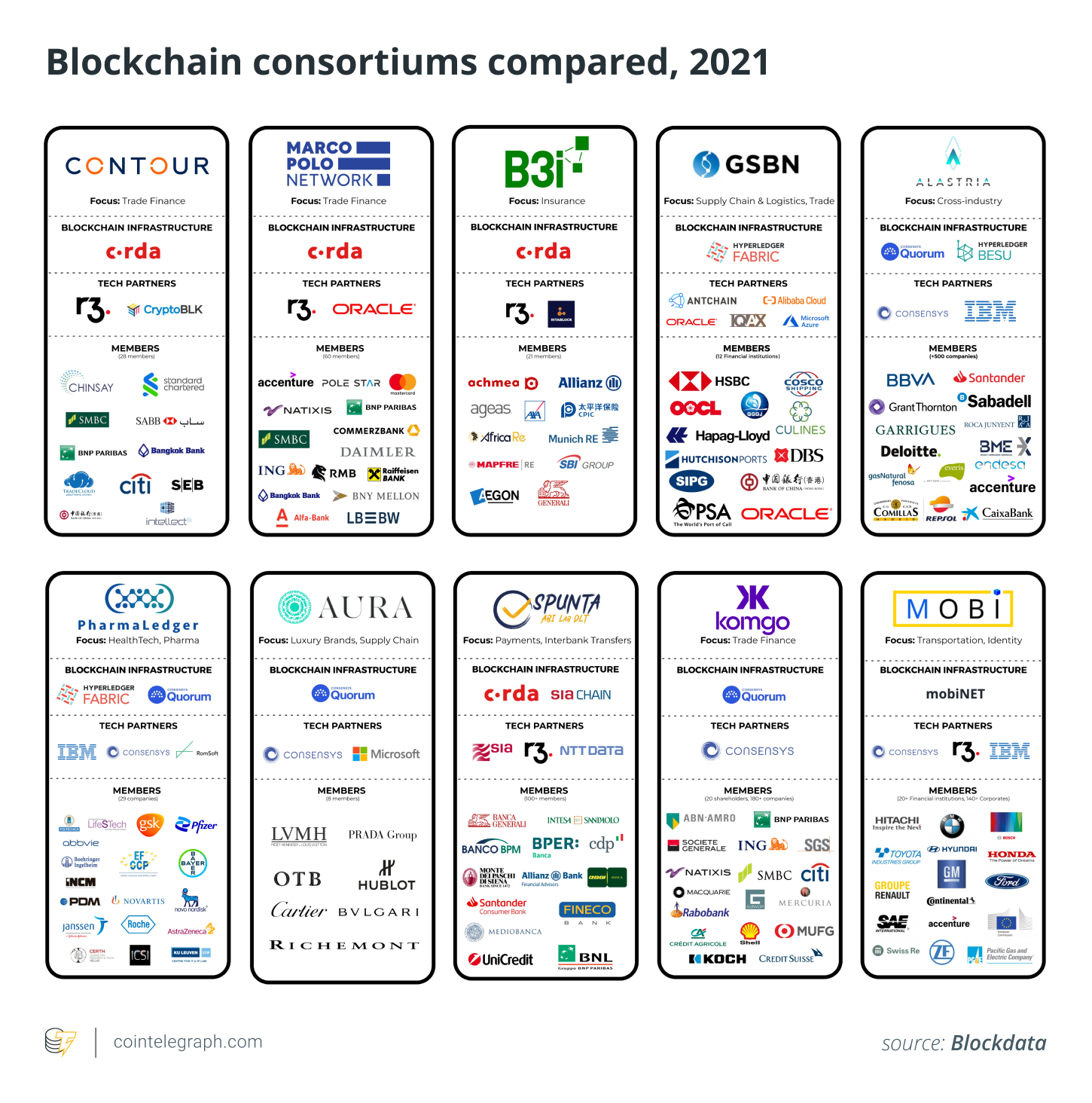
Part of the ascendancy of enterprise blockchain has come from a growing desire by corporate decision-makers to join forces with others to develop and work on similar solutions. All hoped that the more entities working together in developing and managing proof of concepts, or pilot phases, could make developments more valuable. These efforts have been performed via membership to larger collaborative organizations, or the “old world” consortiums. We started seeing the foundation of various designated blockchain consortia for specific industries such as RiskStream and B3i.
Existing industrial consortia and governance bodies also started setting up designated networks for their members like the attempt done inside the GSMA for the mobile space. In 2019, 92% of executives who responded to Deloitte’s Global Blockchain Survey said they already belong to a consortium or planned on joining one.
But, looking back, it seems that production deployments of enterprise blockchain have a thing in common: very few of them are actually led by consortia. Sure, some companies have created ad-hoc consortia, usually representing the interested players of a given ecosystem in order to drive early adoption and reach initial consensus (Mediledger and Tradelens being two examples of this). But, the bottom line is that solutions were developed and deployed by for-profit providers and adopted by for-profit companies without being approved or greenlit by industry-wide consortia every step of the way for implementation.
The justification for the industry silos is dwindling
Enterprises wanting to experiment with the technology, build use cases and gain traction are often deferred from doing so on public chains because of their limitations, particularly those who were inclined to keep their operations internal and private. Before interoperability became an industry focus, developers were understandably forced into developing blockchain in siloed ways. They were permissioned, owned or governed by consortia.
But, it’s now a decade later and consortia are still tied to private-permissioned implementations. The enterprise blockchain space simply can’t ignore evolution. Greater interoperability and the incoming wave of Web3 mean that we need to reassess the pivotal role played by blockchain consortia in the equation.
Will DAOs replace consortia in the enterprise space?
For enterprises, new incoming infrastructures and the role played by decentralized autonomous organizations (DAOs), leveraged by smart contracts and governance protocols, might as well replace the blockchain consortia as the industry focal point. DAOs have even grabbed the attention of more conventional investors including billionaire Mark Cuban who called them “the ultimate combination of capitalism and progressivism.” “The future of corporations could be very different as DAOs take on legacy businesses,” he tweeted in May, “if the community excels at governance, everyone shares in the upside.”
The future of corporations could be very different as DAOs take on legacy businesses. It’s the ultimate combination of capitalism and progressivism. Entrepreneurs that enable DAOs can make $. If the community excels at governance, everyone shares in the upside. Trustless can pay
Venture capital firm Andreessen Horowitz, or a16z, has also led multimillion-dollar fundraising rounds in both individual DAOs and companies that support DAO creation. But, DAOs make sense only in specific contexts and not all fields of enterprises seeking alignment can actually execute this notion. Look out for very exciting news in this field in 2022.
So, where can consortia serve best? Defining the standards not the network
Agreeing on a unified data model, for instance, would represent a huge leap forward for most ecosystems. And, it’s certainly not impossible. When Contour and GSBN (thought to be competitors) collaborated on a model to drive digitization across the global shipping industry, this positively drove interoperability for the users of both Contour and GSBN’s solutions. This is where consortiums play their part to provide corporations and businesses with the ability to work collaboratively and achieve a common goal.
Industry consortia, with great efforts, have no real way of competing with the insane pace of the tech industry constantly creating solutions, platforms and networks. If they choose to stick to defining exactly what the stack should look like, they are bound to remain irrelevant very quickly. If they choose to define standards that could make adoption of any stack for transformation, they will drive value for the enterprises they serve. Voting and achieving a consensus on features or a joint roadmap will happen without intermediaries in the Web3 era.
This article does not contain investment advice or recommendations. Every investment and trading move involves risk, and readers should conduct their own research when making a decision.
The views, thoughts and opinions expressed here are the author’s alone and do not necessarily reflect or represent the views and opinions of Cointelegraph.
Ruth Levi Lotan is a vice president of sales and marketing at ClearX. She is a partnerships enthusiast with a background of more than five years in business intelligence and strategic consulting, working with leading enterprises with a global footprint. Her experience also includes over three years in financing and impact investment including business development efforts with institutional investors and the government sector. Ruth was also involved in the work around Israel’s first Social Impact Bonds (SIBs), a mechanism for unique cooperation between sectors that don’t typically align.
Algorand is a blockchain network created in 2017 by Silvio Micali, an MIT professor who won the Turing Award for his work in cryptography. Algorand is a decentralized permissionless blockchain protocol that anyone can use to develop applications and transfer value. The Algorand protocol is powered by a novel consensus algorithm that enables fast, secure and scalable transactions.
Algorand addresses the common issues that most older blockchains have, specifically concerning scalability and consensus. The blockchain uses Pure proof-of-stake (PPoS), a consensus protocol that selects validators at random according to the weight of their stake in ALGO coins.
What is Algorand trying to solve?
The Algorand protocol is designed to solve three of the biggest problems most blockchains face: security, scalability and decentralization. Dubbed as the “blockchain trilemma,” the Algorand network claims to address the following three major issues.
Security
The Algorand protocol is secure against malicious attacks, making it ideal for transacting, holding high-value assets and building secure enterprise applications. It maintains security on both network and consensus protocol levels and protects individual users’ accounts.
Scalability
The Algorand protocol can handle a large number of transactions per second, making it a more scalable solution than Bitcoin or Ethereum. Algorand’s consensus protocol does away with the need for computational power used in Bitcoin to solve cryptographic problems.
Instead, the protocol’s computation cost per user is only used to generate and verify signatures, as well as operations requiring simple counting. According to Algorand, it can “scale to millions of users and sustain a high transaction rate without incurring significant cost to participating users.”
Decentralization
Algorand is entirely decentralized with no central authority or singular locus of control. Transactions are verified by participating nodes in the network and each node has an equal say in decision-making. This makes Algorand a very decentralized system.
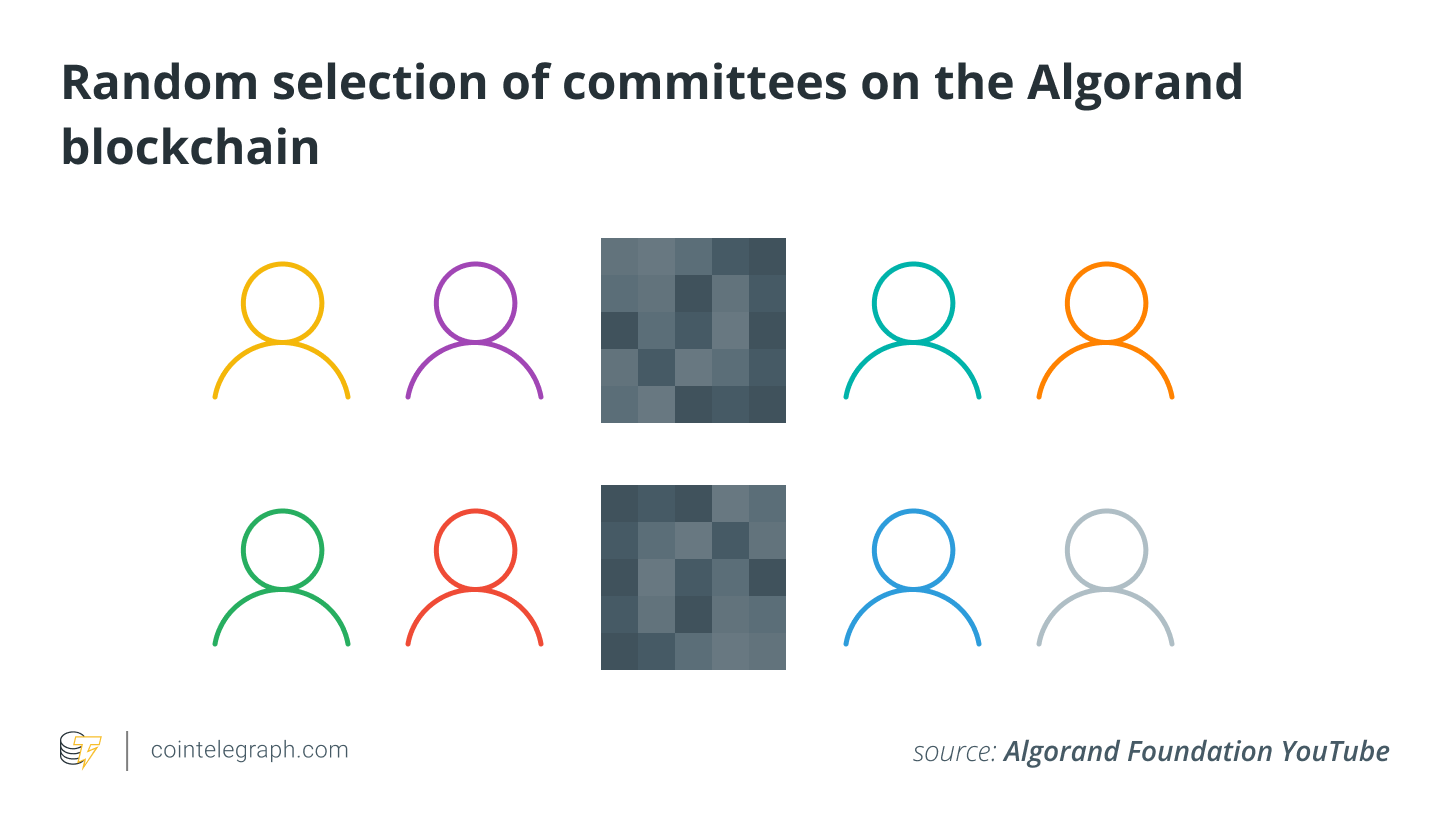
Everyone on the network also has a chance of being part of the committee of users that approve each block because the selection is both random and confidential. There is no fixed committee and its nodes are run by people from all over the world.
How does Algorand work?
What sets Algorand apart from other blockchains is its use of PPoS, a consensus algorithm that employs a Byzantine agreement protocol. Should a node be compromised, staked the native token ALGO owned by participants in the network would automatically be protected with unique keys.
Bitcoin’s consensus mechanism, proof-of-work (PoW), requires large amounts of energy and computing power to create and validate new blocks. PPoS, on the other hand, allows the creation and validation of new blocks in a faster and more efficient manner. This is done by randomly selecting ALGO holders to validate and approve each block in the chain. A new group, or committee, is selected for each new block.
Through the PPoS protocol, only users with large holdings of ALGO can theoretically engage in malicious activities that could potentially compromise other users’ security. However, since the system is based on codependency among participants, malicious activities would also result in a deterioration of their ALGO. Hence, such malicious activity would not be rewarding for any majority holder.
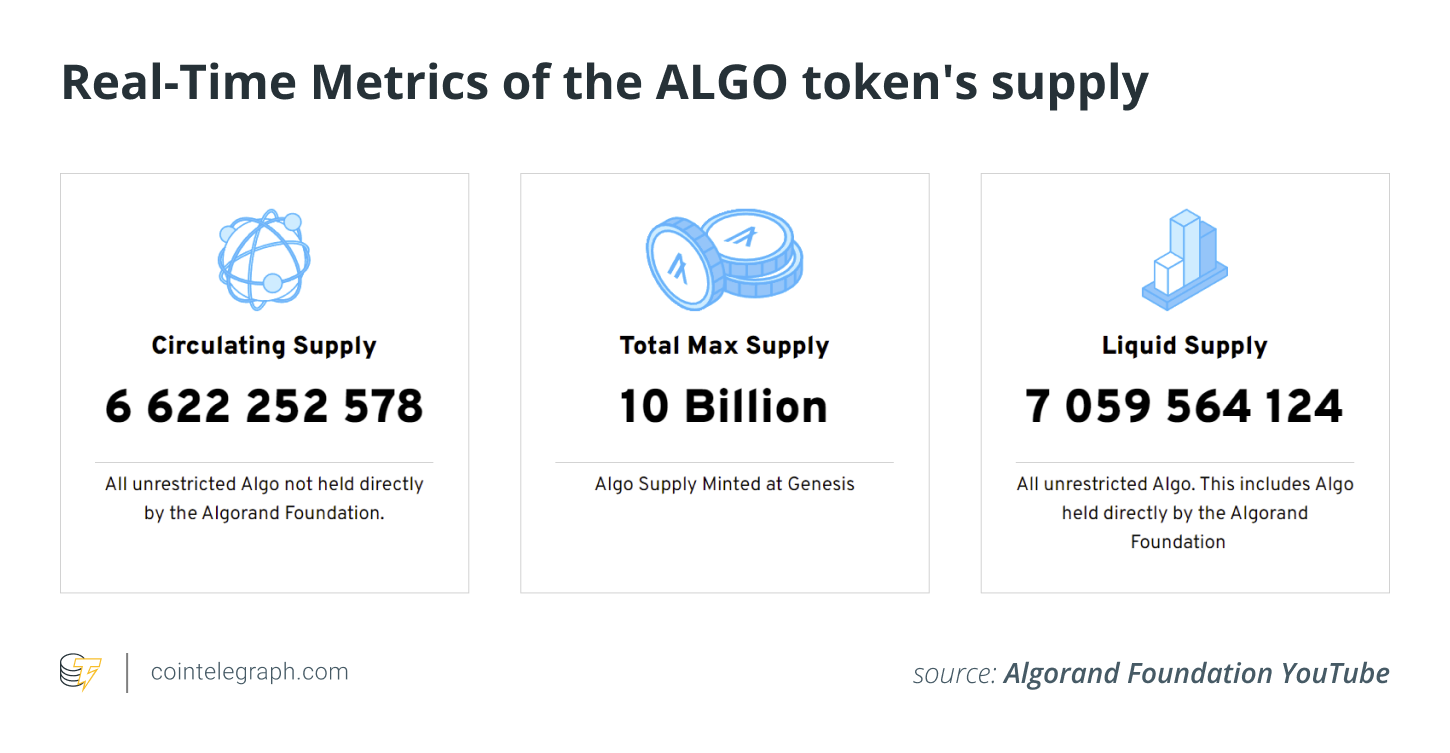
Algorand can process 1,000 transactions per second and all transactions will be final and instantaneous. Algorand also has a fixed supply of 10 billion tokens to add an inflation-resistant mechanism to the network. The majority of these tokens are currently locked up and have yet to be distributed.
Algorand protocol structure
The Algorand protocol is built on three fundamental concepts:
Transactions: Transactions are the basic unit of account in the Algorand network. They are used to transfer value and are verified by all participating nodes in the network.
Blocks: Blocks are groups of transactions collected into a single unit and verified by the consensus algorithm.
Consensus: The consensus algorithm is responsible for verifying blocks and ensuring that they meet the requirements of the Algorand protocol. It also rewards users who participate in its operation.
Algorand staking mechanism: Pure proof-of-stake
Under Algorand’s PPoS approach, the influence held by a user on the choice of a new block is proportional to the number of tokens they have in the system, also called their stake. Each user has a chance to be chosen with the weight of their proposals and votes being directly related to their stake.
Users are selected randomly and secretly for the purpose of proposing blocks and voting on such block proposals. Through this approach, the network’s security is tied to the honesty of the majority of the users in its economy. As long as most of the money is in honest hands, the system will remain secure.
This approach is in opposition to other consensus mechanisms like PoW, DPoS or BPoS wherein small groups within the economy are responsible for the whole system’s security. By principle, a small fraction of users can prevent other users from transacting with these approaches.
Algorand’s approach makes it virtually impossible for holders with smaller stakes in the system to harm the whole network. Meanwhile, majority holders would also not dare to act maliciously, as such actions will result in the devaluation of their own assets and a reduction in the currency’s purchasing power.
Algorand block production under PPoS
New blocks are constructed in two phases under Algorand’s PPoS mechanism. During the first phase, a single token is selected at random. The owner of this token is the user in charge of proposing the next block.
During the second phase, 1000 tokens are selected randomly out of all the tokens in the system. The owners of these tokens make up the phase-2 committee, and they are in charge of approving the block proposed by the user in phase 1.
It is possible for a committee member to be chosen more than once. This also means that a member will have more than one vote in the committee when approving the next block.
The second phase in Algorand’s block production process was put in place to combat any percentage of bad actors. By choosing 1000 tokens at random, the malicious intentions of these bad actors will be trumped by the majority and act in accordance with the rules for the welfare of the network.
Algorand’s native cryptocurrency: ALGO
The native currency of the Algorand network is called ALGO. ALGO tokens are used to pay for transaction fees and reward users who participate in the network’s consensus process.
Transactions with ALGO happen in less than four seconds, regardless of how many transactions you do in a day. Transaction fees are also minimal. Unlike Ethereum, which is notorious for high gas fees, Algo transactions cost very little.
How can I buy ALGO cryptocurrency?
There are several methods for purchasing ALGO. You may buy it directly from another individual in person or over the internet, as you would with any other cryptocurrency.
Alternatively, you may look for a crypto ATM near you that offers ALGO. However, crypto ATM rates can be prohibitive, and there’s no assurance that you’ll be able to locate a counterpart willing to make the trade.
The easiest way to buy ALGO is on a cryptocurrency exchange. Some popular exchanges that offer ALGO include Binance, Kraken and Coinbase. You can buy ALGO with a credit or debit card on these exchanges.
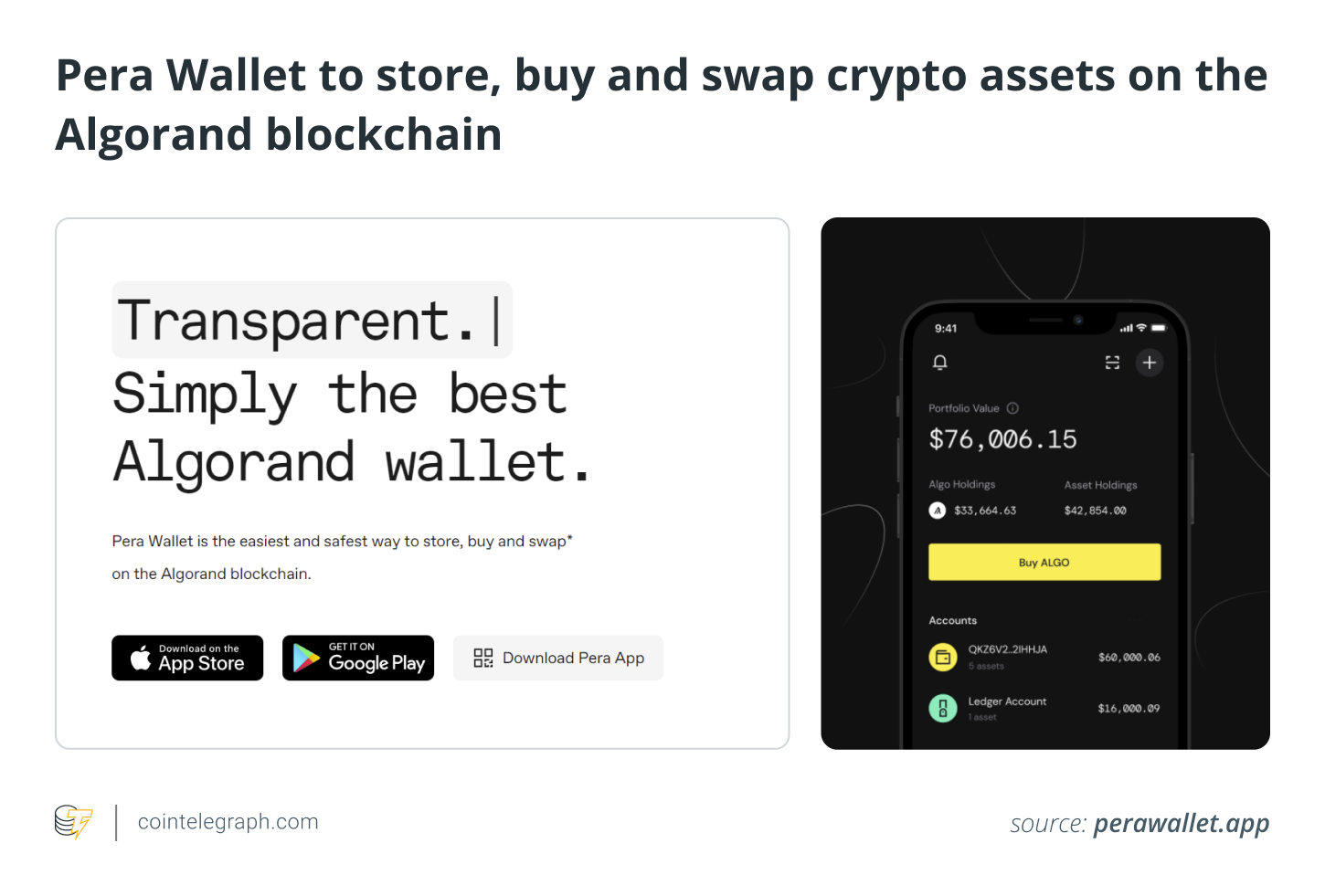
To do so, you first need to get a crypto wallet to hold the ALGO. Some wallets that support ALGO are Pera Wallet, My Algo, Coinbase and Ledger.
Once you’ve set up your wallet, you can now fill your wallet by finding an exchange that supports ALGO.
Set up an account on the exchange if you already do not own one and get it verified. Select “Algorand” from the list of assets to begin your trade. Input the fiat amount to buy ALGO coins and preview your purchase before you finally submit.
After two years and many COVID-19 restrictions finally subsiding, the world is welcoming the return of in-person theater, movies, comedy, music and sports. This has left some wondering what will happen to the legions of digital creatives who occupied and entertained us while normal life was at a standstill — and to the multibillion-dollar economy they inhabit.
Will the world forget the platforms and artists they discovered during the pandemic now the doors of festivals, fashion shows and concerts are open to them again? Is the creator economy, which recent estimates suggest will exceed $100 billion this year, strong enough to withstand a stampede back to real-life experiences?
I strongly believe it is. Government-imposed restrictions may have accelerated the pace of change, but the transformative trends in video streaming we witnessed during the pandemic were nascent before and would have caught hold regardless.
And, while I claim no deep training in macroeconomics, I am a technologist who has spent the past several years working in and around one of the most transformative new technologies to arise in decades: the blockchain. This is the technology that will completely reshape digital life, supercharging the creator economy in the process.
The enforced slowdown has given many artists the time — and the push — needed to experiment in the digital sphere, find new audiences and explore new ways to showcase their talents.
Even musicians who might never have given serious thought to live streaming a concert have taken to the digital stage. And, there’s evidence this will continue. Take singer Dua Lipa, who broke paid livestreaming records with 2020’s Studio 2054 concert. Initially said to be reluctant, Dua Lipa decided to go the livestream route after being forced to postpone an album tour. This turned out to be a good call: Her digital appearance drew more than five million views globally.
A survey from Middlesex University and funded by the UK Economic and Social Research Council showed that some 90% of musicians and 92% of fans believe livestreaming would remain an effective way to reach fans unwilling or unable to travel to venues in the post-pandemic world. Providers should take note: The study also found that audiences do not expect free access to live music and are not particularly discouraged by paywalls.
The rise in creative energy has inspired the developer community as well. New niche streaming platforms have grown up, helped by the emergence of low-cost decentralized infrastructure that allows application builders to encode video, store data and handle identity without having to pay expensive centralized cloud providers for such services.
These centralized providers will increasingly find themselves on the defensive. Two attention-grabbing incidents in 2021 are illustrative: Hackers attacked Twitch and released private information about its code and its users to the world. And, Facebook suffered colossal reputational damage from a lengthy outage and whistleblower claims that its management has repeatedly chosen to prioritize profit over safety.
What comes next?
Big Tech’s woes and pandemic-related restrictions have sped up fundamental changes already underway in how the world produces, consumes and uses video content — changes likely to propel growth in the creator economy well into the future. And, given the increasing availability of low-cost decentralized blockchain infrastructure, these emerging players have a shot at mounting a serious challenge to the FAANG-run streaming providers.
There are five ways that blockchain will hasten growth in the creator economy, and help cement it as a central force in worldwide culture and entertainment:
Exclusivity: Nonfungible token- (NFT-) gated access and NFT ticketing are only two of the decentralized tools that improve the digital experience for event-goers: NFT tickets curb scalping while giving attendees a unique souvenir, all while token gating supports unique experiences for fans such as access to private groups and direct messaging with creators.
Fan ownership: The Web3 era is defined by the shift from extracting value from renters to accreting value to owners. Just as the blockchain enables fans to engage directly with their favorite creators, it offers a pathway to asset ownership in individual creator economies outside of traditional centralized platforms.
Low-cost streaming: Video streaming accounts for more than 80% of Web2 internet traffic and counting. Developers, eager to seize a piece of this market without being crushed by high costs, are increasingly seeking blockchain-based affordable infrastructure to support creator streams. With their new ability to draw global audiences through on-demand access-anywhere streams, creators are turning to uniquely Web3 features such as tipping, paid entry and live shopping to monetize their content.
Immersive interactivity: The one-way nature of Web2 publishing is already giving way to immersive interactivity that rewards users for participation. With the ability to record immutably and securely on the blockchain, creators can incentivize interactions without sacrificing privacy.
Niche down: While Web2 was built to scale up, Web3 is built to niche down. With its lower cost, increased security and resistance to censorship, the blockchain makes it possible to build micro-communities serving smaller niches than would be economically viable in Web2. That’s a fundamental shift that not only puts creators in control but also makes communities less appealing to attention-seeking trolls.
The stage has been set for a blossoming of creative activity, and those poised to take it will be assisted by decentralized infrastructure.
Digital creatives have always recognized that they must be nimble to succeed. Now, there is a technology that will empower them and their analog peers to reach new audiences on their own terms without having to cede power or profit to tech behemoths like Google and Amazon.
My faith in the ability of musicians, gamers, influencers and creators to adapt to the new realities to come — and to thrive in them — has never been stronger.
The creator economy? The clue’s in the name.
This article does not contain investment advice or recommendations. Every investment and trading move involves risk, and readers should conduct their own research when making a decision.
The views, thoughts and opinions expressed here are the author’s alone and do not necessarily reflect or represent the views and opinions of Cointelegraph.
Doug Petkanics is a co-founder at Livepeer, where the team is building a decentralized live video broadcast platform to enable the next generation of video streaming. Prior to Livepeer, Doug was co-founder and CEO of Wildcard, a mobile browser. He also co-founded Hyperpublic, which was acquired by Groupon. He was the VP of Engineering at both.
A major rally in WAVES price this week that saw it nearly double risks faltering in the coming sessions due to a “death cross” technical pattern.
WAVES price crashed 85% after ‘death cross’ in 2018
A death cross measure appears when an asset’s long-term moving average closes above its short-term moving average.
Notably, on the WAVES’ weekly chart, its 50-week exponential moving average (50-week EMA; the red wave) jumped above its 20-week exponential moving average (20-week EMA; the green wave) in the week ending Feb. 21 — a bearish crossover.
That is WAVES’ first “death cross” occurrence on a weekly chart since June 2018. In both cases, the correction in the WAVES market appeared due to selloff across the broader crypto market following a massive bull run.
As it happened, WAVES fell by up to 85% after the 2018 death cross formation, despite briefly closing above both its 20-week and 50-week EMAs in impressive but fake bullish rebound moves.
Therefore, WAVES’ latest upside retracement, albeit its best weekly performance since April 2018, still treads under long-term bearish risks. As a result, a price drop below the 20-week and 50-week EMA could spell another selling round in the market.
That WAVES selloff level
To recap, WAVES, the native token of a blockchain platform of the same name, rallied by as much as 88% week-to-date to reach over $21 apiece during the weekend.
As Cointelegraph covered earlier, migration to Waves 2.0, partnership with interoperable blockchain service provider Allbridge, and an upcoming $150 million fund to boost Waves’ growth in the U.S. served as tailwinds to WAVES upside boom.
But signs of correction have emerged as WAVES falls nearly 10% from its local top near $21 this Saturday.
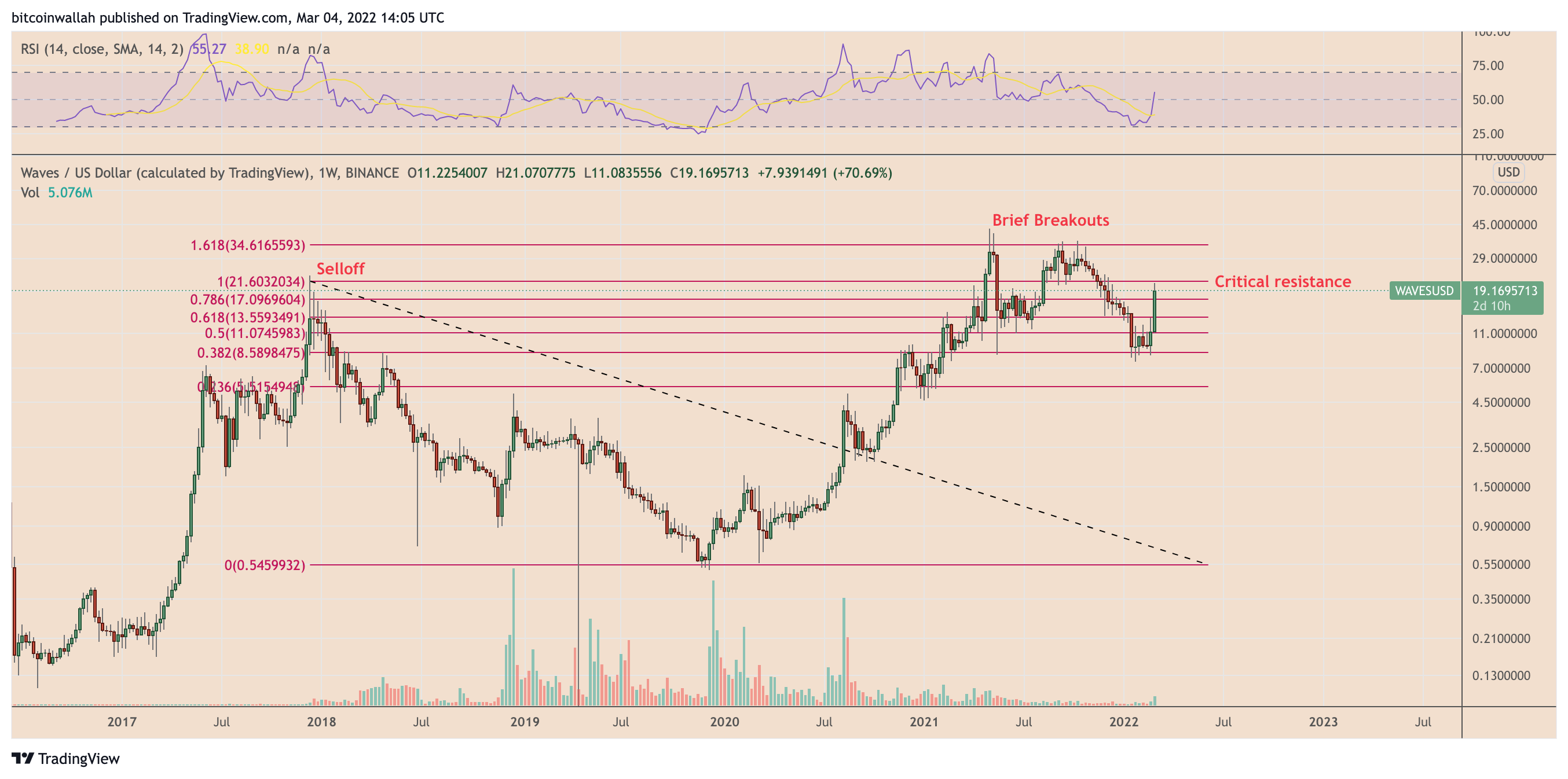
Interestingly, the inflection point coincides with the 1.00 Fib line of the Fibonacci retracement graph made from the 21.60-swing high to 0.54-swing low, which served as key resistance during January 2018, April 2021, and November 2021 corrections — as shown in the chart below.
WAVES/USD weekly price chart featuring its ‘critical resistance.’ Source: TradingView
For instance, in April 2021 and November 2021, bulls attempted to flip $21.60 as support but failed. As a result, WAVES has spent most of its time under the said 1.00 Fib level than above it, suggesting an unstable upside sentiment around it.
The Fibonacci fractal suggests that WAVES would undergo a pullback move toward its next line of supports near $17, $13.50, and $11. Conversely, a decisive move above $21.60 could have bulls retest levels above $34.50.
The views and opinions expressed here are solely those of the author and do not necessarily reflect the views of Cointelegraph.com. Every investment and trading move involves risk, you should conduct your own research when making a decision.