Bitcoin (BTC) is the collateral asset of choice for the world’s biggest decentralized stablecoin, and one of its top executives says there was no other.
Speaking to Bloomberg on April 4, Do Kwon, co-founder of Blockchain protocol Terra, pledged to continue buying BTC to back the firm’s stablecoin, TerraUSD (UST).
Kwon: BTC buys will continue “in perpetuity”
Terra has made waves inside and outside the crypto community in recent weeks thanks to its massive Bitcoin buys.
Currently at just over 30,000 BTC, the reserves of Terra nonprofit the Luna Foundation Guard (LFG) are due to expand to the equivalent of $10 billion.
In his latest comments, however, Kwon went even further, saying that as long as UST is minted, Terra will keep buying BTC to back it.
“One important thing to remember about what we’re going here is that this is not a corporate treasury decision in the sense that I am not buying Bitcoin,” he told Bloomberg TV.
“I’ve already donated money so that we can build up these reserves on behalf of the community and we plan to be doing this in perpetuity, so the $3 billion or so that we’re buying initially to bootstrap the reserves is going to be followed up by… persistent buys of Bitcoin through UST seniorage… every time UST is minted, there will be new bitcoin that is added to the reserves.”
As a decentralized stablecoin, anyone can “mint” UST by burning $1 worth of another decentralized asset, Kwon explained. UST is the largest decentralized stablecoin with a market cap of around $16.5 billion. Tether (USDT), the largest stablecoin as a whole, has a market cap of $82 billion.
“The easy way to understand this is that we’re using Bitcoin to create a decentralized Forex reserve for the Terra stablecoin,” he summarized.
All hail the largest Bitcoin whale?
Active on Twitter, Kwon has previously pledged to overshadow any form of competition, notably MakerDAO’s DAI stablecoin.
The Luna Foundation Guard is well in the green as Terra co-founder Do Kwon stresses he is not “capable of moving” Bitcoin markets.
While cryptically telling followers that he was “just getting started” last week, Kwon has yet to give any further concrete details regarding the timeframes of the BTC buys.
The wallet belonging to LFG last saw inflows on March 30. With 30,727 BTC, it is the 29th largest BTC address.
Once complete, Terra’s reserves will outgun those of any corporate treasury, and will make Kwon and his team the largest Bitcoin whale.
The cryptocurrency market rally that began on April 1 ran into tough resistance on April 4, sparking a market-wide pullback during the afternoon session after exhausted bulls were overwhelmed by bears who managed to push Bitcoin (BTC) below $45,200.
Data from Cointelegraph Markets Pro and TradingView shows that once the afternoon sell-off broke below support at $46,000, the price of BTC hit a daily low of $45,133 before buyers emerged to bid it back above $45,700.
BTC/USDT 1-day chart. Source: TradingView
Here’s what several analysts are saying about the short-term outlook for Bitcoin and what could be in store moving forward in April.
Flipping resistance into support
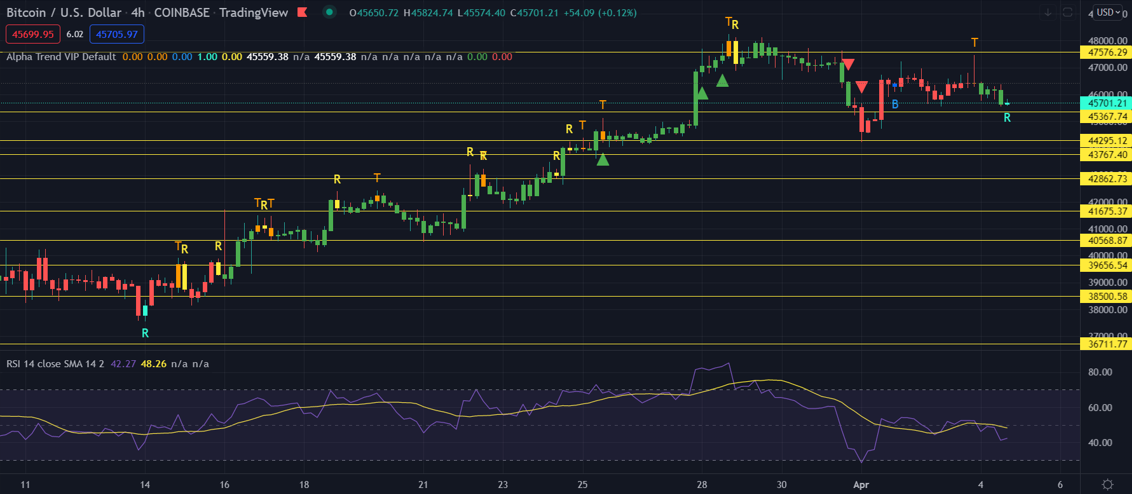
April 4’s weakness on the Bitcoin chart was spotted early by crypto trader and pseudonymous Twitter user ShardiB2, who posted the following chart noting that its price was “starting to reverse” with the 4-hour candle coming close to the bottom of the channel.
BTC/USD 4-hour chart. Source: Twitter
The trader said,
“Could we slip to $44,300? Possibly, but if we do, I [don’t] think it gets any deeper, the ONLY thing that is concerning is maybe tax selling, saw some last year…”
A more general explanation of the current price action was offered by on-chain data analyst Matthew Hyland, who posted the following chart outlining the major support and resistance levels for BTC in its current price range.
BTC/USD 1-day chart. Source: Twitter
Hyland said,
“Bitcoin is trying to flip previous resistance into new support.”
Signs of heavy accumulation
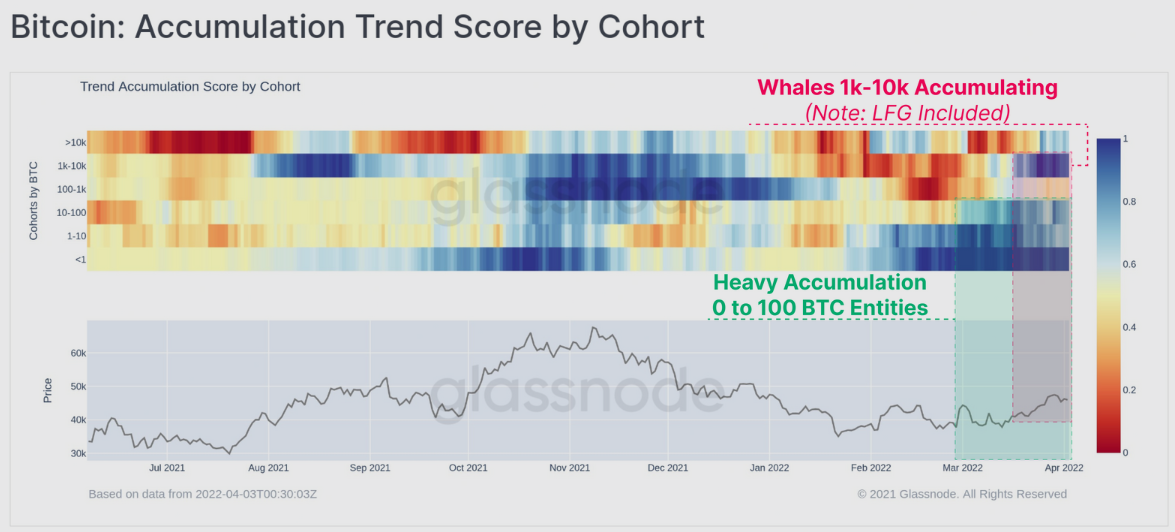
Insight into which players in the market have been most actively accumulating Bitcoin lately was discussed in the most recent newsletter from on-chain analysis firm Glassnode, which noted that “shrimp and whales are the most aggressive accumulators of late.”
On the whale side, Glassnode pointed to “large public buyers such as the Luna Foundation Guard and MicroStrategy,” which have renewed their “emphasis on Bitcoin as pristine collateral” and “have commenced serious accumulation over the last two weeks.”
This whale accumulation can be seen in the red highlighted box on the following chart while smaller buyers “have been the heavy accumulators since late-Jan., with the smaller balances (
Bitcoin accumulation trend score by cohort. Source: Glassnode
Glassnode said,
“In general, the market appears to be viewing Bitcoin and its role in the future economy with a somewhat renewed optimism.”
125-SMA hints at an approaching breakout
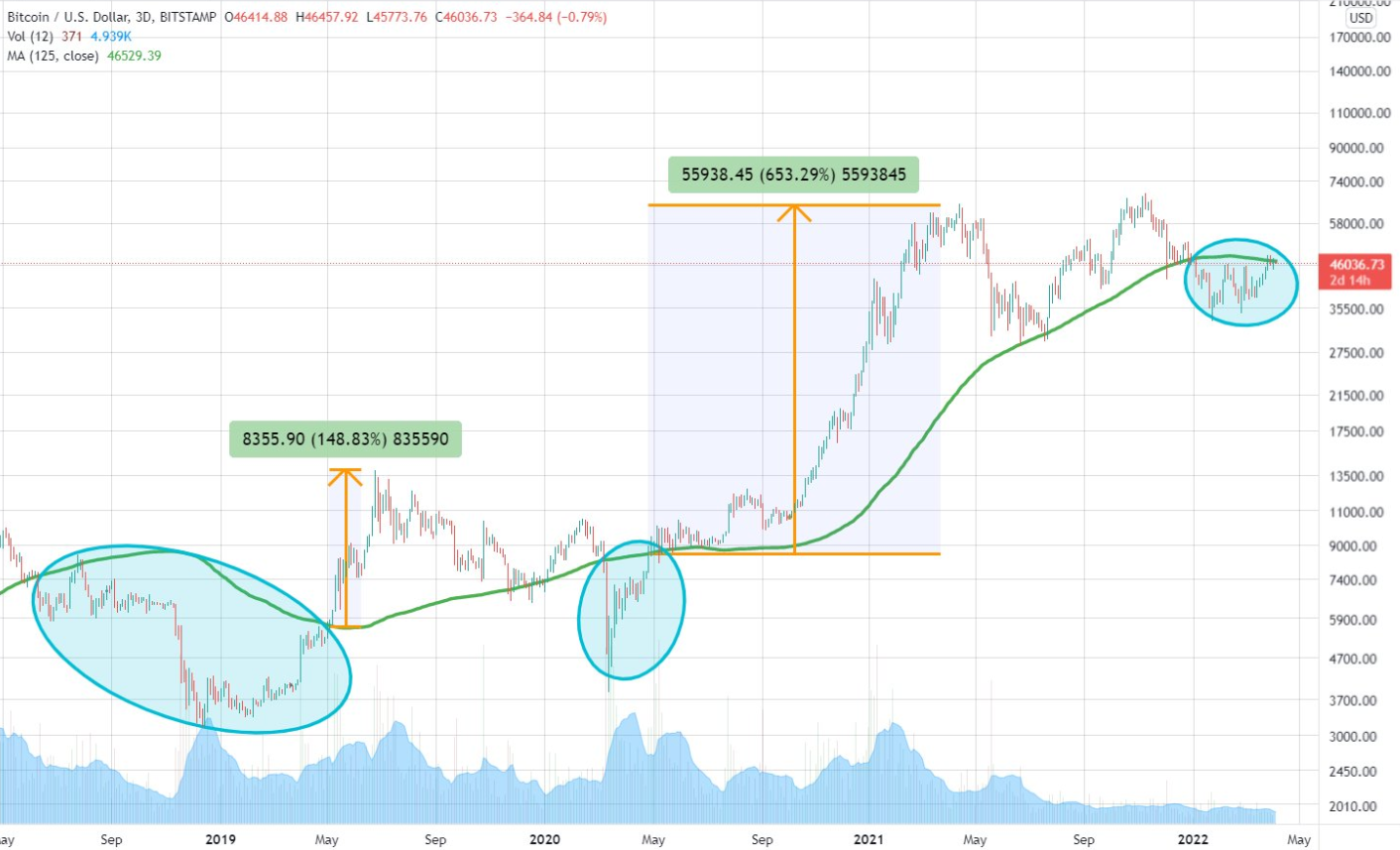
One final “interesting observation” about the price action for Bitcoin was touched on by crypto investor and pseudonymous Twitter user Crypto Bull God, who posted the following chart looking at the history of the BTC price action relative to its 125-day simple moving average (SMA).
BTC/USD 3-day chart. Source: Twitter
The trader said,
“We can see how important this key level is. Once broken below, and then broken back above, we have appreciated massively in price.”
The overall cryptocurrency market cap now stands at $2.124 trillion and Bitcoin’s dominance rate is 40.9%.
The views and opinions expressed here are solely those of the author and do not necessarily reflect the views of Cointelegraph.com. Every investment and trading move involves risk, you should conduct your own research when making a decision.
Coinbase Ventures, an investment arm of American crypto exchange Coinbase, shared a plan to invest $1 million in various Indian cryptocurrency and Web3 initiatives via an in-person pitching event.
In a blog post drafted while he was in India, Coinbase CEO Brian Armstrong revealed that the venture firm intends to tap into India’s software talent with the crypto and Web3 technologies and help accelerate India’s economic and financial inclusion goals.
Calling India’s cryptopreneurs!
Coinbase Ventures is partnering with @BuidlersTribe to host an in-person pitch day in Bangalore in April.
$1M+ is up for grabs, including $25k bonus grants provided by @BeliefDAO, and mentoring sessions with the best minds in crypto.
On Apr. 8, the in-person pitch day will be hosted in Bengaluru in partnership with Buidlers Tribe, which will be further supported by Belief DAO to provide bonus grants up to $25,000. The rising interest of foreign investors in India’s crypto space can be attributed to the recent regulatory clarity brought forward by the controversial crypto tax law.
India’s crypto tax law requires — which has been effective since Apr. 1 — requires all Indian citizens to pay 30% of unrealized crypto gains as tax. Additionally, the investors will not be allowed to offset any crypto losses to compensate for the taxation.
When asked about the general notion about Web3 as a disruptor, Buidlers Tribe co-founder Pareen Lathia told Cointelegraph that Indian entrepreneurs are excited to take their firms global. Speaking about the impact of new tax law in attracting foreign investments, Lathia revealed that:
“Tax law is just one positive step. This is a paradigm shift and regulations will catch up.”
While the Indian Finance Minister Nirmala Sitharaman has previously shared her intent to rethink the crypto tax in the near future, Coinbase’s entry into the market has attracted over 110 applicants.
According to Armstrong, Coinbase has previously invested $150 million in Indian crypto and Web3 companies and plans to onboard 1,000 employees in Coinbase’s Indian tech hub. Establishing regulations serve as a clear invitation to foreign investments, and Armstrong added:
“India is a magical place, and I believe crypto has a big future here. We’re excited to help build that future, and this event is an important step.”
Armstrong remains at the forefront of attaining regulatory clarity on cryptocurrencies in the United States. Over the past year, Coinbase overcame numerous regulatory hurdles put forth by the United States Congress and Securities and Exchange Commission. As a result, the company is expected to play a key role in regulatory discussions around crypto that will ripple across the globe.
The state government of Maharashtra in India started using Polygon blockchain technology to issue caste certificates as a part of the Digital India campaign.
The Maharashtra state government partnered with LegitDoc to roll out 65,000 caste certificates to aid the process of delivering governmental schemes and benefits.
Indian Administrative Service (IAS) officer Shubham Gupta told Cointelegraph that the Indian government is always on the lookout to implement disruptive technologies that can help democratize citizen services:
“Web3 takes the concept of democratization to a whole new level, whereby, data/information can not only made openly sharable but can be made openly unfalsifiable.”
Cryptocurrency investments in Indonesia have seen considerable growth between 2020-2022, with 4% of the country’s population having invested in crypto.
In 2021, crypto transaction volumes surpassed $34 billion, according to Indonesia’s Commodity Futures Trading Regulatory Agency.
This growth has formed a new mindset toward crypto investment, especially in the mainstream media. One example of cryptocurrencies’ growing appeal in the mainstream is the participation of Indonesian celebrities and influencers.
Crypto adoption among celebrities
Celebrities and influencers in Indonesia seem to have become much more involved in Indonesia’s crypto investment industry since 2021.
Many have become brand ambassadors for exchanges and crypto projects to help promote them and essentially raise the trading volume.
The participation of individuals such as Joe Taslim, an Indonesian actor that has gone global, and Indonesian models and actresses Jessica Iskandar and Shandy Aulia might not be surprising, considering celebrities’ inescapable presence in advertising and branding.
Some celebrities have even created their own cryptocurrency.
The trend of celebrity tokens has boomed, especially after one of the most prominent musicians in Indonesia, Anang Hermansyah, created his own token.
Three tokens have gone viral in Indonesia as of February 2022: VCG (VCG), Asix (ASIX) and I-Coin (ICN).
Asix is led by Anang Hermansyah, a prominent figure in Indonesia’s music industry.
VCG went viral thanks to a partnership with RANS Entertainment. This company is owned by Raffi Ahmad and Nagita Slavina, a married couple who are prominent movie stars and business figures in Indonesia and were recently nominated as the Sultans of Contents by Forbes Indonesia.
I-Coin was created by Wirda Mansur, a public figure and daughter of a renowned Indonesian Islamic cleric.
The name of celebrities supporting them and their marketing team has made their token viral and gotten a lot of fear of missing out, or FOMO, from Indonesia’s newbie investors.
But, long before these, the trend started with an influencer named Indra Kenz, who created his own token with his team named Botxcoin (BOTX).
BOTX, an Ethereum-based project that plans to be a decentralized social trading platform, launched in 2021.
BOTX is the first celebrity token in Indonesia and its goal is to become the first decentralized copy trading platform for crypto in Indonesia.
Following its launch, influencers seemed to pay more attention to the growing blockchain and crypto trend. The trend led to an array of influencers talking about cryptocurrency on their own social media.
When this happened, nonfungible tokens (NFTs) also became very popular in Indonesia, especially when the Indonesian NFT collection dubbed “Ghozali Everyday” became globally known for its uniqueness.
Because of the booming crypto and NFT trends, influencers and celebrities have started creating their own NFT and cryptocurrency projects.
One Indonesian celebrity who created their own NFT Projects and went viral globally was Syahrini, an Indonesian singer and socialite.
Under the pseudonym Princess Syahrini, she created an NFT collection and sold them on Binance’s NFT marketplace. It was reported that her “Syahrini’s Metaverse Tour” NFT collection sold out after just eight hours of being listed.
Another prominent figure in Indonesia’s entertainment industry that created their own NFT project was actress, model and singer Luna Maya.
She launched her collection consisting of just 10 NFTs with Tokau, a Japan-based art company that has NFT creation experience.
Her collection was sold on the BakerySwap NFT Marketplace and caught a lot of attention, including from Changpeng Zhao, CEO of Binance.
The trend continued with more celebrities in Indonesia exploring, promoting and creating their own NFT projects.
One example of recent Indonesian influencers and celebrities promoting NFT projects was actor Brandon Salim, renowned Indonesian chef Arnold Poernomo and influencer known as Jejouw.
They promoted one of the most successful NFT projects in Indonesia that went global, “Karafuru,” which has a current trading volume of 37,200 Ether (ETH).
Government response
With the runaway hype of celebrities creating their own NFT and crypto projects, regulators are stepping in to protect investors.
The Commodity Futures Trading Regulatory Agency, also known as BAPPEBTI, is currently giving warnings to celebrities to get their projects approved in the Indonesia legal crypto list before promoting them.
BAPPEBTI, which is responsible for regulating crypto in Indonesia, warns that there are only 229 cryptocurrencies that are legal to trade and transact in Indonesia.
By that warning, BAPPEBTI wants investors to understand that buying or selling celebrity-created tokens in Indonesia is not yet legal. The warning comes from a Twitter thread, originating when new investors began pouring money into viral celebrity tokens:
“New crypto assets that are going to be traded in Indonesia, should be registered under BAPPEBTI through registered crypto exchanges in Indonesia to be assessed by the rules that are applied in Indonesia. For that reason, crypto assets that have not been registered on BAPPEBTI’s legal crypto assets list cannot be traded in Indonesia.”
As of right now, most of the illegal cryptocurrencies have not been fined or given any sentences because most of them are in talks with BAPPEBTI. BAPPEBTI is open to new crypto to be legal in Indonesia, as long as they want to comply with the requirements and processes to be legal and be supervised under the agency.
Currently, there hasn’t been any talk of banning these tokens from the government but rather an invitation for these tokens to be listed as a legal commodity in Indonesia.
BAPPEBTI has also worked with its committees such as the Indonesia Blockchain Association to help create a better environment for crypto in Indonesia, especially with the rise of celebrity tokens.
Coinvestasi has successfully gotten a comment from the aforementioned committee around the topic of celebrity tokens.
The comment directly came from the chairwoman of Indonesia Blockchain Association. She stated:
“My perspective on the celebrity token trend in Indonesia is neutral as long as they comply with existing regulations, because for the past couple of years, there are lots of Indonesians that created their own cryptocurrencies. But what I think is important for Indonesian developers to understand is that their cryptocurrencies must have values for investors and users and must have something that differentiate them from other existing cryptocurrencies. This is because they have a responsibility to their investors and token holders. Developers need to work together to help change the mindset of cryptocurrencies as a scam in Indonesia.”
This statement clearly shows that the government wants the best for crypto investors and creators in Indonesia. It can be concluded that Indonesia’s government supports the growth of cryptocurrencies as long as it is done in a regulated and safe manner.
Growing crypto adoption in Indonesia
The trend of celebrities and influencers joining up to create and promote crypto projects has made Indonesia’s crypto landscape bigger.
Data showed that the growth has been exponential, reaching more than 100% growth in transaction volumes since 2020, largely supported by retail investors.
Institutions also became interested, as evidenced by their participation in funding and investing in blockchain or crypto-related projects.
Major business conglomerate Sinar Mas supported the launch of a new cryptocurrency named NanoByte (NBT), which has Tokocrypto exchange as its partner.
Nanobyte is a token created by an exchange that also plans to be integrated into the current fiat payment system, integrating with e-money and credit cards in Indonesia. This is to help investors and holders use their crypto wallets and NBT to pay for their everyday needs.
Another example is BRI Ventures, the venture arm of one of Indonesia’s leading government-owned banks, which created an accelerator that acts as an incubator for Indonesian blockchain companies to grow globally.
These projects could trigger a domino effect among Indonesian financial institutions to invest in the blockchain or crypto sector.
But, this also pressures regulators to develop new regulations to support the growth so that Indonesia does not get left behind.
Lawmakers in Australia want to regulate decentralized autonomous organizations (DAOs). In this three-part series, Oleksii Konashevych discusses the risks of stifling the emerging phenomenon of DAOs and possible solutions.
Per se, it is not new, as the Australian Senate Committee led by Senator Bragg recommended in October 2021 that decentralized autonomous organizations be brought under the fold of the Corporations Act, which provides standards for corporate governance and personalities.
“Decentralized Autonomous Organisations can replace Companies. It might be the most significant development since the first joint-stock companies floated on the Amsterdam Stock Exchange in 1602.”
He continued: “If that doesn’t make policymakers listen, perhaps this will. Given that DAOs are recognized as partnerships, not companies, they are not liable to pay company tax. Company tax accounted for 17.1% of total Commonwealth government revenue. Our reliance on company income tax is unsustainable.” Bragg added, “DAOs are an existential threat to the tax base and they must be recognized and regulated as a matter of urgency.”
On his website, you can find an extended version of the statement, where the senator shows some economic figures to support his conclusions.
At this point, I should clarify that the partners of a partnership do pay taxes but separately: Individuals pay income tax and companies in the partnership still pay the company tax, as would any other normal company.
Then the senator clarifies what aspects of the DAOs, exactly, the government plans to regulate, “Recognizing the fact that DAOs are self-regulating and transparent, with an in-built system for governance.”
He continued, “The Treasury will need to address these issues, leaving the field open for DAOs to continue to live up to their name. Any attempt to prescribe a code [would] be self-defeating.”
Indeed, if properly implemented, all three objectives can be achieved: the consumers will be protected from malicious and unscrupulous businessmen, revenues will be duly taxed and at the same time, the emerging industry of DAOs will not be stifled.
And here is a snag. All DAO and fintech regulations we have seen in the world so far went down that bureaucratic path of relying on conventional approaches and methods. The red tape. The difference between them is just about the tightness of the noose.
The problem is that new approaches to regulating this industry are not discussed widely in society and among politicians. They are not on the agenda. But these concepts exist, and I spent five years of my academic research working on them.
The risk is that because these new concepts are not raised, they are not on the agenda of politicians and bureaucrats, so when it comes to regulating, they will refer to the existing methods, to something that they know, and this is not good because they only know the conventional ways of regulating. But DAOs appeared as the response to obsolete approaches, excessive bureaucracy and red tape.
Read about replacing a company registry and the “Code is Law” paradigm in Parts 2 and 3.
The views, thoughts and opinions expressed here are the author’s alone and do not necessarily reflect or represent the views and opinions of Cointelegraph.
Oleksii Konashevych has a Ph.D. in Law, Science, and Technology, and is the CEO of the Australian Institute for Digital Transformation. In his academic research, he presented a concept of a new generation of property registries that are based on a blockchain. He presented an idea of title tokens and supported it with technical protocols for smart laws and digital authorities to enable full-featured legal governance of digitized property rights. He also developed a cross-chain protocol that enables the use of multiple ledgers for a blockchain estate registry, which he presented to the Australian Senate in 2021.
Coming every Saturday, Hodler’s Digest will help you track every single important news story that happened this week. The best (and worst) quotes, adoption and regulation highlights, leading coins, predictions and much more — a week on Cointelegraph in one link.
The cryptocurrency industry has fired back at the European Parliament, the legislative arm of the European Union, voting in favor of stringent crypto regulations relating to ”unhosted” private wallets.
The guidelines would require crypto service providers to verify the identity of every individual using an unhosted wallet that interacts with them, while any transaction greater than 1,000 euros would need to be reported to authorities.
“Imagine if the EU required your bank to report you to the authorities every time you paid your rent merely because the transaction was over 1,000 euros,” Coinbase CEO Brian Armstrong wrote on Twitter. “Or if you sent money to your cousin to help with groceries, the EU required your bank to collect and verify private information about your cousin before allowing you to send the funds.”
Axie Infinity’s Ronin Bridge was the victim of a hefty hack worth around $612 million earlier this week, with 173,600 Ether and 25.5 million USD Coin being stolen from the platform.
Ronin developers stated that the attacker used hacked private keys to forge fake withdrawals, draining the funds from the Ronin Bridge in just two transactions.
In a statement on Wednesday, the developers stated that they were “working with law enforcement officials, forensic cryptographers and our investors to make sure that all funds are recovered or reimbursed. All of the AXS, RON and SLP [tokens] on Ronin are safe right now.”
As part of the Bitcoin buying spree led by Terraform Labs founder Do Kwon, the Terra wallet belonging to Luna Foundation Guard approached $1.5 billion in BTC following another huge $139 million purchase this week.
Terra has been snapping up BTC aggressively since late January to build reserves to back its TerraUSD (UST) stablecoin, with Kwon also outlining earlier this month that Terra plans to accumulate a whopping $10 billion worth of BTC.
Terraform Labs is on track to overtake Tesla as the second-largest holder of Bitcoin soon, with MicroStrategy also in its sights, according to data from Bitcoin Treasuries.
Top NFT marketplace OpenSea announced a long-awaited integration with the Solana blockchain on Wednesday. The expanded support, expected to go live in April, adds to OpenSea’s existing support of Ethereum, layer-2 Polygon and Klaytn.
It appears the move has been well received, with OpenSea’s 16-second teaser video on Twitter pulling 615,500 views, 8,964 retweets and 21,700 likes within 18 hours of posting.
Alluding to the vast number of tweets and media publications commenting on the potential for a Solana launch, OpenSea cheerfully referred to the announcement as the “best-kept secret in Web3.”
ConsenSys-owned MetaMask revealed important updates for iPhone and Apple Pay users on Tuesday that enable them to purchase cryptocurrency directly through the app via debit or credit cards, removing the hassle of sending Ether from an outside source to add funds.
Notably, the move is said to lower gas fees, and MetaMask is utilizing two payment gateways, Wyre and Transak, to support debit card and credit card purchases. Users are now able to deposit a maximum of $400 daily into their wallets via the new service.
“We wanted to expand the way in which users can convert crypto within the app itself and not have to leave it,” James Beck, director of communications and content at ConsenSys, told Cointelegraph.
Winners and Losers
At the end of the week, Bitcoin (BTC) is at $45,119, Ether (ETH) at $3,275 and XRP at $0.81 The total market cap is at $2.07 trillion, according to CoinMarketCap.
Among the biggest 100 cryptocurrencies, the top three altcoin gainers of the week are STEPN (GMT) at 325.60%, Zilliqa (ZIL) at 303.89% and SKALE Network (SKL) at 82.33%The top three altcoin losers of the week are Axie Infinity (AXS) at -13.23%, Zcash (ZEC) at -8.16% and Helium (HNT) at -7.54%.
“I’m sort of betting that the long-term scenario of Bitcoin going up and the reserves being strong enough to withstand UST demand drops is the more likely scenario.”
“Dictators aren’t really going to like Bitcoin because they can’t control it.”
Alex Gladstein, chief strategy officer at the Human Rights Foundation
“Ethereum is like New York City: it is vast, expensive and congested in certain areas. However, it also features the richest application ecosystem, with over 500 apps that command a total value of over $100 billion — more than 10x larger than any other competing network.”
“Web3 takes the concept of democratization to a whole new level, whereby data/information cannot only be made openly shareable but can be made openly unfalsifiable.”
Shubham Gupta, Indian Administrative Service officer
“I’d put the chance of Bitcoin ever moving to PoS at exactly 0%. There is no appetite among Bitcoiners to destroy the security of the protocol by making such a move.”
“People should have the freedom to choose other money. If the government is going to abuse our cash, we should have the freedom to use other, higher quality cash.”
Pierre Poilievre, Canadian Conservative Party candidate for prime minister
U.S. investment giant VanEck has come up with a lofty prediction concerning Bitcoin — and one that has very little chance of coming to fruition in the foreseeable future. The firm suggested this week that 1 BTC could be worth $4.8 million if it becomes the world’s reserve currency.
The extremely optimistic estimation was part of a report by VanEck’s head of active EM debt management, Eric Fine, and chief economist Natalia Gurushina, who outlined a thought experiment comparing the price implications for gold and Bitcoin after being adopted as reserve currencies.
VanEck’s analysis found that the implied price for BTC ranged from $1.3 million to $4.8 million. But they ultimately concluded that the Chinese yuan is the most likely currency to become a global reserve asset if the U.S. dollar crumbles moving forward.
A bunch of angry gamers review-bombed Storybook Brawl on Steam over fears of potential NFT and blockchain integrations, following crypto exchange FTX US acquiring its developer, Good Luck Games.
FTX US announced the acquisition on Friday and, at the time of reporting, 600 out of 761 reviews were negative, with most of them commenting about how good the game was until it sold out to a crypto firm.
“Good Luck Games was acquired by FTX, a cryptocurrency company, as a way to ‘help crypto make inroads with gamers.’ I want no part of that and I don‘t want crypto ‘making inroads’ in things I‘m interested in. Uninstalled,” wrote Steam user “King Bear,” who has clocked more than 60 hours in the game.
The Central Bank of Sudan (CBOS) has warned local citizens about dealing with cryptocurrencies over risks such as “financial crimes, electronic piracy and the risk of losing their value.”
The warning came amid reports that crypto is gaining traction in Sudan at a time when the African nation is dealing with three-digit inflation following a 2021 military coup.
The CBOS also cited legal risks, as cryptocurrencies are not classified as money “or even private money and property” under Sudanese law. The central bank admitted that it has been noticing an uptick in crypto promotions on social media recently.
Greenpeace has teamed up with Ripple co-founder and executive chairman Chris Larsen to launch a new campaign aimed at changing Bitcoin’s mining practices to an environmentally sustainable model.
The campaign is called “Change the Code, Not the Climate,” and Greenpeace in particular cited concerns that the energy required to mine Bitcoin comes mostly from fossil fuels.
“If only 30 people — the key miners, exchanges and core developers who build and contribute to Bitcoin’s code — agreed to reinvent proof-of-work mining or move to a low-energy protocol, Bitcoin would stop polluting the planet,” the campaign notes.
Bitcoin enthusiasts were less than pleased with the new campaign, with several prominent industry leaders arguing that the Bitcoin network would never abandon proof-of-work.
“Anyone who says that David Gerard personally stopped their crypto getting into Wikipedia is a fuckwit,” says editor, Wikimedia spokesman and professional crypto hater David Gerard in his typically no-nonsense fashion.
Just when the Bitcoin (BTC) miners helped release the 19th millionth BTC in circulation on Friday, the BTC network’s mining difficulty reciprocated by reaching an all-time high of 28.587 trillion.
Bitcoin’s network difficulty correlates to the computational power required to mine BTC blocks, which currently demands an estimated hash rate of 201.84 exahash per second (EH/s), according to data from Blockchain.com.
Bitcoin hash rate over the past three years. Source: Blockchain.com
A higher hash rate ensures resilience against double-spending attacks, which is the process of reversing BTC transactions over the blockchain by contributing to at least 51% of the Bitcoin hash rate.
Back on Mar. 4, roughly a month before reaching an all-time high, the BTC network difficulty experienced a slight decline from 27.96 trillion to 27.55 trillion, which eventually fell down to 27.45 trillion until Mar. 30. Prior to that, the resilient Bitcoin network grew consistently since July 2021.
With just 2 million BTC left to mine as rewards and an influx of Bitcoin miners from across the world, the BTC network is expected to increasingly grow stronger as it supports the thriving community. it is estimated that the remaining 2 million BTC (out of the total supply of 21 million) will be eventually mined roughly by the year 2140 owing to factors including halving.
On Mar. 30, a Terra wallet belonging to LFG (Luna Foundation Guard) amassed $139 million in BTC, bringing its total coffers up to 31,000 BTC or $1.47 billion.
The last week of March saw the decentralized finance (DeFi) market surge to new highs as institutional investors returned to the market. Amid the rising popularity of DeFi products, Axie Inifity’s Ronin bridge faced the worst hack in crypto history, raising security concerns for the market.
MetaMask integrated Apple Pay support, allowing users to purchase crypto using their Apple Pay account directly, and Binance launched Bridge 2.0 to integrate CeFi and DeFi into one platform.
Looking at the price side, the majority of DeFi tokens in the top 100 not only registered double-digit gains but also rose to new multi-month highs, with several tokens seeing three-digit gains over the past week.
Axie Infinity’s Ronin bridge hacked for over $600M
According to Axie Infinity’s official Discord and Ronin Network’s official Twitter thread, along with its Substack page, the Ronin bridge and Katana decentralized exchange have been halted after suffering an exploit for 173,600 Ether (ETH) and 25.5 million USD Coin (USDC), worth a combined $612 million at Tuesday’s prices.
In a statement, its developers said they were “currently working with law enforcement officials, forensic cryptographers and our investors to make sure that all funds are recovered or reimbursed. All of the AXS, RON and SLP [tokens] on Ronin are safe right now.”
Binance launches Binance Bridge 2.0 to integrate CeFi and DeFi
On Tuesday, centralized cryptocurrency exchange Binance announced the rollout of Binance Bridge 2.0. The feature enables users to bridge assets from any blockchain, including tokens not listed on the Binance app, to the BNB Chain. Bridged tokens listed on Binance will be stored in the Funding or Spot Wallet, while unlisted bridged tokens will be transferred to the Funding Wallet only.
Users can bridge in or bridge out tokens between their native blockchains and BNB Chain via regular deposit and withdrawal functions. In the future, Binance also plans to create a better version of its mobile app to allow users to facilitate such conversion via a single click.
MetaMask rolls out Apple Pay integration and other iOS updates
ConsenSys-owned MetaMask tweeted a thread of updates on Tuesday for iPhone and Apple Pay users. The main feature is the ability to buy cryptocurrency using a debit or credit card through the mobile application, eliminating the need to transfer ETH from a centralized exchange like Coinbase into the application.
MetaMask uses two payment gateways, Wyre and Transak, to support debit card and credit card transactions. Users can now use their Visa and Mastercard credit cards stored in Apple Pay to buy ETH and deposit a daily maximum of $400 into their wallets thanks to the Wyre API.
DeFi sector TVL rises as investors return to a bullish crypto market
The month of March has been a tale of two halves for the cryptocurrency market, and the weakness that has been seen since the start of the year is starting to fade. Bitcoin’s (BTC) strong move above the $40,000 level is helping to lift sentiment across the sector, while DeFi tokens are also beginning to move upward.
Data from cryptocurrency market intelligence firm Messari shows that a majority of the top tokens in the DeFi sector have posted double-digit gains over the past 30 days, led by THORChain (RUNE), which has increased by 199.81%, and Aave, which has seen its price increase 53.95%
Analytical data reveals that DeFi’s total value locked has jumped by another $3.6 billion over the last week, reaching $133.6 billion at the time of writing. Data from Cointelegraph Markets Pro and TradingView reveals that DeFi’s top 100 tokens by market capitalization performed reasonably well across the last seven days, with many registering a double-digit gain and a few even seeing a three-digit rise.
The weekly performance of the majority of the tokens seemed bullish, with RUNE taking the lead this week as well, registering a 46% surge in price over the past week, followed by Aave with 41%, and PancakeSwap (CAKE) with a 35% surge.
Before you go!
The Ronin bridge exploits resulted in upwards of $600 million worth of tokens being stolen and took an interesting turn when people noticed that the exploit actually happened six days before it became public on March 29. The exploiter behind the attack not only drained millions of dollars worth of ETH but also went to short the Axie Infinity token in hopes that when the news about the hack became public, its price would plummet.
Thanks for reading our summary of this week’s most impactful DeFi developments. Join us again next Friday for more stories, insights and education in this dynamically advancing space.
Netflix’s new crypto documentary titled “Trust No One: The Hunt for the Crypto King” was released on 30 March amid much fanfare. The documentary is based on the mysterious death of the now defunct crypto exchange QuadrigaCX founder.
The founder of the crypto exchange allegedly died on a trip to India. Along with him, he took away the whereabouts of the keys to crypto wallets containing $250 million worth of cryptocurrencies.
Unofficial investigations and numerous conspiracy theories followed the mysterious disappearance/death of the QuadrigaCX founder. The Netflix investigative documentary aims to clear some mystery around the high-profile crypto case that puzzles many even today.
The crypto swindler documentary takes inspiration from “DON’T F*CK WITH CATS”-style investigative thriller and people already seemed to be hooked to the release. One Twitter user wrote:
“Watched it at the gym tonight. Got only 1/2 way through, but it’s already insane: Biggest red flag is faking death with Crohn’s disease, seriously?! You don’t need an MD to know Crohn’s disease rarely leads to death!”
A user who had allegedly used the QudrigaCX back in the day claimed that he smelled fishy behavior way early and took money out in time, after watching the documentary, he wrote:
“I had a lot of coins on that exchange. But one day I sensed something strange with the way the trades were being handled. Having set up bloomberg systems for AIMCO, i had a good feeling for how these exchanges should work. Right then and there I pulled all the coins out.”
While the investive documentary is quite engaging and doesn’t really require anyone to have any crypto knowledge to understand it, many in the crypto community who has closely covered the story or were affected by the bust of the exchange found it quite fulfilling.
Mike Oltoff, founder and CEO of Coin card claimed many of his friends played a cameo in the documentary including himself
“It’s so weird to see a bunch of my friends in a documentary, but they all did great! Funny enough, I cameo on this documentary too in the background of one of the videos about Patryn. “
Investors tend to not complain about a price rally, except when the chart presents steep downside risks. For example, analyzing Ether’s (ETH) current price chart could lead one to conclude that the ascending channel since March 15 is too aggressive.
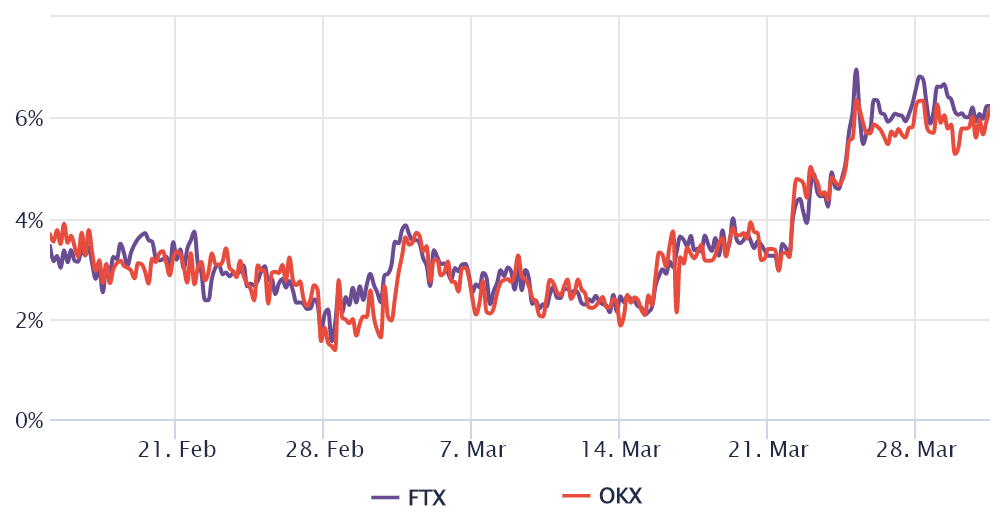
Ether price at FTX, in USD. Source: TradingView
Thus, it is only natural for traders to fear that losing the $3,340 support could lead to a retest of the $3,100 level or a 12% correction down to $3,000. Of course this largely depends on how traders are positioned, along with the Ethereum network’s on-chain metrics.
For starters, the Ethereum network’s total value locked (TVL) peaked at ETH 32.8 million on Jan. 23, and has since gone down by 20%. TVL measures the number of coins deposited on smart contracts, including decentralized finance (DeFi), gaming, NFT marketplaces, social networks, collectibles and high risk.
Moreover, the Ethereum network’s average transaction fee bottomed at $8 on March 16, but has recently increased to $15. Thus, one must evaluate if that reflects lesser use of decentralized applications (DApps) or users benefiting from layer-2 scaling solutions.
Ether’s futures premium shows little excitement
Traders should analyze Ether futures market data to understand how professional traders are positioned. The quarterly contracts are whales and market makers’ preferred instruments because they avoid the fluctuating funding rate from the perpetual futures.
The basis indicator measures the difference between longer-term futures contracts and the current spot market levels. The Ether futures annualized premium should run between 5% to 12% to compensate traders for “locking in” the money for two to three months until the contract expiry.
The current 6% Ether futures basis sits slightly above the minimum threshold for a neutral market. An annualized futures premium below 5% is deemed bearish, while numbers above 12% indicate bullishness.
This data tells us that pro traders are far from excited but in the past couple of months there was a 4% or lower basis rate, which reflected bearish sentiment. Thus, there has been an improvement, but not enough to cause excessive demand from buyers.
To exclude externalities that might have influenced derivatives data, one should analyze the Ethereum network’s on-chain data. For example, monitoring the network use tells us whether actual use cases support the demand for Ether.
On-chain metrics raise concerns
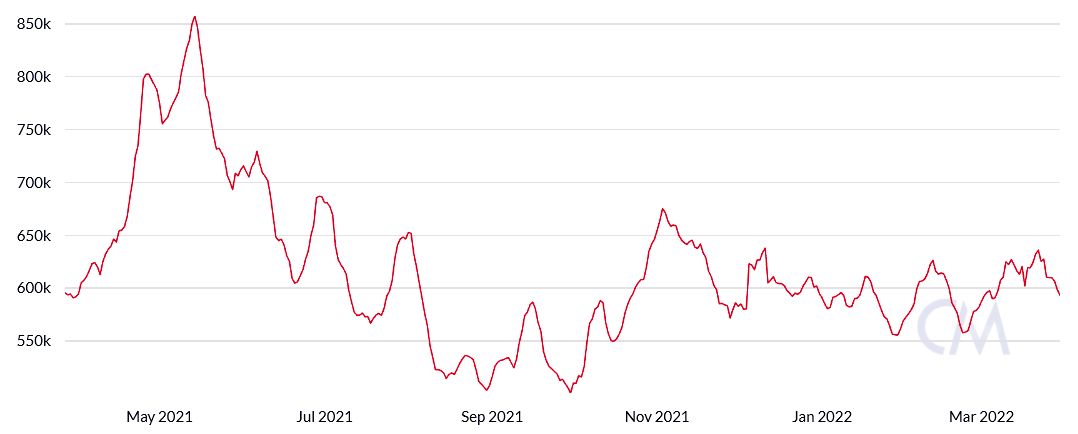
Measuring the number of active addresses on the network provides a quick and reliable indicator of effective use. Of course, this metric could be misguided by the increasing adoption of layer-2 solutions, but it works as a starting point.
7-day average of active addresses on Ethereum. Source: CoinMetrics
The current 593,260 daily active addresses average is a 2% increase from 30 days ago, but it’s nowhere near the 857,520 seen in May 2021. Data shows that Ether token transactions are not showing signs of growth, at least on the primary layer.
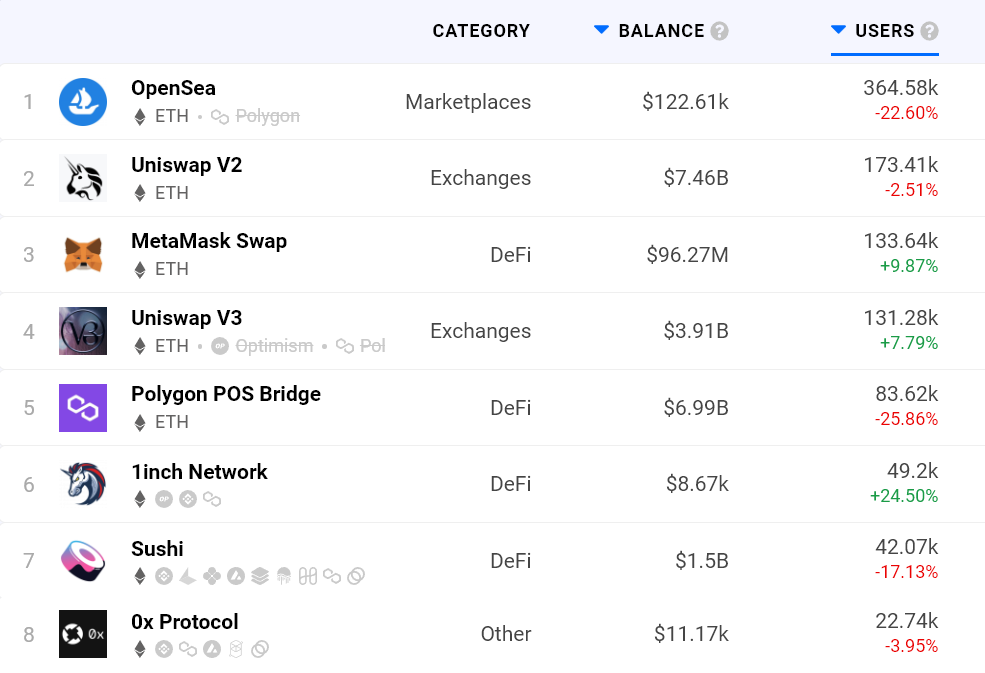
Traders should proceed to DApp usage metrics but avoid exclusive focus on the TVL because that metric is heavily concentrated on lending platforms and decentralized exchanges (DEX), so gauging the number of active addresses provides a broader view.
Ethereum DApps saw an average monthly 11% decrease in active addresses. Overall, the data is disappointing because the smart contract network was specifically designed to host decentralized applications.
As a comparison, the DApps on the Polygon network gained 12% while Solana (SOL) saw a 6% user increase. Unless there is decent growth in Ether transactions and DApp usage, the $3,340 daily close support will probably unwind.
The views and opinions expressed here are solely those of the author and do not necessarily reflect the views of Cointelegraph. Every investment and trading move involves risk. You should conduct your own research when making a decision.