In this episode of The Blockopedia podcast, Pyra’s Co-founder and CEO Diogo sat down with The Blockopedia’s Co-founder Mohammad Ahmad Khan to talk about building a fintech app that lets users invest their entire paycheck into crypto and other assets, spend through credit instead of selling, and recover stronger after a major public setback with the Drift exploit.
Diogo’s path into crypto started early. He first heard about Bitcoin and Ethereum in high school through a friend, and instead of just trading, he went straight to reading white papers. That curiosity carried him through a computer science degree, where he experimented with DeFi spending tools, yield strategies and arbitrage trading before eventually landing in the Solana ecosystem, where he has built ever since.
His first real product was a simple DeFi comparison tool that tracked arbitrage opportunities between decentralized and centralized exchanges. It never took off, but he calls it a valuable first lesson in shipping something real and getting feedback.
What Pyra Actually Does
Diogo explained Pyra in plain terms: it is an investment app that lets people build wealth with money they would normally just spend. Traditionally, people invest whatever is left over after covering expenses, which for most people is very little given the cost of living. Pyra flips that. Users invest their paycheck immediately, then draw a line of credit against their portfolio to cover rent, groceries and bills, so the invested capital keeps growing instead of sitting untouched or never existing at all.
He described this as the same strategy wealthy individuals already use, often called buy, borrow, die. Instead of selling assets and triggering capital gains tax, they borrow against their holdings while staying fully invested. Pyra is built to make that same mechanism safe and accessible for everyday users, not just the ultra wealthy with financial advisors managing it manually.
Why Solana
Diogo chose Solana early because it offered speed and low costs at a time when other scaling solutions were still new. That advantage has only compounded, he said, thanks to a large existing DeFi ecosystem and the growing wave of tokenized stocks, bonds and commodities landing on chain. Going multi chain has simply never felt necessary.
A Conversation From the Co Working Floor
The interview itself took place in person at a co working space in Dublin, where Diogo’s team was based for Build Station, an event bringing Solana builders together ahead of the next Colosseum hackathon. His co-founder Errol was on site as well, working alongside him in a space shared with several other Solana ecosystem teams. The setting gave the conversation an unusually grounded, on the ground feel, less a polished studio interview and more a real look at a founding team mid build.
Colosseum, Setbacks and Trying Again
Pyra’s team competed in Solana hackathons twice, first with limited success under an earlier event before Colosseum existed, then again a year later with a far stronger product, which earned them fifth place. Diogo credits persistence as much as skill, pointing to other founders in the ecosystem who applied to Colosseum multiple times before eventually winning grand prizes.
Facing the Drift Exploit
Diogo did not shy away from discussing Pyra’s most public challenge, the Drift exploit. Rather than framing it as the end of the story, he described it as motivation to rebuild with stronger safeguards. Pyra is self custodial and currently integrates with Kamino for lending, but the longer term plan involves diversifying across multiple lending protocols, exploring portfolio insurance, and eventually bringing credit infrastructure in house to reduce reliance on third party risk entirely.
What’s Next
Pyra is expanding beyond crypto assets into stocks, bonds and commodities, aiming to make the platform approachable for everyday users who may be wary of DeFi terminology but understand something like an S&P index or Apple stock. Bank deposits and withdrawals are also coming, along with a risk engine designed to help users avoid liquidation during market downturns so their portfolios can compound over years rather than months.
Funding so far has come from a mix of a small pre seed round, personal funds, friends and family, and hackathon prize money. Diogo says the next step is raising a proper round from investors who believe in the long term vision.
Community and Trust
Asked how he manages community trust, especially after a public setback, Diogo pointed to transparency as the core principle: being open about what the team is building, and staying available to answer questions rather than going quiet.
In a round of rapid fire questions, Diogo named Solana as where he is most bullish right now, said he uses Telegram for business conversations and is expanding into Instagram and TikTok, and shared that his advice to any founder facing a setback is simple: communicate openly, because people are listening even when it does not feel that way.
In a wide ranging conversation on The Blockopedia podcast, Neon Labs CEO Ivan sat down with The Blockopedia’s Co-founder Mohammad Ahmad Khan to walk through a decade of building across Ethereum, Polygon and Solana, and to explain why his newest project, Parasol, might be the missing piece for sophisticated DeFi on Solana.
Few people in Web3 have watched as many ecosystems evolve from the inside as Ivan has. Long before he became CEO of Neon Labs, he was an engineer who stumbled into crypto almost by accident. In 2015, after discovering Ethereum through its ICO, his team built an email platform on top of it called Lemon Email. It launched in 2017, right as ether’s price exploded, leaving them with what he jokingly calls the world’s most expensive email product. It wasn’t a financial success, but it hooked him permanently on distributed systems.
From there his path wound through some of the most influential corners of Web3. He became an early contributor to Polkadot, worked closely with researchers who went on to found Polygon, and later served as an angel investor and VP of strategy at Tenderly. That breadth of exposure, he says, shaped his current thinking about infrastructure.
Why Tribalism Holds Web3 Back
One theme Ivan returned to repeatedly is how much friction in crypto comes from projects refusing to acknowledge trade offs. Every chain makes compromises, and pretending otherwise only fuels the kind of tribalism that keeps ecosystems talking past each other. Having built across Ethereum, Polygon and Solana, he sees the appeal and the limits of each rather than treating any single chain as a religion.
He also pointed to a deeper structural issue in how projects fund themselves. Too much capital in Web3 comes from investor pools rather than real end users, which he argues quietly distorts incentives across the industry.
What Neon EVM Actually Does
For newcomers, Ivan broke Neon EVM down simply. It is an EVM running on top of Solana, letting developers deploy Ethereum style Solidity applications while tapping into Solana’s speed. The idea began in 2021 as a way to combine Ethereum’s mature tooling with Solana’s parallel execution.
Enter Parasol
But as Solana’s own native ecosystem matured, Ivan and his team noticed a gap. Complex DeFi applications that thrive on Ethereum often cannot run natively on Solana due to compute limits and consensus constraints. Rather than porting more Ethereum apps over, Neon Labs built Parasol, a network extension that expands what Solana native programs can do, without users ever leaving their Solana wallet or noticing anything changed under the hood.
Parasol’s first target is central limit order book perpetuals, largely because building general purpose zero knowledge circuits for every possible use case would take years. Ivan wants to be in the market now, building specific products first, then broadening the framework over time. He also emphasized that Neon Labs is open to developer collaboration on zero knowledge tooling for Solana.
Betting Big on Network Extensions
Among current Web3 trends, Ivan is most excited about network extensions themselves, the idea of expanding a mainnet’s capabilities invisibly rather than routing users through a separate layer. He would like to see similar approaches eventually applied to Ethereum, not just Solana.
Advice for Builders
Asked what matters most for founders in deep tech infrastructure, Ivan’s answer was refreshingly practical: play to your strengths, and never build in isolation. If you are not technical, focus on the application layer and leave protocol work to specialists. If you are technical, find a cofounder who understands customers. Above all, talk to real users early and often. Waiting until a product feels perfect before showing it to anyone is, in his words, the most dangerous way to build.
He also credited Solana’s regional Superteams as one of the most genuinely supportive builder communities he has encountered across any ecosystem, and encouraged anyone building on Solana to connect with them early.
Looking forward, Ivan sees real world assets and more sophisticated onchain finance as one of the more interesting frontiers for Solana DeFi, and believes Parasol is positioned to help drive that next phase.
Digital payments have evolved dramatically since their popularity at the peak of the COVID-19 pandemic, transitioning from the early days of simple online transactions to an era where instant, global value exchange has become more common.
As payment technology continues to advance, more people and enterprises are in constant search of payment systems that are not only faster and cheaper but also more transparent. According to the latest World Bank Global Findex data, digital account ownership in the Europe and Central Asia (ECA) region rose from 57% to 77% of adults over the last decade, while the share using digital payments rose from 33% to 53%.
This evolution is largely driven by changing user expectations, as more people today demand seamless, immediate transactions that fit their on-the-go lifestyles.
The expansion of global commerce has introduced a new layer of complexity to payment systems. Businesses are no longer confined to local markets; they now operate on a global scale, demanding payment solutions that handle cross-border transactions with ease and efficiency. In this changing landscape, innovation in payment technology is crucial.
The Evolution of Digital Payments
As we navigate into an increasingly digital financial landscape, it’s important to understand the evolution of payment systems.
Before we dive into instant electronic transfers and digital currencies, in the early 20th century, the business world operated merely on trust. Cash was king, along with handwritten ledgers, and face-to-face transactions dominated the financial operations.
From the 1910s to the 1960s, we transitioned from cash to cards, particularly credit cards. Department stores and oil companies started these systems not just as payment tools but as examples of customer relationship management. Fast-forward to today: millions of active cards remain in circulation worldwide, despite the rise of online banking, digital wallets, QR codes, and mobile payments.
Speaking of online payments, the evolution of e-commerce has permanently changed payment processing, shifting it from a mere back-office task to a crucial business strategy. By integrating payment systems with broader business operations, organizations have achieved unprecedented levels of automation and oversight. Enhanced security features, such as real-time fraud detection, along with the convenience of digital wallets, have streamlined the payment processes.
In the 2010s – 2020s, more contactless transaction capabilities were introduced and popularized due to the pandemic, ultimately accelerating payment processing. Real-time expense tracking, integrated with treasury management systems, provides visibility into cash flows. As we welcome more emerging technologies like blockchain and AI, the payment settlement continues to offer new possibilities.
Challenges Facing Today’s Payment Systems
However, today’s digital payment systems face four major challenges: high transaction costs, cross-border payment delays, lengthy settlement times, and limited transparency.
Cross-border delays can occur when international payments move through multiple intermediaries, currencies, and regulatory systems. Transaction costs can also add up, with banks, payment processors, card networks, and foreign exchange providers charging fees for every transaction.
Countries like the Philippines and India are now enacting regulations to cap or eliminate transaction fees to ensure fairer pricing for digital payments. In contrast, countries like the United States and Mexico still face high digital payment and card processing costs.
Settlement times can extend beyond the moment a payment appears to be completed, leaving funds tied up between financial institutions. Limited transparency adds another layer of challenge as businesses and customers may have little visibility into a payment’s progress, the fees, or when funds will be settled.
Apart from that, Native Teams identified regulatory compliance, fraud, and security risks as hindering the adoption of today’s digital payment systems.
The firm explained that navigating through a complex web of international financial regulations is one of the most significant challenges that businesses face in global payment processing. Each country has varying compliance requirements, anti-money laundering (AML) regulations, and tax rules, making it difficult to comply with the laws. Nowadays, fraudsters and hackers continue to exploit vulnerabilities in global payment networks, leading to business or institutional financial losses and reputational damage.
How Blockchain Is Influencing Payment Innovation
Blockchain technology stands out as a key player in this digital payment revolution.
By providing a decentralized and transparent ledger, blockchain enhances security and improves the traceability of transactions. Blockchain also enables faster settlement times, reduces transaction costs, and eliminates the need for intermediaries, streamlining the payment process.
Another thing blockchain enables in the digital payment ecosystem is micropayments: small financial transactions, usually made online.
Micropayments are influencing the payment industry by making transactions that are too small or costly for traditional payment systems economically viable.
Blockchain enables low-value payments to be processed with lower fees and greater efficiency, opening the door to new models such as pay-per-use services, digital content micropayments, in-game purchases, data monetization, and machine-to-machine payments.
As the Internet of Things (IoT) and microservices expand, the ability to send small amounts of value quickly and frequently could make these tiny payments more embedded in everyday digital transactions.
Rather than relying on fixed subscriptions or large transactions, businesses can charge consumers only for the product or asset they use, while automated systems and connected devices can exchange value without requiring traditional intermediaries.
Blockchain is also influencing payment innovation by improving the efficiency of cross-border transactions.
Traditional international payments and remittances often involve multiple intermediaries, currency conversions, fees, and long settlement times. Blockchain-based payment systems can streamline these processes by enabling faster, more direct cross-border transfers of value, reducing friction, and potentially lowering transaction costs.
As enterprises seek to meet the demands of a global, digital-native consumer base, blockchain is positioning itself as a vital component in the future of digital payments, paving the way for more efficient, transparent business practices.
Industries Adopting Blockchain Payments
Blockchain is increasingly shaping the payments sector in retail, finance, gaming, trade, and digital content.
In retail, nearly 4 in 10 US merchants accept digital currency at checkout, according to a January 2026 report by the National Cryptocurrency Association and PayPal. The figure rises to 50% among the large enterprises. The report covered 619 payment decision-makers across retail and e-commerce, hospitality, luxury goods, and digital gaming.
Retail adoption is moving toward blockchain in the background, as customers pay with stablecoins and digital currencies while merchants receive fiat.
Arguably, the strongest industry to adopt blockchain is financial services.
In 2025, the Bank for International Settlements (BIS) estimated that stablecoins processed around $390 billion in payments. While JPMorgan, a finance giant, is already moving its JPM Coin, the bank has reported that the coin has processed $1 billion in daily transactions at its peak.
Financial institutions are also using blockchain not necessarily for consumer-facing crypto payments, but for settlement, treasury, cross-border transfers, and payment infrastructure.
Gaming has a different adoption pattern.
Rather than simply accepting Bitcoin payments or stablecoins at checkout, blockchain payments are often integrated into in-game economies, digital assets, NFT transactions, and even peer-to-peer payments. This demonstrates that blockchain payments can become part of the digital economy, allowing players to transfer value and digital assets rather than merely using blockchain as a tool or another checkout option.
Adopting blockchain in international trade could reduce settlement times, dependence on intermediaries, FX friction, and working-capital delays. McKinsey estimates that B2B stablecoin payments accounted for around $226 billion annually, representing roughly 60% of total stablecoin payment volume. B2B stablecoin payments grew 733% year-over-year, they add.
Lastly, in the digital creator economy, blockchain is particularly relevant because creators often work across borders.
Digital assets like crypto and stablecoins can reduce payment delays, currency conversion costs, and dependence on traditional international payout systems. Just recently, Meta quietly rolled out USDC payments for creators, initially in Colombia and the Philippines, with plans to expand to more than 160 markets.
What Businesses Should Watch
Businesses should not assess blockchain payments solely based on speed or cost. Instead, they should focus on whether the network is compliant with regulations, widely accepted by customers, compatible with existing payment systems, and scalable enough to manage high transaction volumes.
Let’s explore how regulation, consumer adoption, interoperability, and scalability should be considered in payment systems:
Regulation
Businesses should closely monitor how governments regulate stablecoins, digital assets, and blockchain-based payment providers. Regulations determine which blockchain payment models can operate legally, what KYC/AML, consumer protection, and reserve requirements businesses must meet, and how cross-border transactions are handled.
What to watch out for: Licensing requirements, AML-KYC rules, consumer protection, taxation, and cross-border regulatory compliance.
Consumer adoption
Any payment method, whether digital or blockchain-based, can only become commercially valuable when customers and merchants actually use it. Businesses must look beyond transaction volumes and determine if customers are using blockchain-based payments for their daily purchases, remittances, and other real-world activities. Blockchain isn’t an efficient addition to your payment options if the customers aren’t familiar with the technology or if the transaction costs are high for the merchant’s use.
What to watch out for: Consumer trust, ease of use, merchant acceptance, transaction costs, and wallet adoption.
Interoperability
As more blockchains and tokenized payment networks emerge, businesses need to avoid becoming locked in a single network. As BIS warns, fragmented networks can trap liquidity and undermine the blockchain’s effects, while interoperable systems can allow those effects to compound.
Interoperability determines whether funds can move seamlessly between different blockchain networks, banks, payment systems, or digital wallets. If using a certain blockchain network hinders interoperability of funds, enterprises should determine whether adopting it will be beneficial.
What to watch out for: Common standards, cross-chain settlement, wallet compatibility, connections to existing payment rails, and risks.
Scalability
Lastly, businesses need to check whether blockchain networks can handle high payment volumes at a consistent speed and low cost. A system that works well for a pilot may struggle when transaction volumes increase.
What to watch out for: Transactions per second, network congestion, fees during peak periods, settlement finality, uptime, and the network’s ability to scale without sacrificing security.
Conclusion
The evolution of digital payments shows that innovation does not necessarily mean replacing existing systems but rather making payments faster, more accessible, more efficient, and more transparent.
Blockchain is contributing to this evolution by addressing some long-standing challenges in payment infrastructure, specifically in cross-border transfers, settlement times, and transaction costs. Blockchain’s use across financial services, retail, international trade, gaming, and the creator economy demonstrates that the technology can serve as an additional layer of payment infrastructure rather than a replacement for traditional financial systems.
For enterprises, however, blockchain adoption should go beyond asking whether it is faster or cheaper. Regulation, consumer adoption, interoperability, and scalability largely determine if blockchain-based payments can move from experimentation to a commercially viable system. A blockchain network may offer faster settlement, but limited regulatory clarity, low adoption, and scalability constraints may limit its value.
Ultimately, blockchain’s role in payments may be less about conventional banks, card networks, or digital payment rails and more about complementing them—filling gaps and enabling new ways for businesses and consumers to move value in the global and digital economy.
Whop today announces Whop Finance, a new suite of financial tools built for the internet economy, and its inaugural product: Whop Treasury.
Whop was built with a single mission: to help anyone make a sustainable income online. Last week, Whop launched Whop Payments Network, opening access to leading payment infrastructure for platforms and businesses worldwide. With Whop Finance, Whop takes the next step, moving beyond payments into a full financial platform, completing the flywheel by giving businesses the financial tools they have always needed. Whop Treasury is where that starts.
“Earning, holding, growing, and spending money have historically been fragmented across different systems. With Whop Finance, we’re changing that by building the financial infrastructure for the next generation of internet businesses,” said Steven Schwartz, CEO and Co-Founder of Whop. “Our new Treasury offering is the inflection point: funds held in Whop Treasury don’t sit idle—they generate yield, move seamlessly, and, through our partnership with Tether, are securely held in USDT. Our goal is to help businesses and brands manage their entire financial lifecycle in one place—where every balance is active, liquid, and working by default.”
Whop Treasury:
Whop Treasury enables businesses to generate yield on their funds, earning up to 6% APY with real-time accrual and no minimum lockups. Full liquidity is maintained at all times. In addition to yield, merchants can allocate to strategic assets including Tether Gold, introducing portfolio diversification and long-term resilience into their revenue strategy.
Designed around the principle of self-custody, Whop Treasury puts control firmly in the hands of the merchant. All transactions are authorized exclusively via biometric passkey, and revenue flows into dedicated treasuries for each business, earning yield automatically and remaining fully withdrawable at any time.
For businesses on Whop Payments Network, the connection is native. Revenue received through Payments Network can be set up to transfer automatically into Whop Treasury, generating yield from the moment it lands. Individual users can also hold USDT and earn yield directly through Whop Finance, giving anyone on Whop access to the same financial infrastructure as the businesses they buy from.
Partners and Infrastructure
Whop Treasury is made possible by a network of industry-leading partners and infrastructure. User funds are held in USDT0 on Plasma, a blockchain purpose-built for stablecoin transactions at scale. Tether, whose strategic investment in Whop was announced earlier this year, serves as the currency provider underpinning the entire system, bringing the trust and stability of the world’s largest stablecoin to every Treasury balance. Wallet infrastructure is built on Tether’s Wallet Development Kit (WDK). Deposits via card and crypto are powered by MoonPay, one of the world’s leading onramp providers, giving merchants a seamless path to fund their Treasury from day one.
Yield generation is powered by Aave, the largest on-chain lending protocol, trusted by institutions including JPMorgan and BlackRock.
Looking forward
Whop Treasury is the first product in the Whop Finance suite. Support for additional assets, including Bitcoin and Ethereum, is on the roadmap. As the suite grows, so does the vision: a single platform where every dollar earned online can be held, grown, and spent without ever leaving Whop.
About Whop
Whop is a financial technology company on a mission to provide the world with sustainable income. Our vision is to create the world’s largest internet market, where people can create, connect, and transact all from a single platform. Whop enables individuals and businesses to accept payments, launch ventures, and engage with others across the network. Today, Whop facilitates over $3 billion in annual payouts to people in 144 countries. For more information, visit whop.com.
Most traders nowadays want automation – faster moves, less emotional decision-making, and a shot at 24/7 market opportunities – but then hit a wall when it comes to coding. If you’ve tried scripting your own strategy, you know it’s a time-consuming headache: debugging, wrestling with Python syntax, and hoping a rogue comma doesn’t wipe your portfolio. Even pro developers get tripped up by API documentation and edge-case errors.
What’s worse, many off-the-shelf algo trading platforms cost a premium and still require you to write or copy code. At this point, most non-coders give up or rely on basic manual trading tools, missing out on smarter, automated strategies.
API Copilot on Delta Exchange transforms how crypto traders automate complex strategies, letting anyone trade algorithmically without touching actual code.
In this post, we’ll break down how it works, why it matters, and how traders are using it to level up their automated crypto trading strategies.
API Copilot: Delta Exchange’s Tool for Automation
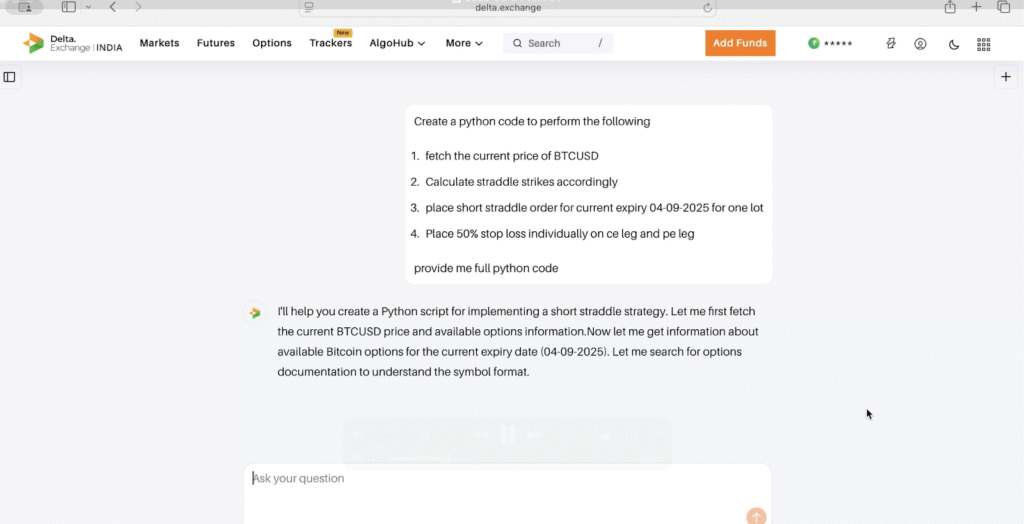
API Copilot on Delta Exchange solves this coding bottleneck in an easy way. It sits right inside the platform, as a user-friendly AI assistant tuned to the needs of crypto traders – not generic coders. You can interact with Copilot much like texting a friend or using ChatGPT, only now – with a crypto trading focus – it’s actually writing, fixing, and explaining code as you build your strategies.
A notable brownie point of API Copilot is that it responds to plain English, so we can outline ideas, trading conditions, or risk controls, and get a Python script in seconds. No more trawling through outdated API docs or hiring a developer for minor tweaks.
For traders, this means less friction and faster iteration: test, refine, and automate strategies on the same day.
Building and Testing Strategies Without Coding
Code generation user input
Here’s a walkthrough of a typical experience:
Let’s say you’re interested in BTC futures and want to automate buying whenever the price drops a certain percentage within an hour. Instead of parsing documentation or writing code from scratch, you need to simply describe your idea to API Copilot. In moments, you will receive a customized script, ready for testing.
API Copilot can also help debug errors, walk through order placement logic, and explain tricky aspects like WebSocket connections or market data access – making the whole process more approachable for newcomers and time-saving for experts.
Step-by-Step Setup: Getting Started with API Copilot on Delta Exchange
Follow these quick easy steps to get started with API Copilot:
Register on Delta Exchange using basic details and complete KYC to unlock trading features.
Browse the platform’s derivatives offerings to get familiar with available products.
Navigate to AlgoHub and create an API key under the API tab.
Once the key is set, go back to AlgoHub. API Copilot will be live, ready to assist in building, automating, and testing strategies.
This seamless, integrated experience means that you’re not shuffling between different platforms or tools – everything is already available at your fingertips.
Benefits that Go Beyond Basic Automation
Delta Exchange is more than just APIs – it offers advanced tools and features that simplify trading:
INR support for effortless deposits and withdrawals, so no multi-currency headaches for Indian traders.
Direct integrations with TradingView, Tradetron, AlgoTest, and NextLevelBot, which allow you to supplement or connect existing strategies without complex third-party setups.
Low minimum lot sizes, sometimes as little as ₹2,500 to ₹5,000, so you’re able to experiment with ideas without risking large amounts of capital.
Risk-free demo accounts, perfect for testing crypto trading strategies until you’re confident enough to commit real funds to your automated trading.
Fast, reliable executions make sure your algo trading bots don’t lag behind market moves – a must for both retail and institutional traders.
Why Does API Copilot Matter?
Delta Exchange’s API Copilot makes running crypto trading strategies hassle-free
For years, there was a clear divide in crypto trading: coders could automate, scale, and backtest almost anything, while the rest had to rely on intuition, slow manual orders, or pricey signal services. API Copilot democratises this space – a trader with no prior coding experience can bring creative ideas to life, test them, and run complex automated strategies in production.
The world of crypto APIs is booming, projected to reach nearly $8 billion by 2035, with use cases multiplying from simple trade execution to advanced risk management and portfolio hedging. With Copilot, every trader has a shortcut into this growing market.
Realistic Expectations and Risk Awareness
While API Copilot can bridge the technical gap, it’s important to remember that successful trading still relies on sound strategy, market awareness, and risk management. Automation amplifies ideas, but it doesn’t guarantee profits or shield anyone from crypto volatility.
Using demo accounts and small lot sizes is a safe way to validate new strategies. Always be sure to review risk profiles and don’t jump into fully automated trading without testing and tweaks.
To Sum Up
API Copilot makes algo trading approachable and flexible for anyone – even those with zero coding background. It’s part of a broader shift in the crypto trading space towards inclusivity, speed, and strategy-first experimentation. Whether you’re building simple triggers, executing on price movement, or running complex multi-leg options spreads, the process is fluid, iterative, and much less stressful.
If you’re looking to test your next crypto trading strategy, consider trying out API Copilot. For traders aiming to compete in fast-moving markets, this is a step toward smarter, more automated decision-making.
To start testing crypto trading strategies with API Copilot, visit www.delta.exchange and join the community on X for the latest updates.
Disclaimer: Investing in cryptocurrency entails bearing the high risk of market volatility. Kindly research before investing.
Heads up, fam! Aivora is leveling up our entire trading rewards system (Voucher) —we’re migrating from the OG Blue Voucher (USDT Bonus) to the new USDT Experience Gold (The Red Voucher). This upgrade is designed to streamline the rewards mechanism and help our traders manage their stack more efficiently on Futures trading.
If you’re used to the Blue Voucher, which basically worked like real stablecoin (USDT) for trading, the upcoming Red Voucher will be the new main reward, strictly used to offset trading fees and cover losses during a trade. Understanding the mechanics of each voucher is key, especially during this transition, so you don’t miss out on any rewards or get rugged by confusion.
The Red Voucher: USDT Experience Gold
This is the voucher Aivora is keeping post-upgrade, acting like a genuine capital shield for degens (traders).
Automatically covers trading fees and mitigates losses when you’re making Futures trades.
It’s non-withdrawable and non-transferable. It’s only for U-based Futures (USDT-margined Futures).
Cannot be stacked with other coupons, and it will expire automatically after a set period.
The Red Voucher helps minimize risk on test trades or when the market is in full send/FUD mode. It’s especially perfect for rookies who want to ape into Futures without risking their main stack.
A simple breakdown:
If you have a $10 Red Voucher and you hit a $10 loss on a Futures trade, the system automatically uses the voucher to cover that loss instead of dipping into your actual assets.
The Blue Voucher: USDT Bonus (soon to be discontinued)
Previously, the Blue Voucher was treated like a tradable USDT reward. When activated, your Futures account balance would increase by the voucher’s face value.
This reward could be combined with your actual capital for trading, and any profits earned from that capital were withdrawable.
It would auto-revert upon expiration and was non-transferable. However, to optimize our reward system and enhance risk management, Aivora will stop issuing the Blue Voucher soon, replacing it completely with the Red Voucher.
Blue Voucher (USDT Bonus): Acts like real USDT → profiteering? you can cash out the gains.
Red Voucher (Experience Gold): Non-withdrawable → only for covering fees and mitigating losses.
Post-migration, all Aivora reward programs will exclusively utilize the Red Voucher. This change is our move towards a more transparent and safer reward system for Futures traders.
Pro Tip: Make sure to activate and use all your existing Blue Vouchers before the deadline. Also, get familiar with the Red Voucher’s mechanics to maximize your trading edge.
How to Activate
Access Account Management
Log in to Aivora -> Account Management -> Voucher Center -> Activate Voucher
Activate Voucher
Don’t forget to follow our channels to get more alpha and fresh vouchers from Aivora!
About Aivora
Aivora Exchange is a trading platform focused on a user-friendly trading experience, transparent cashback, and community incentive programs. With features like VIP Zone and Apply Voucher, Aivora is creating a mechanism for influencers, communities, and active traders to share in the benefits and promote sustainable growth.
While most exchanges typically issue vouchers through limited events, Aivora Exchange has taken a different approach by implementing Apply Voucher, a feature that allows the community to directly apply for futures trading vouchers from the platform without intermediaries or event screening.
This is considered a “one-of-a-kind” feature in the current market, aiming for a transparent, fast, and user-centric experience for active traders.
Users can easily access theAivora Trading Voucher page to apply for bonuses. Aivora also encourages registering an account via the official link or using a referral code to gain additional benefits.
Unlike traditional voucher systems, this new feature offers the community several advantages:
Direct Voucher Application: No need to participate in events or go through partner screening.
Support for Active Traders: Geared towards high-volume traders, influencers, KOLs (Key Opinion Leaders), and community leaders.
Flexibility & Transparency: Users have control over the number of vouchers they want to apply for and the reason for their request.
Community Connection: Vouchers are not only for individuals but can also be applied for as a team with a list of accompanying UIDs.
Apply Voucher Process – Detailed Form
To apply for a voucher, users need to fill out the online form. Required fields include:
Who are you?* — A brief introduction of yourself or your community role.
UID* — Enter your Aivora account UID.
Team link or UID list — If applying as a team, you must provide a link or list of UIDs.
How much trial bonus do you want to claim?* — Enter the desired amount of vouchers/bonuses.
Application Reason* — State the reason for your voucher request.
Referrer’s Name (Community/KOL/Other) — Fill in the name of the person or community that referred you (if any).
Aivora will review the applications and distribute vouchers based on the information provided. This model increases opportunities for both individual traders and communities while reducing barriers to accessing futures bonus packages.
Why is Applying Vouchers a Different Approach?
While exchanges often link vouchers to short-term marketing campaigns or events, Aivora has chosen to empower users directly. With Apply Voucher, everyone can:
Proactively plan trades with futures bonuses.
Easily access cashback mechanisms and long-term incentives.
Have their community role recognized through group applications.
For Vietnamese traders, applying for vouchers through trading communities or events was previously limited. Now, the Apply Voucher feature opens up a more equitable option. As long as you are a trader in need and provide a valid reason, the opportunity to receive a voucher is within your grasp.
Aivora Launches VIP Zone: Exclusive Perks & Cashback for Influencers
Aivora Exchange is strengthening its community strategy with the launch of VIP Zone, an exclusive program for key opinion leaders, high-volume traders, VIP customers from other exchanges, and community leaders.
The objective is to establish a mutually beneficial mechanism: influencers expand their reach, while Aivora achieves user growth, creating long-term value for both parties.
By simply filling out the application form, candidates will be assessed based on their marketing skills, relevant experience, and community outreach capabilities. The Aivora team will respond within 2-3 business days, providing training resources, a dedicated communication channel, and one-on-one support for qualified individuals.
Key Benefits of Joining VIP Zone
By participating in the VIP Zone, influencers will receive multiple benefits tailored to their community role:
Commission and Event Bonuses: Receive up to 60% cashback on commissions, plus additional performance-based bonuses.
Professional Support: Gain access to training, marketing materials, and direct support from the Aivora team.
Event Resources: Priority participation in campaigns, early access to promotional materials, and brand exposure opportunities.
Branding Support: Build personal branding, enhance credibility, and increase recognition within the community.
A unique feature is the transparent payment mechanism: commissions and bonuses are settled monthly and paid directly into the Aivora account, making it easy for influencers to monitor and plan.
Candidates need to complete the official form for Aivora’s evaluation. The form includes important fields such as:
Name/Nickname
Region/Country
Email address
Telegram
X (Twitter)
Are you an Aivora user? (Yes/No, please provide UID if applicable)
Are you currently a VIP customer at another exchange? (Yes/No, if Yes, a proof screenshot is required)
Additionally, upon form submission, the system will record the name, email, and photo linked to your Google account. After completion, the Aivora team will review the profile and provide a response within 2-3 business days.
VIP Zone is more than just a referral program; it is Aivora’s long-term strategy to build sustainable relationships with influencers and the community. With attractive cashback rates, professional support, and opportunities to become a representative face in campaigns, VIP Zone is expected to be a powerful tool that helps influencers increase their income and strengthen their personal brand.
FAQ
How can I become an Aivora VIP?
Fill out the application form. Aivora will assess your marketing skills and community influence. The results will be communicated within 2-3 business days.
What support do Aivora VIPs receive?
They are provided with marketing materials, training, event resources, a dedicated communication channel, and one-on-one support.
How are commissions and bonuses paid?
All are settled monthly and paid directly into your Aivora account.
About Aivora
Aivora Exchange is a user-centric exchange focused on user experience and community incentive programs. By combining trading features, promotional events, and influencer support through the VIP Zone, Aivora aims to become a reliable destination for both individual traders and the global community.
Event trading – a highlight that attracts retail traders
What makes Aivora unique is its continuous series of trading events. Not rare campaigns, Aivora maintains events as part of the daily experience. Traders participate not only to trade, but also to enjoy the feeling of competition, hunting for prizes, and connecting with the community.
Aivora’s trading volume race ranking season 8
Advantages of trading on Aivora:
High frequency: there are always new events during the week or month.
Fast payouts: at the end of the event, you receive the prize on the same day.
Few participants: since the exchange is new, the competition rate is low, and the opportunity is higher.
Suitable for retail traders: the ROI and PnL mechanism allows small capital to still climb the rankings.
Valid vouchers: even when using vouchers to trade, the results are still counted.
Recent outstanding events
Instead of focusing on a single program, Aivora organizes many parallel events so the community always has options:
1/ Weekly Trading Competition
A weekly trading competition with a transparent ranking board, with prizes awarded on the same day the event ends.
2/ New user welcome bonus – up to 4,888 USDT
Users who complete check-in, invite friends, or deposit and trade according to milestones will receive rewards.
For example: deposit 10,000 USD and trade 2,000,000 USD will receive 400 USDT + 5000 Lucky points.
Prize draw event to receive 1 BTC
3/ Spin to Win – a maximum prize of 1 BTC
Complete tasks to receive a prize draw ticket. Prizes include BTC, SOL, USDT or Lucky points. The value increases according to the VIP level based on the number of accumulated Lucky points.
Spin to Win
Lucky Wheel Reward
4/ Daily check-in to get reward
Users check in daily to accumulate Lucky points, which can be exchanged for USDT futures bonus, lottery tickets or items at the Lucky Shop.
Daily Check In
Lucky Shop Reward
5/ VIP ZONE with up to 60% discount fee program
Apply to be VIP on Aivora
CoinMarketCap certification – A platform to consolidate reputation
In parallel with the series of events, Aivora has officially been certified for its assets by CoinMarketCap, a turning point that affirms the transparency of the exchange. According to data from CMC:
24h trading volume: about 292 million USD.
Public reserve assets: about 68 million USD.
Aivora has been listed on CoinMarketCap
In the context of many new exchanges appearing and then disappearing, the recognition from CMC is not just a “certification mark,” but also a testament to the fact that Aivora has enough liquidity and transparency to stand firm in the global market. This is the basis for traders to feel more secure when participating in events and trading on the exchange.
FAQ
Do I need a large capital to participate in Aivora’s events?
No. Thanks to the way ROI and PnL are calculated, small-capital traders can still achieve high rankings if they trade effectively.
When will I receive the prize if I win an event?
Aivora stands out with its fast payout mechanism — most are awarded on the same day the event ends.
What is the value of Lucky Point?
Lucky Points can be accumulated through check-ins or tasks, and then used to exchange for USDT futures bonus, lottery tickets, or items at the Lucky Shop. In addition, the number of Lucky points also helps to upgrade your VIP level to receive more privileges.
Aivora is a new centralized Crypto exchange established in 2024 and is in the process of expanding its market with attractive airdrop programs for users.
This article will provide detailed, illustrated instructions so you can easily complete tasks and participate in airdrop programs such as: Daily check-in, New user bonus, Spin to win 1 BTC, daily tasks, etc.
Let’s find out how to hunt for Aivora exchange’s airdrop in the article below!
How to hunt for Aivora airdrop
Initial setup
To hunt for airdrop from Aivora exchange, you need to complete the following initial setup steps:
Step 1: Register for an Aivora account. Remember to use the Referral Code (Optional) EAAALAHV to receive exclusive offers!
Step 2: Complete KYC on Aivora exchange.
Step 3: Deposit money into Aivora according to the milestones to participate in rewards from the exchange.
Daily check-in
Check in every day to receive Lucky points daily by following these steps:
Step 1: Click the ongoing event button (e.g., Spin to win 1 BTC) on the menu bar to enter the Benefits section of the exchange.
Step 2: Click the Check-in button to proceed with daily check-in.
Step 3: Click the Check In button to complete the task.
That’s it, remember to check in every day to accumulate a lot of Lucky points and be eligible for other tasks.
Bonus for new users
If you are a new Aivora user, you will receive a bonus of up to 4,888 USDT from the exchange when you complete the challenges.
Deposit 50,000 USD and volume reaching 20,000,000$: Receive 4,438 USDT and 14,800 Lucky points
Spin to win 1 BTC
Next, you can complete the mission milestones in the Spin to win 1 BTC event to receive prize spins.
On this spin, you will have the opportunity to receive gifts such as:
Solana (SOL)
USDT
Lucky points
Receive more spins to continue participating in the spin.
Note: The reward will increase according to the VIP milestones you reach. These VIP milestones are calculated based on the number of Lucky points you own.
Complete tasks
In addition, you can complete tasks such as Daily Tasks, Limited-Time Tasks and Exclusive Task (box number 1) to earn more Lucky points. The parts you need to pay attention to include:
Number 2: Progress bar and how to complete the task
Number 3: Button that takes you to the mission page
Number 4: The reward you receive
After you have Lucky points, switch to the Lucky Shop tab (located in guide box number 1 in the photo) to redeem rewards. Here, you can use Lucky points to redeem USDT futures bonuses, Lottery Tickets to continue participating in the event and win prizes at larger milestones.
Aivora trading contest
In addition, this exchange also regularly launches other reward programs to encourage users, for example, the Aivora trading contest which takes place every week.
Therefore, in addition to the events mentioned above, you should follow Aivora’s X channel to participate in these events and receive more rewards!
Tips for optimizing rewards from Aivora
Below are some notes that can help you optimize rewards from Aivora exchange’s airdrop program, including:
The USDT reward received cannot be withdrawn directly. However, it is considered as cash on the exchange, can be used for trading, leverage and 100% of the profit can be withdrawn. More specifically, this USDT reward will be prioritized for deduction in losing orders.
The milestone conditions will be calculated together for all tasks. Therefore, you can complete many tasks at once with just 1 transaction.
The futures trading volume milestone will be calculated on the total size of the contract. Therefore, you can use high leverage to quickly complete the task. However, you need to be aware of the risks when using high leverage.
Use the USDT reward you have received and take advantage of high leverage to complete higher mission milestones.
Regularly follow and participate in other side events of Aivora to optimize rewards.
What is Aivora?
Aivora is a new generation CEX exchange established in 2024, applying Artificial Intelligence (AI) technology to support Crypto investors.
This exchange is registered in the state of Colorado and currently has a Money Service Business (MSB) license to provide currency services to more than 50 states in the United States. In addition, Aivora also has subsidiaries in Dubai, Malaysia, Singapore and is actively expanding its market to many other countries.
Aivora exchange’s airdrop program
As a newly established exchange, Aivora regularly launches airdrop programs and events to encourage user participation. Register for an Aivora exchange account here.
You can check in the notification section, on event banners or follow Aivora’s official media channels (Telegram, X) to participate in time and win prizes!
Follow Aivora and ongoing events
As a relatively new exchange, Aivora chooses to approach the market by constantly launching attractive programs and events. Instead of just emphasizing trading services, the exchange prioritizes creating many activities to attract attention and build a cohesive community, for example:
Welcome bonus for new users up to 4,888 USDT
This is considered a strong move to affirm competition with major exchanges. The high bonus gives new users more motivation to register and experience the platform’s features.
Lucky spin with a maximum prize of 1 Bitcoin
This is an entertaining but highly attractive event thanks to the valuable prize. The opportunity to own 1 BTC makes this program a highlight that attracts the attention of the trader community.
Farm keys – open boxes – get iPhone 17
This activity applies the “gamification” element to trading, bringing a fun and rewarding experience. Bringing hot technology products like the iPhone 17 into the prize further increases the attraction for young users.
This is a regular playground for traders to compete in skills. With clear rankings and rewards, the event helps the community maintain regular participation and increase connectivity.
There are also many other events and to not miss out, follow the social channels below:
What are the requirements to participate in Aivora airdrop?
You need to register for an Aivora exchange account and complete KYC to be eligible to participate in the airdrop.
Do I need capital to participate in the Aivora airdrop?
Yes. You will need to deposit money into the exchange to complete tasks and trade to reach the required volume.
What are Aivora’s transaction fees?
Currently (27/07/2025), Aivora is applying almost the best fees on the market with 0.08% (Market)/0.1% (Taker) for Spot trading and 0.02%/0.05% for Futures trading.
Above are the detailed steps guiding how to hunt for Aivora exchange’s airdrop. If you encounter any problems during the process, please leave a comment below so we can help you answer them!
Note: The content above is not investment advice. You should only refer to it and do your own research carefully before deciding to invest. Be a responsible investor with your assets, wish you success!
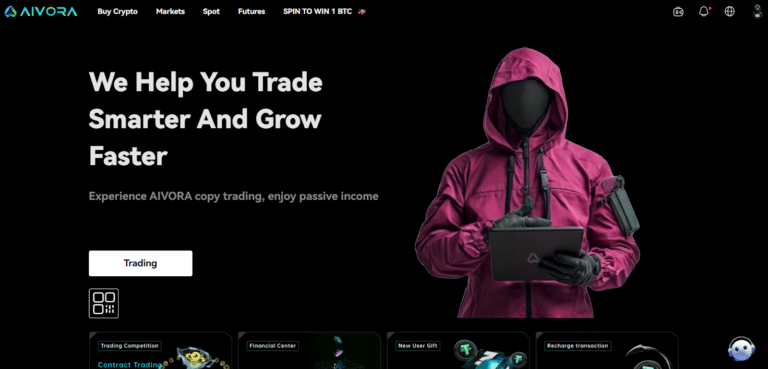
Aivora is a newly launched crypto exchange designed to leverage the power of AI in the daily trading activities of cryptocurrency investors.
Currently, Aivora supports essential features such as Spot and Futures trading with some of the most competitive fees in the market.
What is Aivora?
Aivora is a next-generation centralized cryptocurrency exchange (CEX) founded in 2024 in the British Virgin Islands. Its mission is to integrate artificial intelligence (AI) to deliver the best trading experience and strategy recommendations for crypto investors.
At present, Aivora is actively expanding its market presence by establishing subsidiaries, applying for regulatory licenses in multiple countries.
Licenses and Jurisdictions
Although founded in the British Virgin Islands, Aivora is registered in Colorado, USA under filing number 20248368980.
The exchange is also registered as a Money Service Business (MSB) with FinCEN under license number 31000289207053, enabling it to provide financial services across more than 50 U.S. states.
Furthermore, Aivora has set up subsidiaries in Dubai, Malaysia, and Singapore to expand global operations and support crypto users worldwide.
Key Highlights of Aivora
Unique Interface: Aivora’s platform is designed with a Cyberpunk theme, giving traders the sense of entering a futuristic, AI-powered trading world.
AI Integration in Trading: The built-in AI assistant, Aiva, is embedded directly into the trading interface, allowing users to get instant support without switching tabs or going through complicated logins.
Real-Time AI Insights: Aiva provides trading recommendations such as entry points, take-profit (TP), and stop-loss (SL) based on real-time market data. These insights are powered by big data analysis, helping traders strengthen their strategies.
Aivora’s Core Features
Beyond AI assistance, Aivora offers essential tools and services every crypto trader needs:
Markets
This feature provides an overview of all crypto assets listed on Aivora, allowing traders to track market trends and discover investment opportunities.
Spot Trading
Aivora’s Spot market enables direct asset exchanges without intermediaries. Currently, it supports nearly 100 popular trading pairs with high liquidity and extremely low fees — just 0.08% (maker) for standard (VIP 0) users. The platform also integrates an order book and TradingView charts, giving traders professional tools for technical analysis.
Futures Trading
In addition to Spot, Aivora supports Futures contracts with leverage of up to x125. With order books and TradingView charts, users can apply technical indicators to optimize entry and exit points.
Competitive Fees
Aivora offers one of the lowest fee structures in the CEX market:
Spot: 0.08% (Maker) / 0.1% (Taker)
Futures: 0.02% (Maker) / 0.05% (Taker)
How to Register and Complete KYC on Aivora
Follow these simple steps to create an account and verify your identity:
Step 1: Go to the Aivora sign-up page, enter your account details, agree to the terms, and click Sign Up.
Tip: Use a referral code to unlock exclusive benefits!
Step 2: After registration, click your profile avatar in the top-right corner and select Account Management to proceed with KYC.
Step 3: Open the Identity Verification tab and click Verify Now.
Step 4: Click Continue, agree to the terms, and choose whether to use your PC or smartphone camera to upload your ID (e.g., national ID card).
Step 5: Wait around 5 minutes for Aivora’s system to review your documents. Once approved, you can access all Aivora features.
Don’t forget to join the Spin to Win 1 BTC campaign available to new users.
Frequently Asked Questions (FAQ)
Is Aivora safe? With valid licenses registered in the United States, users can have a certain level of confidence when trading on Aivora. However, since this is still a very new exchange, it will take more time to further strengthen its security and reliability.
Is Aivora difficult to use? No. Aivora is designed to be user-friendly for both new and experienced traders. This makes it easy for anyone to trade daily on the platform.
How can I deposit funds into Aivora? Currently, you can deposit funds into Aivora via on-chain transfers. Your wallet address can be found by navigating to the wallet icon on the homepage → Assets → Deposit.
Does Aivora have a mobile app? Yes. Aivora is available on both the App Store (iOS) and Google Play (Android). Simply search for “Aivora” to download and use the exchange on your mobile device.