Analysts in both crypto and traditional markets have noted some startling similarities between the recent downturn and the one caused by a pandemic panic in March, 2020.
The real question is whether it’s the start of a larger downturn or if there will be a significant bounce-back as in 2020 that led to an extended bull run in both crypto and stocks markets.
Podcaster and author of The Pomp Letter, Anthony “Pomp” Pompliano is on the permabull side of the ledger, tweeting on May 18 that since March 1, 2020 when one Bitcoin cost about $8,545, “Bitcoin is up 340%.”
Bitcoin is up 340% since March 1, 2020.
As central banks around the world devalued their currencies at a historic rate, there is only one asset that stood out from the pack.#bitcoin is the savings technology that shields billions of people from undisciplined monetary policy.
Among those hopeful of a turnaround is investment firm Real Vision’s CEO Raoul Pal who believes Bitcoin markets have been painting a pattern that shares traits with the March 2020 crash.
In his May 13 episode of Raoul Pal Adventures in Crypto, Pal explained that with the downward price action last week, Bitcoin (BTC) may have “shot straight down” to the bottom of the current wedge formation and is now in a range that will eventually lead to another rise in price. He said,
“That was exactly the kind of pattern we had in March 2020.”
On March 12, 2020, investors panic-sold many assets, including Bitcoin, as fear about how the market would be impacted by the COVID-19 pandemic and global lockdowns. On that day, Bitcoin fell 45% from $7,935 to $5,142 according to CoinGecko.
The current decline in traditional markets has led to a loss of $7.6 trillion in market cap from the tech heavy Nasdaq, in non-inflation adjusted terms, more than the dot-com bubble and the March 2020 sell-offs.
The numbers are obviously not adjusted for inflation but still mind-blowing to see in this context. pic.twitter.com/aHem93mhpo
— Michaël van de Poppe (@CryptoMichNL) May 17, 2022
The 50 day moving average (MA) of financials, real estate, and technology investments is close to the overwhelmingly oversold levels seen just over two years ago. Respectively, in March 2020 those levels were 0, 0, and 1 compared to 2, 3, and 4 so far in May based on data from Fidelity Investments. In a May 18 tweet, Fidelity’s own Director of Global Macro Jurrien Timmer called March 2020 “one of the most oversold setups in the history of the market.”
Managing partner at The Future Fund Gary Black pointed out on May 17 that Tesla (TSLA) is trading at a 20% discount, the widest from analyst target price since March 2020. He added that “Over the next 12 months, $TSLA rose 660%.”
The last time $TSLA traded at this wide a discount (25%) vs the avg Street PT ($984) was in March 2020, at the height of the Covid crisis. Over the next 12 months, $TSLA rose 660%. Source: https://t.co/5fcVwWX78ipic.twitter.com/z2AHe5zkVi
The S&P 500 Index also displays similarities as it recorded a 52-week low of 3,930 on May 12 only to bounce back to 4,088 by market close on May 17. Chief Market Strategist for financial research firm LPL Research observed in a May 18 tweet that the last time the index had done that was in March 2020.
The S&P 500 just made a 2% gain in two of the past three days coming off of a 52-week low.
Before traders get too excited, market conditions are very different now, with rising inflation and interest rates. Back then, governments reacted with unprecedented support packages to prop up prices. Reuters reported on May 14 that the strong bounce in the market in 2020 was fueled by what it called an “unprecedented Fed stimulus.”
Analyst and author of the Rekt Capital Newsletter, Rekt Capital tweeted on May 17 that BTC “is entering a period of outsized opportunity” based on analysis of the Log Channel which he says resembles what happened in March 2020. However he’s not clear if we’ve bottomed out yet.
With the development of gaming platforms, virtual items have also become a popular method of monetization, but most games store data on private servers, giving gamers a reason to doubt their reliability and transferability.
Developers can change the game policy at any time to maximize their profits. They are not obliged to consult users or take responsibility for the harm caused to the game ecosystem.
This problem can be solved by blockchain technology which makes it possible to own and transfer virtual assets to anyone through nonfungible tokens (NFT).
In a world where gamers spend a lot of time and money developing their characters and seeking out unique items, games that allow them to earn and influence the game’s development are very attractive. One of the most popular genres of games is massive multiplayer online (MMO) strategy games that are focused on building civilizations and managing the gaming ecosystem. One such game is called Leagues of Kingdoms (LOK).
PC gaming is one of the most popular forms of entertainment worldwide, with more than three billion fans of PC and console games in the world and a sales income calculated in hundreds of billions of dollars.
What is LOK?
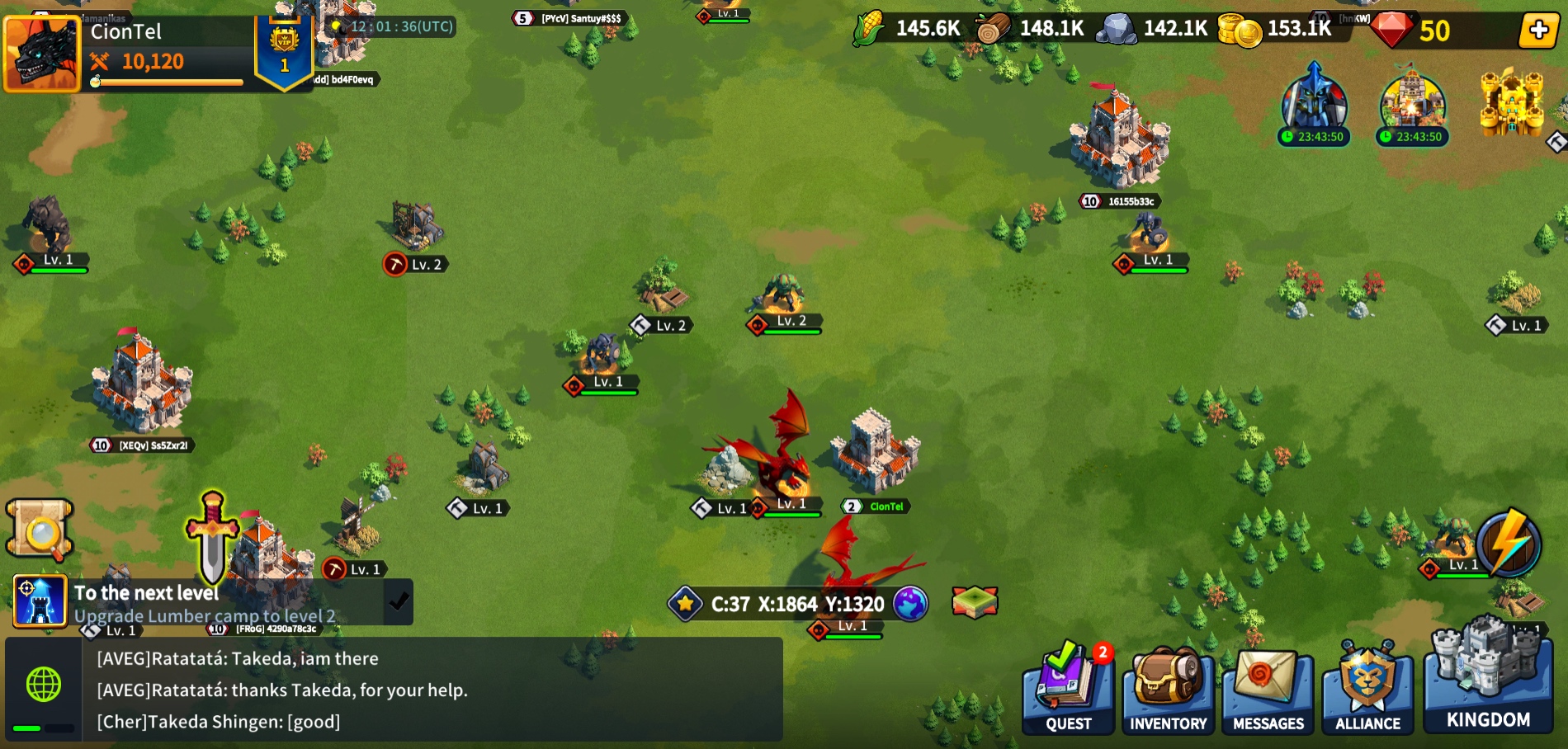
League of Kingdoms (LOK) is an MMO strategy game based on the Ethereum blockchain. It is a decentralized and independent ecosystem. Gamers can buy land and other NFT assets in the official game store or from other players on the OpenSea marketplace. Ownership is secured on the blockchain.
Gamers can create their own kingdoms and raise armies to protect their subjects and participate in battles. Players can also participate in various quests, events, contests and competitions to win awards.
Kings can team up with other kingdoms to create alliances, which fight for control of different territories.
Players also can take part in decision-making processes, like voting for new game content. Proposals that receive the most votes are implemented in the following update of the game.
Game modes and earning
Every gamer starts with a single-player mode and is immediately ordered to complete simple tasks for which bonuses will be awarded. The game also offers to join one of the alliances. But, in order to fully play, the gamer needs to purchase additional resources in the gaming store.
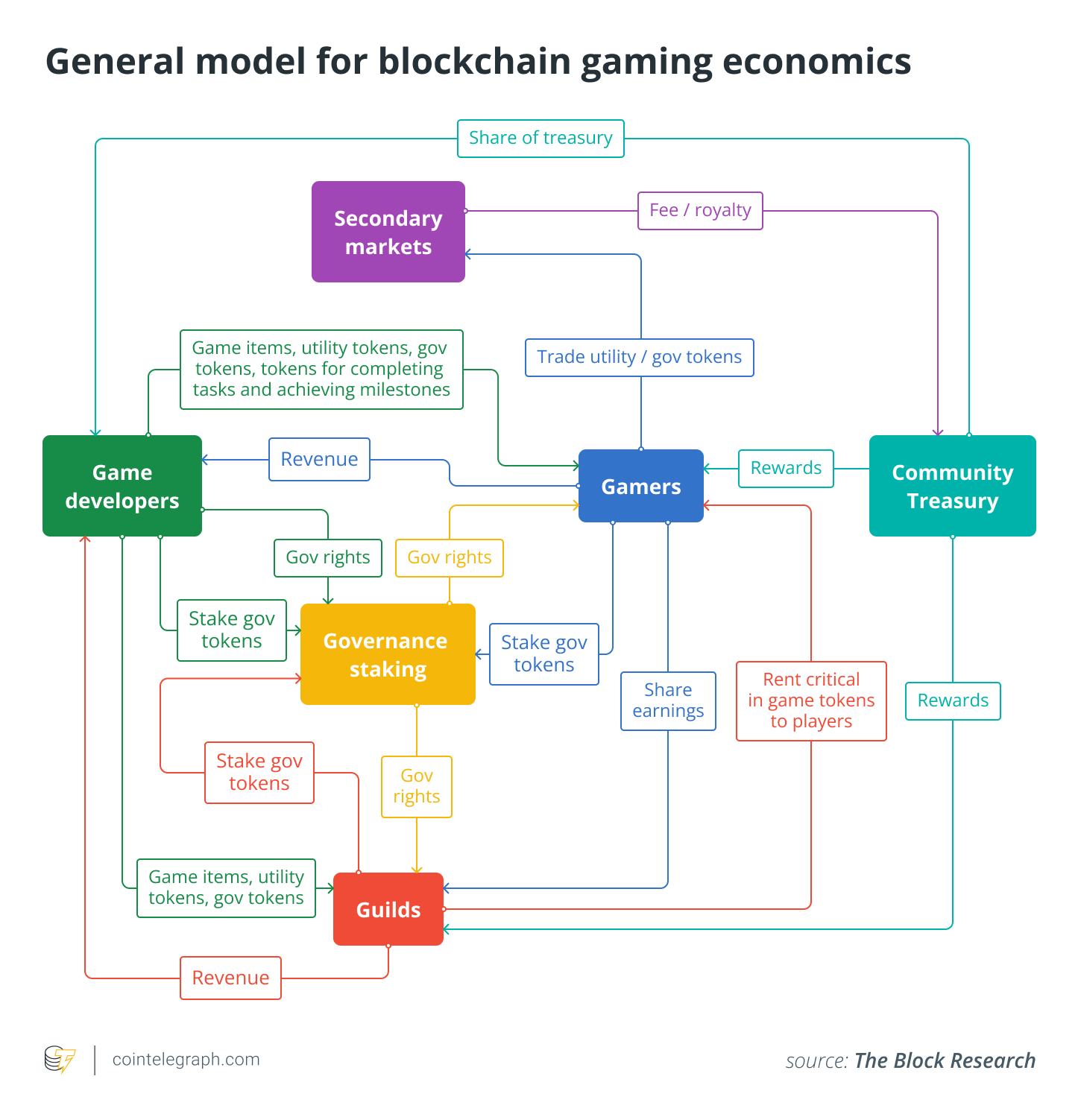
The NFT land token is the centerpiece of the game, and kingdom-building is the central element of League of Kingdom’s gameplay. Gamers start with a small primitive city-state and develop it into a powerful kingdom. One of the unique features of League of Kingdoms is its treasure and skill system. There are artifacts that can be crafted and used to unlock special magical abilities.
Buying the “Gold Mine” to build it and get resources.
The League of Kingdom platform has several game modes.
The single-player mode is designed to create a kingdom. The gamer creates buildings, explores the ecosystem, collects resources and prepares an army to protect their own kingdom and strengthen the alliance.
In player-versus-environment mode, gamers farm valuable resources and send warriors to hunt evil monsters. According to the developers, in the future, a monster invasion mode called Trial of Agony will be introduced.
Player-versus-player is designed for competition between gamers. Players fight for resources and ownership, using game elements and special skills to strengthen their armies and capture enemy castles.
MMO mode allows players to participate in alliance wars, the siege of shrines and other competitions.
On my way to defeat another castle.
Making money in LOK is the most important occupation. Gamers can earn cryptocurrency by owning NFTs. Part of the gaming fees goes to reward active players and landlords. Players can also trade game elements on NFT markets.
The landowner receives 5% of the collected resources, which can be used to benefit the kingdom or mine NFTs. LOK has a Dai (DAI) prize pool to pay landowners.
The land in the project is a unique unit of digital real estate, presented in the format of an NFT, which can be used to play and earn points for development. In total, there are 65,536 plots located on several continents.
Dragos are mythical creatures with the powers of various elements. Each dragon is unique. They serve their master and fight for him in battle. This is a decisive element of the battles in the game, which determines tactical and strategic options. Dragos are collectible NFTs with unique appearances and features. Owning a Drago provides various benefits in different areas of the game. By owning a dragon, the player also gets the opportunity to earn Dragon Soul tokens (DST).
Han Yoo, chief operating officer of LOK, told Cointelegraph that the project team places particular emphasis on these NFTs:
“Drago — a dragon-like creature NFT, was introduced in the League of Kingdoms on May 16. Drago NFT and DST token loop will usher in a new era of play-to-earn in the LOK. Drago will also launch with a rental system. More gameplay content related to Drago will be released as well. One of them will be Drago Arena where Dragos can fight and compete with each other. It will be a sort of mini-game to diversify the entertainment of our game.”
Trouble in the kingdom
LOK is available for PC and also has a mobile version, which can be downloaded from Google Play and the Apple App Store, although the developers are experiencing difficulties on the latter.
The game may be interesting, but many mobile-version players complain that there are still many bugs and the translation of the interface into different languages is not done professionally. Recently, bots have become a major problem in the game as the user base rapidly grows.
The project team has recognized these difficulties. Yoo mentioned that in order to boost the attractiveness of the game, the developers used too many bots and, as a result, the game has a lot of errors:
“We’ve been updating our server with several patches and updates to accommodate the growing number of users, but the proportion of bots is quite high compared to other games, and it is causing lag and bugs in our game. We’ve developed an anti-bot system to filter out the flood of bot accounts. Also, we are encrypting the codes to prevent bot developers and abusers from exploiting our game. Currently, we are building a dedicated unit to monitor and ban the bot and cheaters, as well to comb out the malicious users from the game.”
Despite these hiccups, the project has a roadmap for two years ahead and an extensive community of players. LOK is already a full-fledged working app that thousands of users have downloaded.
At the moment, the game itself looks like a niche product compared to currently popular NFT games like Axie Infinity and Gods Unchained. But, LOK is a real-time strategy game which is a rather unusual choice for an NFT game. Real-time strategies are interesting in the context of complex game mechanics and LOK seems to succeed in transforming into a cross between a farm simulator and Pokémon with the introduction of the Drago ownership system. However, the game’s large community and powerful team of specialists speak to its viability.
The views and opinions expressed here are solely those of the author and do not necessarily reflect the views of Cointelegraph.com. Every investment and trading move involves risk, you should conduct your own research when making a decision.
Cryptocurrency investors and traders have cashed out $7.7 billion from the stablecoin Tether (USDT) resulting in its market capitalization falling by 7.8% over the past seven days to $76 billion.
The amount withdrawn from the top stablecoin is nearly double the $4.1 billion it held in cash reserves at the end of 2021 according to Tether’s latest reserves report from December 2021.
To maintain Tether’s peg with the US dollar the company behind the token backs USDT with assets such as cash, bonds, and Treasury bills, the purpose being that each token is backed by at least $1 worth of assets.
According to the latest reserves report, the company had a total assets amount of at least $78.6 billion, around $4 billion or 5% of which was cash.
However, the firm seems to be able to maintain its cash reserves despite the “bank run” scenario caused by the collapse of the algorithmic stablecoin TerraUSD (UST) which had investors fleeing not only stablecoins but the entire crypto market for fear of collapse.
A separate transparency report updated daily shows that 6.36% of Tether’s assets are currently held in cash which would amount to roughly $4.8 billion if Tether’s reserves closely match the USDT market cap.
On May 12, market panic caused USDT/USD to trade under $0.99 on major exchanges, causing Tether to issue a statement at the time stating that it will honor all redemptions to $1.
The same day, Tether’s Chief Technology Officer Paolo Ardoino said in a Twitter spaces chat that the majority of the company’s reserves are in U.S. Treasuries and that over the last six months it has reduced its exposure to commercial paper.
This obscurity coupled with the recent short-lived de-pegging had some investors rushing to swap their Tether for another popular US dollar stablecoin, USD Coin (USDC) on the notion that USDC was audited and already fully backed by cash and U.S. Treasuries.
A blog post on May 13 by Circle’s Chief Financial Officer Jeremy Fox-Geen made in response to the stablecoin fallout reaffirmed that USD Coin was fully backed by cash and U.S. Treasuries for the 50.6 billion USDC in circulation.
Data from CoinGecko further shows investors finding a safe harbor in USDC, a 6.3% leap in the USDC market cap took place between May 3 and May 17 representing $3.1 billion of inflows over that time.
As the dust settles from the Terra ecosystem crash, and the community decides what the next steps should be, the CEO of a validator runner in South Korea thinks the old Terra chain should be shut down permanently.
Jiyun Kim, CEO of blockchain solutions company DSRV, wrote an opinion post on his own behalf, detailing how the Terra team tip-toed around the idea of halting block production while LUNA prices crashed and its Terra USD (UST) stablecoin was depegged. He now urges validators in the Terra ecosystem to reject a hard fork in favor of a brand new community-driven blockchain.
DSRV runs a validator node on Terra with 9.36% of the on-chain voting power. DSRV has suffered as much as any investor because its node had collected 14 billion LUNA worth about $1 billion in LUNA by May 8, which is now worth about $3 million.
Kim wrote that the decision to halt the chain on May 12 was not taken lightly by the Terra Validator League, which was renamed the “Terra Rebirth League”. However, he said the Terra team failed to give the proper notification using the word ‘Confirm’ to actually confirm with all validators that they should halt the chain, which left him feeling “betrayed.” He wrote:
“And the announcement that they made [made it sound like] the chain restart was originally the validator’s opinion. YES, they didn’t use the term “Confirm”.”
Terra founder Do Kwon proposed reconstituting the chain and resetting token supply to 1 billion LUNA on May 13. Kim appears to completely disagree with Kwon as he wrote in his post that re-using the Terra chain “is completely making Terra chain’s internal value to 0.”
“The previous Terra chain should permanently vanish. And a completely new chain driven by the community should [be made to] save the Lunatics.”
There may be more to the story as Kim wrote in his post that validator league control has been relinquished to the community, giving a semblance of decentralization, which could potentially protect the Terra team from further legal burdens. He wondered if the project is preparing to deal with imminent legal hurdles by asking “maybe this can be used to mitigate their legal risk?”
Wu Blockchain tweeted on May 14 that a resident of Singapore has already filed suit against Do Kwon for UST and LUNA investors.
A user on reddit claimed to have sent a police report have been made against Do Kwon, on behalf of UST and Luna investors. He said at least 1,000 Singapore citizens have invested in Luna and UST. https://t.co/eIQ9AGul4Thttps://t.co/YzPf8iWHI7
Kim told Cointelegraph on May 16 that he wants to “save the community” but that there is no major coordinator in victim support efforts “because there are still legal issues there.”
“I’m not a hero, but I really want to save people.”
On May 8, a sell-off of UST tokens sparked a panic, ultimately leading to the price of LUNA to fall from $73 to a minuscule $0.000000999967 on May 13 according to CoinGecko. UST is still catastrophically depegged from the dollar, trading at $0.16 while LUNA is virtually worthless, trading down 30.8% over the last 24 hours at $0.00026619.
Web3 has brought a lot of excitement into the industry, as evidenced by the nearly $50 billion market capitalization Web3 tokens have grown in recent years. The very ethos of Web3 is one of its most attractive traits. It is an ecosystem free from barriers or intermediaries, welcoming to anyone from anywhere and open anytime.
However, there is one massive problem: There is no infrastructure within decentralized finance (DeFi) robust enough to execute these large orders in an entirely decentralized manner, as the use of centralized exchanges contradicts the decentralized nature of the decentralized autonomous organization, or DAO. Let’s unpack the relationship between DAOs and decentralized exchanges (DEXs) and how a specialized DEX could benefit DAOs now and in the future.
Benefiting the pod
While the promise of Web3 has attracted traders of all income levels to the space, large traders, or whales, developed into one of the most influential types of crypto traders.
Traditionally, whales fall into one of two categories: large individual traders or entities. Recently, DAOs have emerged as a new form of whale trader. Operating entirely democratically, these organizations have been executing large order trades to generate forms of passive income for DAO members.
But, there is one massive problem: There is no infrastructure within DeFi robust enough to execute these large orders in an entirely decentralized manner. Sure, they can use centralized exchanges and pay exorbitant fees, but the use of such centralized platforms contradicts the decentralized nature of the DAO.
DAOs need custom-built decentralized exchanges that can execute large order trades in a secure, cost-effective and decentralized way. Let’s unpack the relationship between DAOs and DEXs, and how a specialized DEX could benefit DAOs now and in the future.
The decentralized autonomous organization is no longer just a theoretical concept — it’s becoming commonplace. And, as with anything in the blockchain space, they’re evolving. DAOs and their use cases have continued to reach new iterations since their inception. The first DAO, confusingly named The DAO, came to light in April 2016 as a crowdfunding campaign and became one of the largest in history, raising more than $150 million of Ether (ETH).
Since then, the organizations have evolved in every area, from membership requirements and leadership structures to the ways they generate value for their members. While early DAOs were simple crowdfunding sources, some have since launched nonfungible token (NFT) projects or made major inroads into the mainstream, like attempting to purchase the first-edition print of the Constitution or sports teams utilizing NFTs in various ways. Others have taken on a more traditional business model, offering revenue shares to members in exchange for DAO tokens.
Increasingly, whale trading is one of the lesser-known ways DAOs operate. These whales are defined as large traders who can move the market with a single trade. They’re often organizations or funds that hold large quantities of crypto, making them extremely influential in the space. And, as we’ve seen with traditional whales, they often trade with other large traders, or counterparties, to generate income.
DEXs can be crucial in providing the infrastructure necessary for DAOs to flourish among their newly acquired traffic and asset flows. Assets need to be kept safe and out of centralized entities, and only DEXs can provide the connection.
As DAOs continue to emerge for the new kind of whale trader, they will depend on DEXs that can facilitate large orders in a safe and cost-effective manner. While most large-order DeFi traders acquiesce to negative factors like impermanent loss and exorbitant fees, DAOs and their whale-trading counterparts would massively benefit from custom-built DEXs that implement tools like time- weighted average price (TWAP) to execute large orders with zero price impact — fully on-chain.
DAOs, operating as whale traders, can significantly influence DeFi moving forward. Without a DEX to meet their needs, however, DAOs may never fully realize their potential and continue suffering from the current DeFi limitations plaguing all whale traders.
Caution: Whales are more common than they appear
Whales have become a class of traders that can include individuals, organizations or even DAOs. In fact, DAOs have quickly become major players in the whale trade game. It is now clear that the whales have evolved from lone-wolf traders to huge pods of industry changers.
Why are DAOs so good at whale trading? For one, they’re very mission-driven. Unlike traditional traders motivated by making a quick profit, DAOs are driven by their organizational goals. This gives them a longer-term perspective and makes them more willing to take on risky trades that could turn out to be very profitable.
Furthermore, DAOs are often better funded than individual traders. They can pool resources and use them to buy large amounts of tokens when they believe the price is low. This allows them to make significant profits when the price eventually rises.
DAOs are also generally more transparent than traditional trader organizations. They often publish their trading strategies and results openly, building trust among their members and allowing others to learn from their successes and failures.
All of these factors have made DAOs extremely successful at whale trading — this is only the beginning for whale DAOsThe question is: How will they do it? The solution is simple: a decentralized exchange built specifically for DAOs to execute their large trades in a secure, cost-effective and decentralized way.
As crypto trading goes mainstream, more and more retail investors are becoming involved in the space, and whales transitioning from traditional traders to DAOs will become inevitable. Rather than face large traders on their own, they are turning to DAOs to trade on their behalf through governance votings. This migration is not without its challenges, however, as current infrastructures are not conducive to DAOs. In order for DAOs to flourish, DeFi platforms must begin catering to their unique needs.
DAOs offer a number of advantages to investors such as retail crypto traders having an inherent incompatibility with traditional centralized financial systems. This mistrust is only amplified when dealing with large institutions. DAOs level the playing field by piecing together large institutional benefits without the centralized aspect by pooling memebers’ resources and coming together as a community.
The biggest challenge facing DAOs right now is the lack of infrastructure to support their growth. The most glaring example of this is the fact that ConstitutionDAO has to wire all the money into one individual’s bank account in order to make the payment to Sotheby’s.
Such limitations make it difficult for DAOs to scale, and platforms must develop to cater to the growing needs of the DeFi space and DAO infrastucture. There is a glimmering chance that as DAOs find their niche, they will become a major player in the world of Web3. This, in turn, will help bring more liquidity and capital into the space. Let’s begin this great migration into Web3.
This article does not contain investment advice or recommendations. Every investment and trading move involves risk, and readers should conduct their own research when making a decision.
The views, thoughts and opinions expressed here are the author’s alone and do not necessarily reflect or represent the views and opinions of Cointelegraph.
0xDorsal is the pseudonymous co-founder of Integral, the world’s first DeFi primitive for large orders. Dorsal’s background as a hedge fund manager positioned him well to help drive the migration from TradFi to DeFi. Dorsal has extensive experience as a business development lead within DeFi. In addition to his work at Integral, Dorsal is especially interested in market design, liquidity, DAOs and coordination.
The concept of the Metaverse has been around since the 1980s, but it has only been in recent years that we’ve seen hundreds of projects popping up on the scene. What we are currently experiencing are gamified worlds with limited integration and engagement abilities. Right now, the Metaverse is still a blank canvas for early adopters to test and entertain the concept. When looking at the future of engagement in the Metaverse and bridging the gaps between the physical and digital worlds, however, we need to push the boundaries and go beyond what is currently seen as a metaverse. Let us begin looking at leaders who have begun building the next internet, which promises to be powerful for commerce, engagement and entertainment.
For the Metaverse to succeed and become a regular tool used in people’s daily lives, it must enable users to engage with it. As a sci-fi concept or within the gaming world, metaverses sound fantastic. But, for them to thrive as a social and business tool, we must ensure that there is a layer of utility or incentives that keep users invested. Web3-powered technology has a significant role to play in helping push forward with the concept and idea of the Metaverse thanks to blockchain technology, nonfungible tokens (NFTs), extended reality (XR), artificial-intelligence (AI) capabilities and plenty more. Metaverses that feature bespoke functionalities, speak to their customers and industry of choice and build new avenues of virtual engagement will find the most value in a metaverse-as-a-service (MaaS) offering. It will enable its users to customize their own cities from A-Z and will be the foundation of the next internet.
So, what is MaaS? It is a service model where brands can define their spaces to be whatever they want them to be. A MaaS platform enables others to create digital locations that fit each of its users’ unique needs, whatever that may look like. For the Metaverse to succeed as a practical concept, MaaS solutions will be key. Here’s why.
Each metaverse has different requirements
Everyone has a perspective or vision about what the metaverse could be or become, whether that is a gamified world or an access point to Web3. Users want the opportunity to define the space and shape it into a platform that mirrors even the most vivid of imaginations. A world where users can connect with their favorite musical or visual artists will vary vastly from a world built to engage with sports fans. While Web3 acts as the common thread across the many metaverses, the idea is to use decentralization to ensure each one is unique and serves different purposes. One-size-fits-all is not what the Metaverse is or should be about. With MaaS, customization will be critical and in the hands of the creators. An e-sports metaverse dome will rely more heavily on team branding and gamified tokenization, whereas an entertainer may want to create an event space to host virtual concerts.
Each metaverse has different requirements based on the industry and the layer of engagement they are looking at activating with the end-user. A metaverse is a place for brands to expand their fan bases and build communities as an added layer of engagement. So, not only will the elements be different, but the branding throughout the Metaverse will have to look different as well. As more brands choose to expand their community engagement efforts into the Metaverse, the more customizable it needs to be.
Not everyone will have the skill to set up this type of metaverse — just like not everyone could learn to code to set up a website, but then platforms like WordPress and Shopify came along. Those platforms offered the opportunity of a core base built by technology experts and experts in the field while allowing customization by the end-user as per branding and strategy. This is the benefit of MaaS.
Building with interoperability in mind
The virtual environment is a place to socialize, build relationships and create communities where people can have real-time interactions with other users. To take this one step further, users should not be locked into one metaverse or community but must be able to interact with and transport their avatar between other metaverses. Imagine if you had to change browsers every time you had to visit a website, depending on where it was built or hosted. Chances are you wouldn’t. Interoperability ensures that any metaverse built won’t become a virtual island and that people across multiple metaverses will be able to exchange experiences and possessions. As such, each element has to be designed around interoperability, as each Web3-powered solution needs to work in each metaverse — whether it is a token, an avatar, an NFT or other digital assets.
Building with interoperability in mind will connect people, have open borders and make the Metaverse more accessible to all. Borderless solutions have taken off in other industries, but the same concept must also apply in digital realms. For example, avatars within an e-sports metaverse should be able to travel to their favorite fashion brand’s metaverse to make purchases as well.
Enabling users to build on top of the physical world
The Metaverse shouldn’t act as a replacement for the physical world but should be an added layer of engagement that enhances real-world experiences. A MaaS will enable users to integrate engagement layers within their own physical world as well. For example, if a person has an NFT on display in their physical house, a visitor can scan a QR code and end up in that person’s metaverse, where the visitor can continue looking through the host’s gallery of NFTs — this function can be activated through XR. Without MaaS as an option, the Metaverse will continue to be a gamified world that only digitally exists as singular disconnected spaces. MaaS will bridge the gap between the physical and digital worlds through immersive experiences and an always-on layer of engagement.
As metaverses continue to launch, it is up to more than just the blockchain experts behind them to shape what they will look like. MaaS will be a catalyst for creativity, as well as the next necessary step for the creator economy to thrive.
When the internet launched back in the 1980s, it would have never grown into what it is today without those who started building on it. Early adopters will lay the foundation for how the Metaverse will develop and what it will become. Mass adoption of the Metaverse can only happen when MaaS enables users other than crypto natives to start creating their own metaverses, paving the way for the next generation of the digital ecosystem.
This article does not contain investment advice or recommendations. Every investment and trading move involves risk, and readers should conduct their own research when making a decision.
The views, thoughts and opinions expressed here are the author’s alone and do not necessarily reflect or represent the views and opinions of Cointelegraph.
Sandra Helou is head of Metaverse and NFTs at Zilliqa. With in-depth knowledge and a multidisciplinary background spanning traditional and digital industries, Sandra leads Zilliqa’s NFT and Metaverse projects across growth, partnerships, strategy, marketing, and conceptualization. Her global experience across Australia, Asia, Europe and the Middle East enables her to deliver on both strategy and execution levels. A Futurist and action leader at heart, Sandra is committed to enriching and innovating the creator economy, Web3 and MetaFi/NFT space.
Diamonds are some of the world’s most valued gemstones, and the global diamond industry has managed to remain afloat despite being partially eclipsed by the emergence of modern stocks and novel virtual assets.
The diamond industry, however, appears to be undergoing a paradigm shift in recent times — incorporating modern technology such as blockchain to improve diamond production, tracking and ultimate sales.
Leanne Kemp, CEO of independent technology company EverLedger, stressed the need for blockchain integration in the industry to improve the tracking of a stone’s provenance.
Speaking on the issue of data manipulation concerning a diamond’s provenance four years ago, Kemp noted that “we see document tampering where one stone has been claimed across similar timelines with multiple insurers.”
While it has yet to directly provide a solution to all the concerns of the diamond industry, blockchain is being used to solve a few of them by facilitating transparency that helps track the provenance of diamonds. This is primarily aimed at suppressing the sales of “conflict diamonds.” Diamond mining corporation De Beers Group has pointed out the potential of blockchain in the industry for increased accuracy, trust and transparency with regard to determining a diamond’s origin.
The diamond industry maintains its distinction
Despite being impacted by the Great Recession of 2008, which saw the general stock market slump by an unprecedented margin, the diamond industry has managed to maintain its prominence notwithstanding a noticeable drop in global production of rough diamonds.
The idea of integrating blockchain into the industry — which was only introduced in recent years — is likely to reawaken mainstream interest and further improve global production.
The years leading to 2008 saw a steady increase in rough diamond production. According to data from German database company Statista, from 2005 to 2008, global production of rough diamonds never went below 160 million carats.
Following the economic decline of 2008, however, the average production in the last decade has averaged 142 million carats with 116 million carats produced in 2021. The year 2017 saw the largest turnover in the decade, with 152 million carats of diamonds produced.
About 99% of the global diamond mining process is carried out in nine countries with Russia, Botswana, The Democratic Republic of Congo, Australia and Canada respectively considered the top five countries involved. Diamond mining is almost monopolized, with companies such as ALROSA and De Beers controlling a large portion of the industry.
Ethical concerns about the diamond industry abound
There are a few reasons why investors do not seem to be flocking to the 68-billion-dollar enterprise that is the diamond industry, especially in recent times.
Lucrative as it is, ethical concerns regarding the backbone of the diamond industry are prevalent. This has scared away potential investors, especially in times like these when investor behavior is increasingly affected by consumers’ moral and ethical positions.
According to Johannes Schweifer, CEO of Crypto Valley’s CoreLedger, security and transparency challenges, as well as ethical concerns plague the diamond industry. Since over a decade ago, there have been claims of a link between diamond mining and regional hostilities, as noticed in some parts of Africa. Schweifer told Cointelegraph:
“The biggest problem in the diamond industry has always been transparency. Most gemstones aren’t able to tell their origin stories. But, what if the stone on your wedding ring is actually a blood diamond, wouldn’t you want to know that? Knowing the origin and ensuring transparency from the ‘mine to the finger’ can not only help you sleep better, but it can also save lives.”
Conflict diamonds, otherwise called blood diamonds, are diamonds mined in territories controlled by rebels opposing a legitimate government and subsequently used to fund these rebel movements.
Diamond prospectors in Sierra Leone. Source: AP
Some instances of the unethical utilization of blood diamonds were evident in the 1990s in countries such as the Democratic Republic of Congo, Angola and Sierra Leone. Evidence proved that these diamonds were mined and used to purchase arms and ammunition for military and paramilitary movements.
Aside from the sale of diamonds to fuel conflict, numerous reports of unscrupulous labor tactics used to exploit workers in mining sites have surfaced. Child labor also appears to be prevalent in the majority of these areas.
Furthermore, the diamond industry has come under fire for the patent monopoly that exists regarding the control of mining processes, distribution and sale of diamonds. This has fueled concerns of an existing cartel that dictates the flow of the industry.
In addition, the industry appears to be swarmed with problems such as the environmental concerns of mining, hazardous working atmosphere and insecurity, to name a few.
In light of the problem of blood diamonds, global mining giant De Beers announced the pilot of its blockchain program Tracr, which will ensure that the company does not handle blood diamonds, particularly in distribution and sales. This announcement was made in January of 2018.
However, De Beers would not be the first to make plans to track diamonds in order to resolve the issue of conflict in diamond distribution.
Almost 20 years ago in 2003, the United Nations established the Kimberley Process Certificate Scheme with the goal of inhibiting the flow of blood diamonds into the global diamond market. This decision was reached following the Fowler Report of 2000 which showed that blood diamonds were still being used in conflict funding by the National Union for the Total Independence of Angola.
However, the Kimberley Process has been condemned by organizations such as the Canada-based nongovernmental organization IMPACT, and Global Witness, an NGO headquartered in London which looks to prevent natural resource exploitation and human rights abuses, among other things. They alleged inefficiency.
Speaking to BBC in 2011, Global Witness founding director Charmian Gooch noted that “nearly nine years after the Kimberley Process was launched, the sad truth is that most consumers still cannot be sure where their diamonds come from.”
Gooch noted that the initiative has failed three separate tests especially in addressing unique concerns in Ivory Coast, Venezuela and Zimbabwe as her NGO left the process.
Furthermore, IMPACT cited a failure to give accurate reports of the origins of diamonds and a “false confidence” given to consumers as reasons for its criticism of the Kimberley Process. Joanne Lebert, executive director at IMPACT, noted this as the NGO pulled out of the initiative in January of 2018.
IMPACT pulled out of the process a few days after the announcement of De Beers’ Tracr. Tracr was piloted in early May 2018 with initial plans to launch later in the same year and a vision to make the platform accessible to the global diamond market.
In the pilot, De Beers announced that it was able to successfully track 100 diamonds of high value as they passed through the conventional journey from their birthplace, the mine and to the ultimate retailer.
“Blockchain technology and tokenization can provide a way to fractionalize ownership — instead of going full-risk on a single stone, one can spread the risk across many investors. Even the assessment and evaluation process can even be outsourced or shared. From an investment perspective, tokenization is a great way to open up diamonds to the average person,” Schweifer added.
Tracr uses an identifying tag that De Beers dubbed Global Diamond ID, particular to each diamond, which identifies the diamond’s individual attributes such as clarity, color and carat weight. The unique information peculiar to a particular diamond as noted by its ID is then logged on a public ledger which Tracr uses to follow the diamond’s progress along the distribution chain.
Tracr was officially launched earlier in May with De Beers noting that the initiative is already integrated into its business module globally. About a quarter of De Beers’ production by value has already been logged on Tracr in their first three Sights of 2022. A Sight is a term for a sale event with a respective lot of diamonds that are put up for sale.
De Beers also pointed out some of the key benefits of the blockchain used which involve immutability, security, data security, privacy, transparency and speed. According to De Beers, the blockchain is expected to be able to “register one million diamonds a week onto the platform.”
Blockchain increases transparency for every party involved
De Beers is not the only company working on blockchain tracing solutions for the provenance of diamonds. IBM unveiled the TrustChain Initiative in April 2018 in collaboration with an association of jewelry companies.
The TrustChain Initiative was created with the goal of increasing transparency for consumers by tracking the origins of jewelry using the IBM blockchain platform.
On January 12, 2021, diamond marketplace Rare Carat partnered with EverLedger to provide more transparency on the origins of diamonds on its platform by using EverLedger’s blockchain.
The global diamond industry is top-tier despite its several challenges and bleak past. Like finance and a host of other sectors, blockchain has proven to be useful in improving the diamond industry, especially in addressing issues with regard to the origins of diamonds.
The proper ledger to use in tracing the provenance of jewelry should be immutable and transparent, hence a public ledger without a central point of control should be employed. Otherwise, the whole idea of transparent evaluation is dead on arrival as was allegedly noted in the Kimberley Process.
“When it comes to transparency, the largest beneficiaries of blockchain are consumers and authorities. Ultimately, this will hold the industry to a higher standard and hopefully improve the working conditions of miners as well. In a business as murky and dangerous as diamonds, this can truly be seen as a benefit,” Schweifer said.
He added that diamonds are high-value-density assets, so “it is almost impossible for the average person to own a large, investment-grade stone.” Even for those that can afford them, diamonds are a tricky investment, as a lot of experience is required to avoid being cheated or losing money.
Aurora, an Ethereum Virtual Machine (EVM) designed to scale decentralized applications (DApp) built on the Near protocol, has launched a token fund worth $90 million.
The fund was launched today in partnership with Proximity Labs and will be focused on financing decentralized finance (DeFi) applications on the Near protocol.
Near Protocol is a DApp platform that focuses on usability among developers and users. As an emerging layer-1 competitor to Ethereum, Near Protocol is also smart-contract capable and runs a proof-of-stake consensus mechanism.
Funding was provided by Aurora Labs, which allocated 25 million AURORA tokens — currently valued at roughly $90 million — from its DAO treasury to proximity labs.
As a result of the funding model, Proximity Labs will now be responsible for managing the funds and providing grants to developers aiming to build DeFi Dapps on Aurora.
The Aurora Labs team believes that the token-based funding structure will also increase activity across the network.
The founder of Aurora Labs, Dr. Alex Shevchenko stated that the launch of the new token fund will help make developing Ethereum applications on the Near protocol more attractive to developers.
“Aurora DAO continues its mission to extend the Ethereum economy outside Ethereum blockchain. This grant is a next big step in the development of the Aurora ecosystem and I’m happy that Proximity Labs accompanies us in this journey.”
The EVM is a blockchain-based computer engine at the core of Ethereum’s operating system, responsible for transaction execution, smart contract deployment and other operating functionalities, in addition to enabling developers to build DApps on its blockchain.
An increasing number of independent blockchains have adopted the EVM as the default smart contract engine, including BNB Chain, Avalanche Chain, Polygon and Fantom.
Decentralized blockchain technology has been around for a relatively short period of time, in the grand scheme of things, but its decentralized nature has the power to keep data and information out of the hands of censors looking to create a “safe” and “faultless” version of history.
Blockchain is permissionless and literally owned by no one. So, while we can’t save the Alexandria libraries of the past, we can make sure the future is well equipped with the tools necessary to preserve historical records.
Here we’ll look at some of the ways nonfungible tokens (NFT) and blockchain technology have been used for keeping archives, the potential downfalls of such technology, and what the future holds for blockchain-based storage systems.
NFTs and archives
While many current use cases surrounding NFTs deal with digital art, there is another side of nonfungible tokens that has only started to be explored.
Keeping an archive can be a costly and time-consuming endeavor, but NFTs can serve as a form of fundraising to support archival development.
For example, fashion designer Paco Rabanne is selling NFTs to fund his physical archive and support his brand name.
Furthermore, the technology itself can be used as means to store information.
Archangel, a test project of a “trusted archive of digital public records” at the Unversity of Surrey, has done just that. From 2017 to 2019, the university was able to create a test blockchain archive storage system that used distributed ledger technology (DLT) and NFTs and shifted “from an institutional underscoring of trust to a technological underscoring of trust.”
Cointelegraph reached out to Foteini Valeonti, a research fellow at University College London and founder of USEUM Collectibles — an organization advising museums, policymakers and cultural organizations on NFTs — to talk about the role of blockchain and NFTs in archives.
Valeonti said that blockchain technology can be a way for museums to “leverage their inherent capacity for provenance and metadata consolidation. So that, finally, each museum exhibit will only have one unique identifier across different institutions, projects and all kinds of different information systems.” It could be a way to track which museum owns what and who had it last.
Last year, the family of the Hobby Lobby empire was found to have hoarded 17,000 ancient Iraqi artifacts looted during the war. This breach of security of ancient artifacts shows that in times of war and instability, the right (or wrong) person can come and steal prized pieces of cultural identity.
The subsequent difficulties in repatriating the stolen artifacts highlight the problem of how cultural items are often poorly cataloged. Valeonti added:
“Keeping unique data for provenance’s sake could help resolve numerous information science challenges that the cultural heritage sector is currently facing.”
Preserving records of war
Digital media is vulnerable to propaganda that aims to shift blame and claim that certain events either happened or didn’t, while people fall into a rabbit hole of constant misinformation in the propogandists’ attempt to invalidate the experience of those living in war-torn regions.
In the case of the current conflict in Ukraine, there has been a huge shift in the way crypto and blockchain can be used to help preserve Ukrainian culture and record people’s experiences of the war.
The Meta History Museum is one decentralized project that is keeping real-time records of events from the ongoing war. First, they sell NFTs to raise money for war funds by showcasing Ukrainian artists around the world. Then, the money is used not only to fund data collecting but also to support Ukrainian forces. So far, the Meta History Museum has raised 270.37 Ether (ETH) or $611,953 at the time of writing.
The Meta History Museum collects tweeted events such as shellings or bombings from the war from Ukrainian state officials and international agencies such as the North Atlantic Treaty Organization or BBC News as a “place to keep the memory of war.” In support of the Meta History Museum’s efforts, Ukrainian Vice Prime Minister Mykhailo Fedorov tweeted, “While Russia uses tanks to destroy Ukraine, we rely on revolutionary blockchain tech.”
Work by Ukrainian artist Alisa Gots. Source: The Meta History Museum
Preventing catastrophes
In wartime, it is essential to have systems in place to protect those in danger. One of these systems is the Hala Sentry system, designed to record immutable data on Ethereum of instances of airstrike alarms, bomb threats and events that could lead to the death of thousands and the destruction of entire cities.
It does this by providing “an interface to data from its sensors, human observers, and strategic partners, along with information from open media.” While this does have an aspect of using automated systems to record wartime history, this makes the data and airstrike records immutable. People can check and see what is happening at any given moment, even if news channels or people are blocking information about certain events.
The project has had a reasonable amount of success, too, as the Hala Sentry system stated that “according to a preliminary assessment, the system reduced the lethality of airstrikes by around 20–30 percent in areas under heavy bombardment in 2018.”
Is there a downside?
As a nascent technology, blockchain tech still suffers from some growing pains in terms of development (scalability is a major problem) as well as regulations surrounding the space.
As stated by Valeonti, “NFT technology is still in its infancy, especially when it comes to record-keeping.” She added that right now, most of the information that is available for data storage is kept partly in decentralized storages and partly in centralized servers. Archangel noted, “A centralized authority model simply doubles down on an institutional basis for trust.”
The adaptation of technology and Web3 must expand onward to ensure that it can handle the sheer amount of data and information that is necessary for decentralized archives to thrive. Blockchain is simply not there yet, according to Valeonti, and developing the tech needs to happen first before trusting barely used technology with priceless information.
In addition to trust, another aspect that puts blockchain technology at a disadvantage is more anthropologically driven mainly because copyright claims on artifacts hold a strong cultural presence over a museum’s use of an artifact.
According to a publication by the World Intellectual Property Organization, “Cultural institutions, including museums, libraries and archives, play an invaluable role in the preservation, safeguarding and promotion of collections of indigenous and traditional cultures, such as artifacts, photographs, sound recordings, films and manuscripts, among others, which document communities’ lives, cultural practices and knowledge systems.”
It is the job of these institutions, first, to protect the artifacts because it does not belong to them, and second, “for the collecting institution, membership records, Internet tracking data and other activities that gather personal information about patrons have to be managed in keeping with privacy legislative requirements,” as well as uphold a private agreement with the parties involved in any sense.
For example, the National Museum of the American Indian in Sutherland, Maryland offers private tours of its artifact collections but only showcases artifacts approved by the Native American tribes that allow the museum to store their people’s history.
Valeonti stated that “a decentralized storage solution that would automatically make all images and assets openly accessible to all would not be an option for the vast majority of museums, which have restrictive copyright policies either because there are other entities — e.g., artist estates — holding copyright onto their artifacts or because they are unable to make their artifacts available in open access — e.g., cannot afford to lose image licensing revenue.”
Another issue with using a blockchain-based decentralized storage system is one that many crypto hodlers can relate to: protecting private keys. Valeonti explained that a “critical barrier, in my view, is the inherent inflexibility of blockchain technology.”
“Unless one uses a centralized, custodial platform, if someone loses their passphrase, then all their assets are lost forever.”
As such, who gets to control the seed phrase? Who will be responsible for making sure the seed phrase is in the right hands? Valeonti further mentioned that “there has been research proposing potential solutions, but it may be a while before we see such inventions deployed live on leading blockchains.”
How to fix this for the better
However difficult the application could be, there are concrete ways to use blockchain, DLT and NFTs to protect data and archives.
Valeonti suggested, “What museums can do is to take a part in these discussions and help shape the future of Web3.” She also said that cultural organizations should be at the forefront of the future — as technology changes, the world of archive storage and museum records must change with it.
Valeoti and her colleagues at UCL are exploring these challenges of “robustness of decentralized storage, metadata consolidation and off-chain metadata permanence” with a national museum in the United Kingdom. It is a great example of blockchain and museums coming together to change how they use and employ archives.
Despite widespread losses being posted throughout the crypto market, Ethereum whales have been busy buying and selling Ether (ETH) at a rate not seen since January this year.
According to data from Santiment, Ethereum whales made a total of 2,956 transactions, each valued at over $1M on Wednesday, marking the highest day of whale transactions in nearly 5 months. Santiment clarified that whales are typically defined as any account holding between $1M to $10M.
#Ethereum‘s whales have been extremely active today, firing off 2,596 transactions valued at $1M or more. This is the highest day of whale transactions since January, and something to monitor if $ETH drops below $2k for the first time since last July. https://t.co/FZoTsFJwEnpic.twitter.com/MVFEpzysxN
The data comes as the ETH/BTC paring also continues its display of relative strength, despite the Terra-based contagion that continues to put downward pressure on the market and general sentiment.
It isn’t just the Ethereum whales that have been busy either — according to data from Glassnode, Wednesday also marked the largest one day transfer of Bitcoin from Whale Entities to exchanges.
Speaking to Cointelegraph, Carlos Gomez, the Chief Investment Officer at Belobaba crypto hedge fund said that this type of market activity may mean crypto investors are closer to the bottom of the current market dip than they realize.
Gomez said that the above graph shows a “clearly coordinated movement of most of the large holders in a specific 24-hour-window,” meaning that whales are continuing to hunt for weak hands.
Gomez added that it’s hard to say whether or not the bottom is well and truly in but he suggested that “recent evidence shows that we’re not too far from it — the only thing is, we may have to live down here at these levels for a few weeks before going up again”